
Come winter in the Santa Cruz mountains, the rain runs down the hills. When the rains start, I throw on my rain gear, grab my shovel, and tromp around the property. My goal: make sure the run-off creeks and streams run unimpeded and in a better direction.
At the beginning of the season, this is work. There’s almost a year of fallen detritus in these small run-off creeks. Leaves, sticks, and branches. Often, small plants have grown. Sometimes I leave them, sometimes I remove them. During that first rain, the detritus clogs the usual run-off streams, which is where I show up. With my shovel in hand, I quickly shovel the detritus away, and the water runs down the hill.
I like to solve problems, and the act of fixing creeks directly links effort to a satisfying outcome.
The Thing About Water
Here’s what you need to know about water running down the hill. It’s going to do its thing whether I’m tinkering or not. The combination of gravity and the stubborn erosion provided by water means a creek will slowly be carved into anything, regardless of my good intentions. Think the Grand Canyon… except way smaller.
During the early rains, when a year’s detritus is sitting on the ground getting in the way, there is a critical blockage that does matter. Mountain roads. The ideal state is that water runs alongside the road to the nearest outlet or drain, which redirects the water under the road and into a stream that eventually flows into a lake or ocean. When the run-off next to the road is blocked, it can either go around the blockage or, and this is the problem, run across the road.
In heavy rain, this cross-the-road blockage scenario can be an issue. See, water is just going to do its thing. Problem is, on this new side of the road, water hasn’t been running, so it’s making up a new path dictated by gravity. This newly directed flow merrily crosses the street, finds the lower part, and runs down the hill. Sometimes, usually, this is a non-issue, but sometimes the run-off on the wrong side of the road quickly erodes the new side of the road.
In a big storm, what starts as blocked run-off can turn into a failed road.
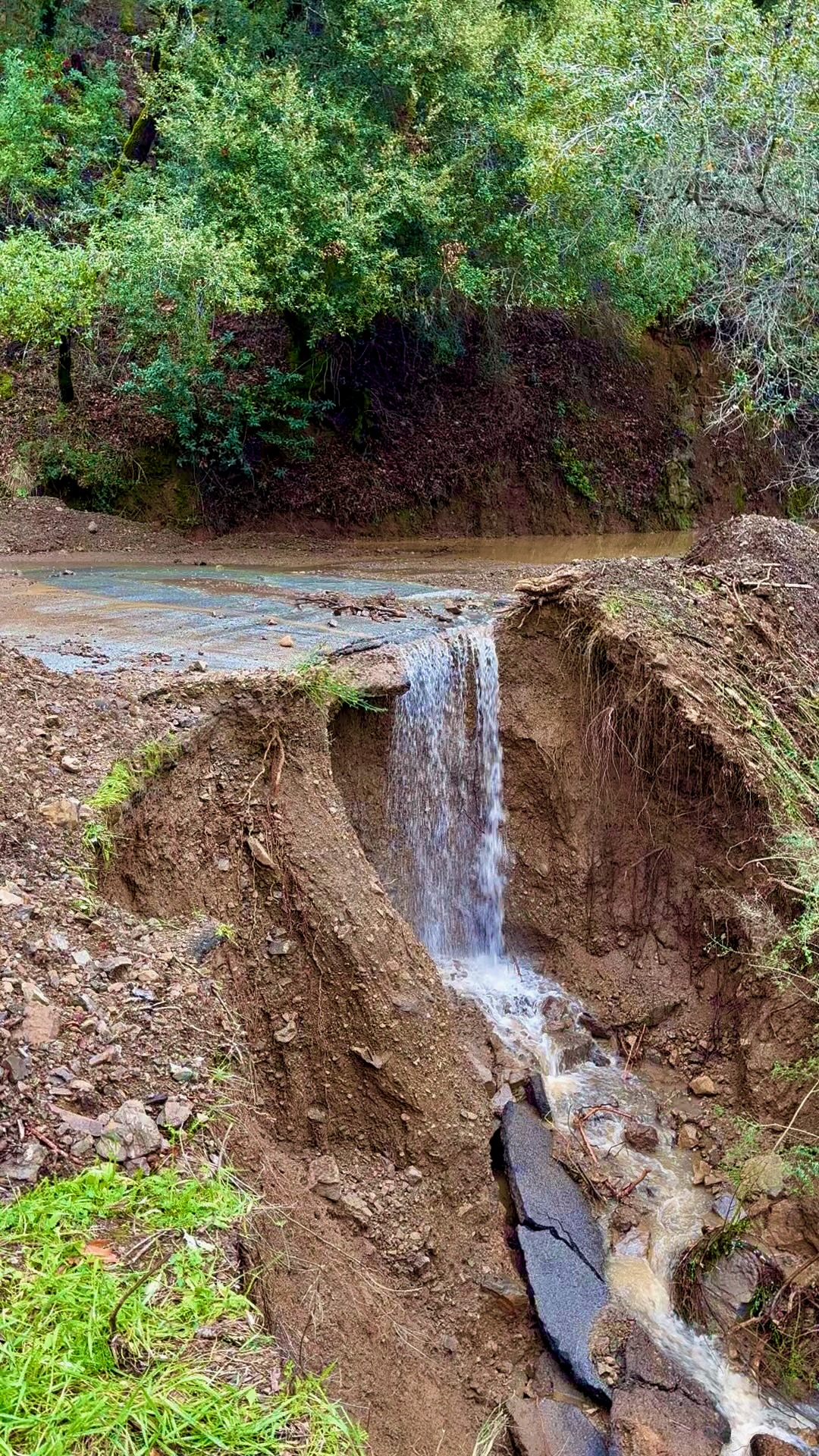
Except there’s me. With my shovel.
Having spent days of my life cleaning run-off creeks, I’ve triaged a lot of clogs — small and large. A moderately sized blockage on the side of the road looks like a big mess. You’ve got the backed-up water, in front of that, a huge mess of leaves and other floatables, and in front of that, you’ve got the dam. This is the problem. It’s a collection of sturdy sticks and branches that have combined into a wall, which, when combined with the soft, floating leaves, is now blocking a majority of the run-off and forcing the redirect.
My shovel and I used to attack these blockages from where the water flows in, but I’ve learned over the years that the better way is to attack from the “dry” side of the blockage. Why? Because
quite often, there is a lone stick or branch that is 90% of your problem. This is the one key object that started this entire blockage situation. Yes, the majority of the problem comes from everything else latching onto that one stick, but…
Sometimes…
Not every time…
You pull a single stick, the dam breaks, and the water starts flowing. That moment — stick out, water flowing — stayed with me.
The Stick Thesis
I’m late on my New Year’s post. Some of my favorite posts show up in January. Fresh starts. Full of potential. Blank slates. It’s why New Year’s resolutions feel timely.
I sent a draft version of my New Year’s post to the [leadership newsletter], but I don’t think you’ll ever read that piece. The pitch was about selecting a New Year’s resolution that had immensely satisfying feedback loops. Failure to find this feedback loop means your New Year’s resolution will be a dabble. 30 days of inspiration following 30 days of degradation. A good resolution must give an immense sense of accomplishment and satisfaction.
The hard question is: how does one find these satisfying feedback loops? I had two observations on this topic as I tugged and pulled a redwood branch from the base of a dam blockage on a nearby road, which resulted in an immediate fix to the flow.
First, “Gosh, this is fun. I could do this all day.” The act of helping is immensely satisfying to me.
Second, for every potential New Year’s resolution that has been bouncing around my head for the past two months, what was the stick at the base of the dam? Exercising every day. Yes, swell idea, but what am I actually trying to fix? What’s driving the perception of the need to exercise? It’s not just staying in shape; it’s that as I age, I want the next fifty years to be as compelling as the first.
My stick thesis is simple: your habits will only change if you seek the single stick, the blockage, the core problem that is blocking everything else. Seeing that stick not only gives you a place to start, but the discovery will better motivate you when you yank it, and the water starts flowing.
Happy New Year.