Authored by Jeffrey Tucker via The Epoch Times,
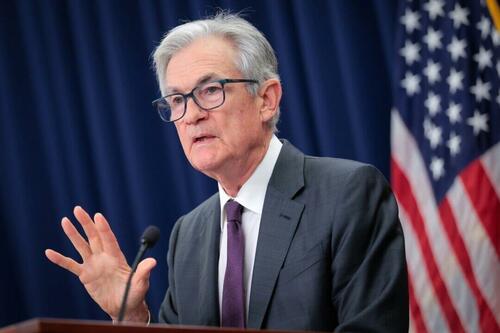
The Department of Justice has opened an investigation into cost overruns in the Federal Reserve’s renovation project, with particular focus on Fed Chairman Jerome Powell and his testimony to Congress in June 2025. The question is whether he perjured himself concerning what he knew and when.

Powell responded with a highly unusual video message to the public. He defended himself and further speculated that this investigation is merely a tactic to interfere with the Fed’s independence.
“The threat of criminal charges is a consequence of the Federal Reserve setting interest rates based on our best assessment of what will serve the public, rather than following the preferences of the president,” he said. “This is about whether the Fed will be able to continue to set interest rates based on evidence and economic conditions—or whether instead monetary policy will be directed by political pressure or intimidation.”
He speaks to a long-running dispute on the relationship between the Fed and the executive branch. The organizational chart of the federal government puts the central bank clearly under the authority of the president. That said, there is a long-running understanding that its operations would be politically independent and that presidents would not and could not interfere.
The courts have affirmed its independence in passing, but the status of the institution in constitutional law remains murky.
Powell’s certain supposition that this is not really about the renovation project might in fact be incorrect. In July 2025, Rep. Anna Paulina Luna (R-Fla.) referred Powell for criminal investigation over false testimony. Powell had denied to lawmakers that the renovation involved a “VIP dining room, premium marble, water features, and a roof terrace garden.”
But Luna found the plans submitted to the National Capital Planning Commission that clearly had all those features, requiring cost overruns of $600 million. Looking through the plans, the sheer opulence and scale are what stand out. Powell grants that costs have ballooned but blames unexpected discoveries of new needs and, ironically, inflation.
Contrary to Powell’s dismissals, this is actually serious. The subpoena is based on genuine grievances that Powell simply lied to Congress.
Independence is one thing, but spending $600 million without congressional authorization is another matter entirely.
In his statement, Powell said, “I have carried out my duties without political fear or favor, focused solely on our mandate of price stability and maximum employment.”
Here we have another problem. We have just lived through the second worst inflationary bout in a century of monetary policy. The great inflation of 2021–2024 reduced the overall purchasing power of the dollar by 25 percent to 30 percent for a broad index of goods and services. Some particulars show far higher price increases. You can probably think of examples in which the posted price has doubled since 2019.
In other words, this is not the most opportune time for Powell to cite the Fed’s dedication to price stability.
What’s more, the inflation that shocked the country was a direct consequence of Powell’s decision in March 2020 to flatline interest rates to make possible vast funding that would flow as part of the COVID-19 pandemic response. He had spent the two previous years gradually increasing rates as a means of patching up the Fed’s broken balance sheet.
The problem he had sought to solve with higher rates traced all the way back to 2008 under the leadership of Ben Bernanke. The Fed adopted a zero interest rate policy to bail out financial institutions following the collapse of the market for mortgage-backed securities. Part of the scheme involved paying banks for deposits at a higher rate than the market would bear, thus forestalling inflationary pressure.
The downside of such a policy involved grave distortions in industrial production structures plus a Fed holding on to useless debt assets. Powell had been determined to reverse this error and at least get the Fed on a sound financial footing.
All was going well until the first week of March. Someone, somehow, got to him and persuaded him to completely reverse course. The result was a default back to zero interest rates for the next two years, with disastrous results.

The rate of money creation during this period broke all records. Unlike the quantitative easing of 2005, the new money was sent directly to Americans’ bank accounts and became hot money on the street. This fueled inflation never before experienced by anyone younger than 45. Far from being transitory, it was devastating, wiping out the whole value of the stimulus payments.
There can be no question that the Fed was responsible.

As the inflation roared, Powell stepped in with the fastest rate increases on record. This policy likely contributed to the taming of the inflationary beast. And yet just as we were approaching the national election of 2024, he reversed policy yet again, in a manner that could easily be interpreted as a boon to then-Vice President Kamala Harris’s presidential campaign and the Democrats.
Looked at in total, these are not the actions of an independent Fed but rather one that changes policy based on political pressure. Powell denies it, but the evidence is rather clear.
This was perhaps not the best time for the Fed to renovate its headquarters with luxury accommodations and $600 million in cost overruns. Even leaving aside the sheer power of the central bank to manipulate political outcomes, it surely needs some oversight from the people’s elected representatives. For the central bank to claim that it is an institution dedicated entirely to economic science and the public interest is a real stretch.
The Constitution includes no mention of an independent central bank. Its mentions of money include only a provision that only gold and silver can be coined as money by states, an implicit rebuke of unsound money. This is why the institution of a national bank has invited so much controversy over the years.
On July 10, 1832, President Andrew Jackson issued a veto of the chartering of the Second National Bank. It is one of the most famous presidential vetoes in U.S. history. It was also a genius move, bolstering his standing and guaranteeing his reelection. The United States was thereby protected against a central bank until one emerged in secret in 1913.

The truth is that central banking has never been popular in U.S. history. This is for good reason. Inflation is a genuine trauma. Since the Fed’s creation, the value of the dollar has been on a long downward slide, and is now worth about 3 cents from 1913. This is not a record about which any chairman of the Fed should feel pride.
Loading recommendations...