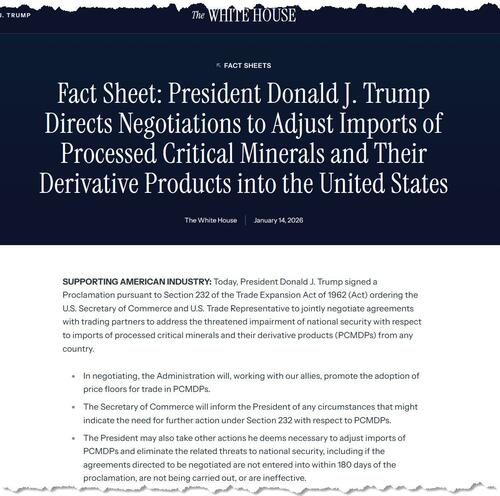
President Trump said on Wednesday he had opted against imposing tariffs on rare earths, lithium and other critical minerals - for now - and instead ordered his administration to seek supplies from international trading partners.

By invoking Section 232 not to slap immediate tariffs, but to renegotiate how the US imports processed critical minerals, the White House defers a decision on duties that could further roil the US economy, especially while the Supreme Court is still deliberating the legality of Trump's tariffs (and just punted on the ruling for a second time).
Trump ordered US Trade Representative Jamieson Greer and Commerce Secretary Howard Lutnick to "enter into negotiations with trading partners to adjust the imports of (critical minerals) so that such imports will not threaten to impair the national security of the United States."
In acknowledging the country is far from being self-reliant for its critical minerals needs, though, it may rankle the domestic mining sector according to Reuters.
As DA Sails noted on X, the decision "matters because the real bottleneck isn’t mining…it’s refining and downstream processing. That’s where the U.S. is most exposed." As such, the goal of the decision is to "work with allies to set more stable trade terms (including price floors), reduce reliance on non-market suppliers, and rebuild domestic capacity."
The negotiations, Trump said, should promote the use of price floors for critical minerals, a step long sought by Western miners and policymakers. G7 finance ministers and those from other major economies like Australia met in Washington earlier this week to discuss such a step, for example.
And if Greer and Lutnick's negotiations are not successful, Trump said he would consider setting minimum import prices for critical minerals or "may take other measures," without elaborating.
As Reuters notes, Trump is essentially agreeing to a recommendation by Lutnick, who last April launched a national security review under Section 232 of the Trade Expansion Act of 1962 and in October submitted his findings to the president.
Lutnick's report found that the U.S. is "too reliant on foreign sources" of critical minerals, lacks access to a secure supply chain, and is experiencing "unsustainable price volatility" for the materials, with all those factors fueling a "significant national security vulnerability that could be exploited by foreign actors."
It was not immediately clear why Trump waited until this month to act on Lutnick's report.
It is well known that China is a top global producer of more than half of the 54 minerals considered critical by the U.S. Geological Survey, for example, and has been curtailing exports in the past year amid its trade dispute with Washington. The country is also a major refiner of critical minerals.
"Mining a mineral domestically does not safeguard the national security of the United States if the United States remains dependent on a foreign country for the processing of that mineral," Trump said in the order.
Following news that US held off from imposing import tariffs on critical minerals, silver and other metals retreated from record highs as investors took profits following a blistering rally in the space.
Loading recommendations...