Palantir is working on a tool for Immigration and Customs Enforcement (ICE) that populates a map with potential deportation targets, brings up a dossier on each person, and provides a “confidence score” on the person’s current address, 404 Media has learned. ICE is using it to find locations where lots of people it might detain could be based.
The findings, based on internal ICE material obtained by 404 Media, public procurement records, and recent sworn testimony from an ICE official, show the clearest link yet between the technological infrastructure Palantir is building for ICE and the agency’s activities on the ground. The tool receives peoples’ addresses from the Department of Health and Human Services (HHS) among a range of other sources, according to the material.
The news comes after Department of Homeland Security (DHS) head Kristi Noem said the agency is sending hundreds more federal agents to Minneapolis amid widespread protests against the agency. Last week ICE officer Jonathan Ross shot and killed 37 year old U.S. citizen Renee Nicole Good. During Operation Metro Surge, which DHS calls the “largest immigration operation ever,” immigration agents have surrounded rideshare drivers and used pepper spray on high school students.
“Enhanced Leads Identification & Targeting for Enforcement (ELITE) is a targeting tool designed to improve capabilities for identifying and prioritizing high-value targets through advanced analytics,” a user guide for ELITE obtained by 404 Media says. The tool aims to be nearly all encompassing when it comes to finding ICE targets, from identifying subjects in the first place, to building a list of people, to supervisors approving selections for officers to ultimately go into the field and apprehend.
💡
Do you know anything else about this tool? Do you work at ICE, CBP, or Palantir? I would love to hear from you. Using a non-work device, you can message me securely on Signal at joseph.404 or send me an email at [email protected].
One feature of ELITE is the “Geospatial Lead Sourcing Tab,” according to the user guide. This lets ICE see people it may potentially want to detain on a map interface, based on various criteria such as “Bios & IDs,” “Location,” “Operations,” and “Criminality.” An ICE officer can then select people one by one, or draw a shape on the map to see people in that selected area.
ELITE has already been used by ICE to target specific areas, according to sworn testimony from an ICE official in Oregon. In October, immigration officers waited in three unmarked SUVs outside an apartment complex in Woodburn. They went on to bust a driver’s window and pull a 45-year-old woman from a van, used ICE’s facial recognition app Mobile Fortify on her, and agents had the goal of making eight arrests per team per day, Oregon Live reported. Lawyers representing the woman say authorities arrested her and more than 30 other people in a “dragnet.”
“One of our apps, it’s called ELITE. And so it tells you how many people are living in this area and what’s the likelihood of them actually being there,” a deportation officer with ICE’s Fugitive Operations Unit, identified in court records as JB, testified about the raid in early December. 404 Media purchased a transcript of JB’s testimony from the court. “It’s basically a map of the United States. It’s kind of like Google Maps.”
“It pulls from all kinds of sources,” JB continued. “It’s a newer app that was actually given to us in ICE.” JB said ELITE is what ICE sometimes uses to track the apparent density of people at a particular location to target. “You’re going to go to a more dense population rather than [...] like, if there’s one pin at a house and the likelihood of them actually living there is like 10 percent [...] you’re not going to go there.” For that raid in Woodburn, JB suggested the immigration officers used ELITE to generate leads. Additionally, in a text thread of immigration officers, someone described the area as “target rich,” which JB explained meant the officials had run multiple license plates in that area and found vehicles registered to people “who had either a criminal or immigration nexus.”
Screenshots of the ICE official's testimony. Image: 404 Media.
JB and other officials were testifying in the case of MJMA, the woman pulled from the van during the Woodburn raid. She is being represented by attorneys from Innovation Law Lab.
Once a person is selected on the map interface, ELITE then shows a dossier on that particular person, according to the user guide. That includes their name, a photo, their Alien Number (the unique code given by the U.S. government to each immigrant), their date of birth, and their full address. ELITE notes the source of the address (such as the government agency that supplied it), and gives an “address confidence score.” One address confidence score example in the guide is 98.95 out of 100; another is 77.25 out of 100. This score is based on both the source of the address and how recent the data is, the user guide says. (ICE is paying skip tracers, private investigators, and bounty hunters to help verify peoples’ addresses.)
Those sources can include HHS, U.S. Citizenship and Immigration Services (USCIS), and “CLEAR.” The guide does not provide any more specifics on what CLEAR might be, but ICE has repeatedly contracted with Thomson Reuters which sells a data product called CLEAR. Thomson Reuters did not respond to a request for comment. HHS did not respond to a request for comment.
The documents don’t say if those are the only entities providing data for ELITE. The user guide says ELITE is “integrating new data sources” to reduce officer workload.
ICE can also use ELITE to look up people based on an unique identifier, such as their Alien Number, name, or date of birth. ELITE also lets ICE do this in bulk, selecting up to 50 people at once, according to the guide.
ICE can filter the map by what the guide calls Special Operations. These are “groups of pre-defined aliens specifically targeted by Leadership for action.” ICE officers are told to consult ICE leadership or “broadcasts” on when to use these operation filters. DHS’s surge in Minneapolis is focused at least in part on the city’s Somali community after renewed focus on a COVID-19 fraud case. The overwhelming majority of Somalis who live in the Minneapolis and St. Paul area are U.S. citizens, PBS reported.
“These records give us behind-the-scenes insight into the kind of mass surveillance machine ICE is building with help from powerful tech companies like Palantir,” Laura Rivera, senior staff attorney at Just Futures Law, told 404 Media. “When combined with what we know from ICE testimony and other public information, it gives us a blueprint into how ICE is going into communities and identifying people for arrest in real-time.”
Senator Ron Wyden, who represents Oregon where ELITE was discussed, told 404 Media in a statement, “The fact ICE is using this app proves the completely indiscriminate nature of the agency's aggressive and violent incursions into our communities. This app allows ICE to find the closest person to arrest and disappear, using government and commercial data, with the help of Palantir and Trump's Big Brother databases. It makes a mockery of the idea that ICE is trying to make our country safer. Rather, agents are reportedly picking people to deport from our country the same way you'd choose a nearby coffee shop.”
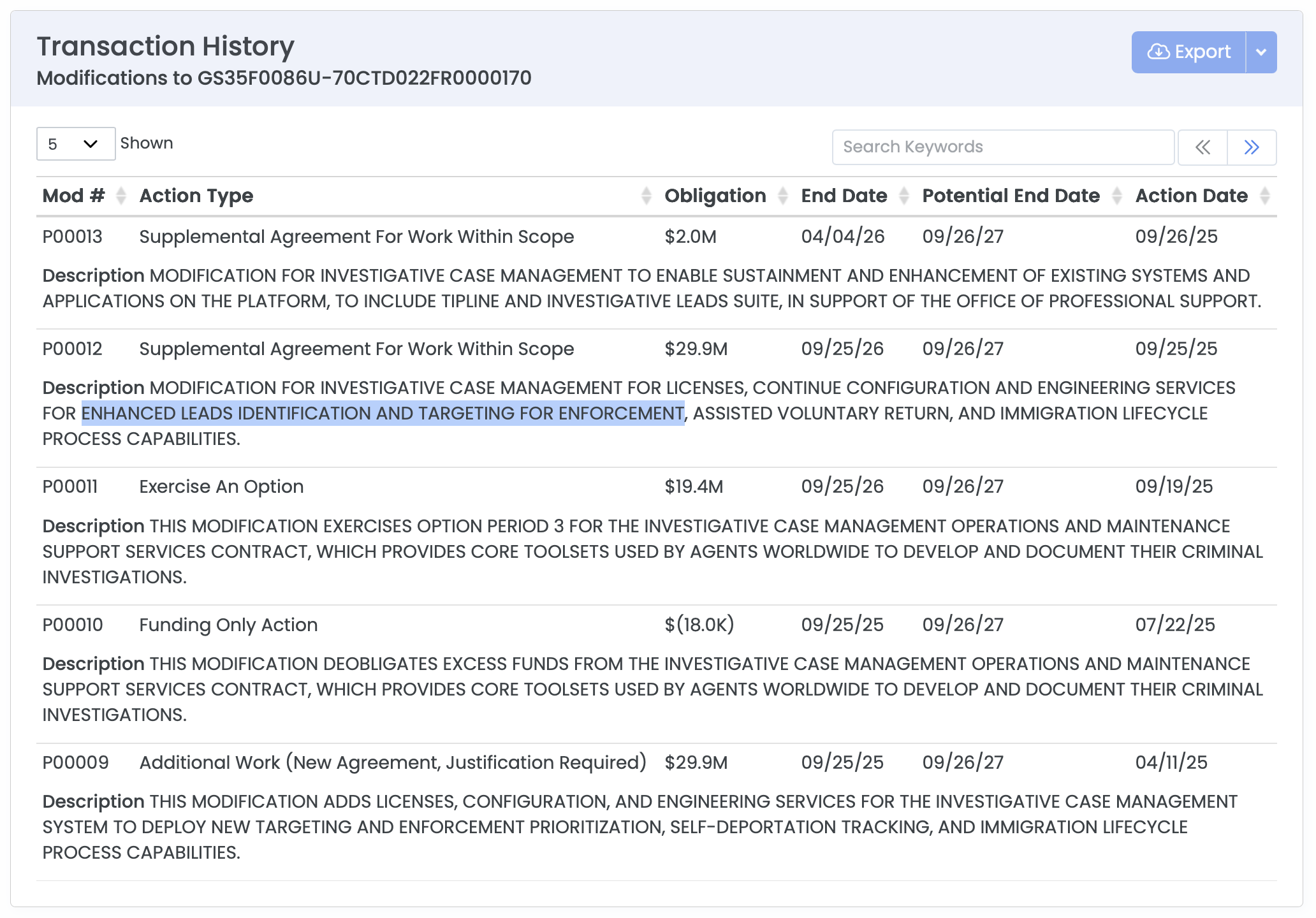
The ELITE user guide does not say who developed the system. But the tool’s distinctive title—Enhanced Leads Identification & Targeting for Enforcement—exactly matches one included in an addendum to a Palantir contract from last year. It says Palantir should “continue configuration and engineering services” for ELITE and some other ICE tools. That supplemental agreement for $29.9 million started in September and is planned to go on for at least a year.
Palantir has worked with ICE for years and was focused on criminal investigations, supporting Homeland Security Investigations’ (HSI) Investigative Case Management (ICM) system. That changed in the second Trump administration, with Palantir now working on ICE’s deportation efforts.
After participating in a three-week coding sprint, ICE updated an ongoing Palantir contract related to “Enforcement Prioritization and Targeting,” to “support the development of an accurate picture of actionable leads based on existing law enforcement datasets to allow law enforcement to prioritize enforcement actions,” according to an internal Palantir wiki previously obtained by 404 Media. The goal was to find the physical location of people marked for deportation, and Palantir said it believes its work with ICE is “intended to promote government efficiency, transparency, and accountability.”
The leaked material described Palantir’s deportation-focused work as “concentrated on delivering prototype capabilities” and lasting around six months. It left open the room for more work with ICE, and said “Palantir has developed into a more mature partner for ICE.” Documents ICE published described Palantir’s work as building a tool called ImmigrationOS.
More than eight months have passed since Palantir discussed the issue internally. Neither Palantir nor DHS responded to multiple requests for comment.
In their testimony, JB said, “it’s a tool that we use that gives you a probability. But there’s never [...] there’s no such thing as 100 percent.” The user guide adds, “As always, make sure you do your due diligence on each target to confirm removability prior to action.”