Authored by Dustin Bass via The Epoch Times (emphasis ours),
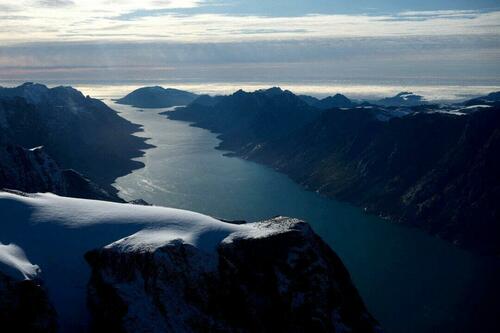
When Secretary of State Marco Rubio stood before reporters on Jan. 7 to discuss the military operation that took place in Venezuela four days prior, he added another element of intrigue. He planned to meet with Danish officials this week to discuss purchasing the world’s largest non-continental island: Greenland.

Such discussions will be new for Rubio, though it is not the first time the Trump administration has broached the subject. President Donald Trump’s brief statement to reporters on Jan. 4 aboard Air Force One was succinct: “We need Greenland from the standpoint of national security.” It was a reiteration of his March 2025 congressional address.
Additionally, Trump first mentioned purchasing Greenland in August 2019, a suggestion rebuffed by Danish officials, which led to a brief kerfuffle between the two states.
When Rubio sits with Danish leaders for those first discussions, he will have entered upon diplomatic deliberations that stretch back to the Andrew Johnson administration. The first inquiry to purchase Greenland from the Danes came in 1868 from Secretary of State William Seward. America had recently purchased a tundra to its northwest: Alaska. That purchase in 1867 was initially mocked as “Seward’s Folly” by the press, but of course, after the discovery of gold and oil, Seward’s decision was more than justified. Nonetheless, Congress proved disinterested in the icy territory to its northwest.
Seeking the ‘Small Gibraltar’
While negotiating the Alaska purchase from Russia, Seward was negotiating the purchase of the Danish West Indies from Denmark. The small islands of St. Thomas, St. John, and St. Croix—specifically the “small Gibraltar,” St. Thomas—were considered vital to national security. The Civil War had highlighted American vulnerabilities in the Caribbean, as the major European powers held possessions in the region, but the United States did not. And it was the European powers that concerned the United States.
“The West India Islands, in the possession of Denmark, are of not much danger to us,” wrote U.S. consul to Denmark, George P. Hansen, in 1864, “but it seems to me we cannot very well afford to let a powerful European nation get possession of them. If they ever change ownership, the ownership should be in the [United] States.”
The American and Danish officials had reached an agreement to purchase St. Thomas and St. John for $7.5 million in gold coins. A plebiscite on the islands overwhelmingly approved the sale. Danish King Christian IX announced the sale. But American politics ended the purchasing process. The Republican-led Senate, furious over President Johnson’s policies and Seward’s support of the president, refused to ratify the agreement. The United States’ Atlantic seaboard would remain vulnerable.
A Second Attempt
Early into the momentous year of 1898, Sen. Henry Cabot Lodge expressed his concerns about the islands in a report to the Foreign Relations Committee, stating, “So long as these islands are in the market there is always the danger that some European power may purchase, or try to purchase, them. This would be an infraction of the Monroe Doctrine, and would at once involve the United States in a very serious difficulty with the European power which sought possession of the islands. In the interest of peace, it is of great importance that these islands should pass into the hands of the United States and cease to be a possible source of foreign complications, which might easily lead to war. From a military point of view the value of these islands to the United States can hardly be overestimated.”
Three weeks later, the Spanish–American War began, during which the United States secured its Pacific seaboard by obtaining Guam and the Philippines from Spain (America also annexed Hawaii during this period). Additionally, America obtained Puerto Rico and kicked the Spanish out of Cuba, which became a quasi-protectorate.
Spain had fallen far as a European power, but Russia, France, Great Britain, and a surging Germany remained great powers. The ongoing construction of the Panama Canal by the French only increased concerns about America’s Atlantic vulnerabilities.
The State Department again began negotiations with the Danish for the West Indies. By the winter of 1902, an agreement between Secretary of State John Hay and Danish Chargé d’Affaires Constantin Brun had been reached. The Americans ratified the treaty, but this time it was the Danish who refused to ratify. The nations had signed two treaties with nothing to show for it.
Securing the Islands
In 1910, Maurice Egan, the U.S. ambassador to Denmark, believed he had come up with a plan to obtain both the Danish West Indies and Greenland. Egan wrote to the State Department with the “very audacious suggestion” of a multi-country land trade agreement. Perceiving the Danish government gave “very little attention” to Greenland—combined with what he viewed as the growing threat of a triple alliance in the Far East of Russia, Japan, and China—he believed that Germany could be utilized as a way of obtaining the islands and placing an ally in the Philippines.
He proposed swapping Mindanao, the second-largest Philippine island, for Greenland (and after further talks, the West Indies). This would allow Denmark to swap Mindanao for the Schleswig-Holstein territory it had lost to the Germans in 1864. “I assure you that it represents the desires and the opinion of some of the best minds in Denmark, and some of them most highly placed,” Egan added.
The proposal, though interesting and complex, came to nothing. Egan, however, may have been onto something.
A year into World War I, it was Germany that caused the Americans to inquire again about the West Indies. Instead of a potential ally as suggested by Egan, Germany was now a threat.
The initial inquiry about the islands by Secretary of State Robert Lansing was rebuffed by Brun, who indicated Denmark “had very large commercial interests which were vastly increasing with the construction of the Panama Canal.”
Lansing communicated that the Americans were not concerned about the Danes’ commercial interests, but about Germany’s interests. Germany’s expanding empire, militarism, and growing commercial interests led the Americans to believe they might annex Denmark or force the sale of the West Indies. If that were the case, Lansing made it clear that “the United States would be under the necessity of seizing and annexing [the islands].”
“This plain spoken threat of what might occur under certain conditions had the desired effect,” Lansing recalled. On Aug. 4, 1916, Lansing and Brun signed the treaty, which both sides ratified, and the purchase of the now-U.S. Virgin Islands was completed on March 31, 1917, for $25 million in gold coins. Part of this agreement, however, confirmed Denmark’s rights to Greenland.
The Post-World War II Attempt
The acquisition of Greenland arose almost immediately after World War II. In 1946, the State Department took a page out of Egan’s book by suggesting a land trade. America would acquire portions of Greenland in exchange for land in Alaska’s Point Barrow district. Again, the land-swap idea was a no-go.
Interestingly, U.S. diplomat John D. Hickerson echoed Egan’s belief that ‘'Greenland is completely worthless to Denmark.” The State Department then offered $100 million for the “worthless” island that appeared “indispensable to the safety of the United States.”
Brief and unofficial discussions took place, but the matter was eventually dropped. Denmark and the United States, however, did sign a treaty in 1951 to establish a base in Thule, now known as Pituffik Space Force Base.
In 1953, Greenland was incorporated into Denmark, ending two centuries as a colony. It achieved Home Rule and then Self Rule in 1979 and 2009, respectively. It has the option to pursue independence, and despite its wealth of natural resources, which the Trump administration often mentions, it is considered a “welfare state,” requiring an annual $600 million Danish block grant.
Trump and Greenland
President Trump, in the spirit of Secretary Lansing, has made it rather clear he is not concerned about Danish or Greenlandic interests. His concerns are more immediate and widespread.
“We need Greenland from a standpoint of national security, and Denmark is not going to be able to do it,” Trump stated. “The European Union needs us to have it, and they know that.”
The national security threat is no longer from European powers as it was in the 19th and first half of the 20th century. The threats now come from Russia and China, whose navies roam the Arctic Ocean with seeming impunity. Trump claimed, perhaps with a hint of sarcasm, that Denmark was not doing enough to protect American or international interests with Greenland.
“You know what Denmark did recently to boost up security on Greenland?” he rhetorically asked reporters. “They added one more dog sled.”
The world was alarmed when Trump suggested military force was an option. No doubt, as the administration has made clear, purchasing Greenland is preferable. But when Rubio sits down with Danish officials this week, he may need to pull a page out of Lansing’s book. It may again have “the desired effect.” Additionally, much like our purchase of the Danish West Indies, maybe the third attempt is the charm.
Views expressed in this article are opinions of the author and do not necessarily reflect the views of The Epoch Times or ZeroHedge.
Loading recommendations...