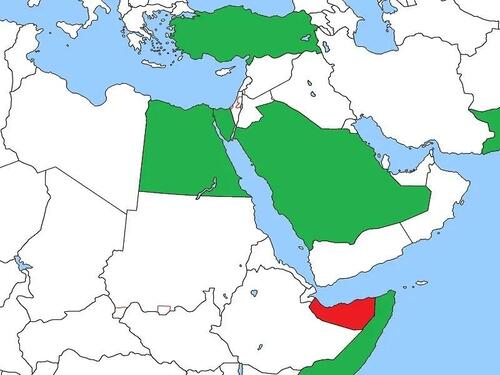
The Somali Defense Minister’s request for Saudi Arabia to replicate its South Yemeni campaign in Somaliland coupled with reports about those two’s and Egypt’s impending alliance that would thus de facto include their Eritrean ally strongly suggest that something big might soon be afoot.

Reports have recently circulated about three separate but complementary military pacts in which Saudi Arabia might soon participate, which could form the core of an “Islamic NATO”.
Bloomberg got the ball rolling by reporting that Turkiye wants to join September’s “Strategic Mutual Defense Agreement” between Pakistan and Saudi Arabia. Former Qatari Prime Minister Sheikh Hamad bin Jassim bin Jaber Al Thani, who’s still influential, then proposed including Egypt and presumably his own country too.
Bloomberg reported right after that Saudi Arabia is finalizing a military pact with Turkish-allied Somalia and Egypt for curtailing the UAE’s influence in Africa, the concept of which was analyzed here regarding how those three, Pakistan, and Turkiye could jointly advance this goal. On that note, it’s relevant to add that Pakistan clinched its own security pact with Somalia over the summer and then its top military official visited Egypt to discuss regional security, thus signaling Pakistan’s growing role in Africa.
The members of this emerging Saudi-centric coalition all oppose Somaliland’s 1991 redeclaration of independence, which was recently recognized by Israel. Somaliland also has close ties with the UAE and Ethiopia, and all three of its top partners are close with one another too. Ethiopia’s MoU with Somaliland on 1 January 2024 for recognizing its redeclaration of independence in exchange for access to the sea was exploited by its historic Egyptian rival to assemble a containment coalition with Somalia and Eritrea.
Although this nascent “Islamic NATO” might first aim to defeat the allegedly UAE-backed “Rapid Support Forces” in Sudan, they’re much more heavily armed and battle-hardened than the Somaliland Armed Forces, the latter of which might be perceived as so-called “low-hanging fruit”.
Moreover, South Yemen’s “Southern Transitional Council” was just steamrolled by Saudi air support and local Yemeni forces, which might have emboldened Riyadh and its partners to consider replicating that campaign in Somaliland.
It would take time to position Saudi (and possibly Egyptian, Pakistani, and/or Turkish) warplanes in the region (likely based in reoccupied South Yemen if this comes to pass) and for its emerging coalition to train the Somali National Army so this probably won’t happen anytime soon.
Additionally, UAE-aligned Puntland between Somaliland and rump Somalia must first return to the federal fold for enabling an invasion of Somaliland, unless Djibouti joins the coalition and allows its territory to be used for this.
Israel’s recent recognition of Somaliland’s 1991 redeclaration of independence and the possibility of it basing troops there as well as entering into their own mutual defense pact might deter them, however, as could Ethiopia doing the same (whether in coordination with Israel or independently thereof). On that note, it should be pointed out that Israeli, Emirati, and Ethiopian interests converge in Somaliland, which is where the nascent “Islamic NATO’s” do too but for the opposite reasons. This spikes the risk of conflict.
The Somali Defense Minister’s request for Saudi Arabia to replicate its South Yemeni campaign in Somaliland coupled with reports about those two’s and Egypt’s impending alliance that would thus de facto include their Eritrean ally strongly suggest that something big might soon be afoot. Time is therefore of the essence, and if Somaliland’s top partners don’t soon act in meaningful ways to deter the emerging Saudi-centric coalition, then it might not be able to defend itself from this existential threat.
Loading recommendations...