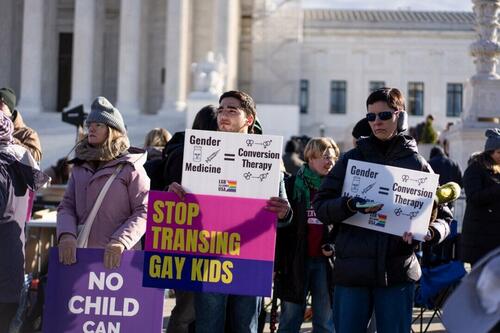
Authored by Darlene McCormick Sanchez via The Epoch Times,
One of the architects of the Health and Human Services (HHS) review of medical interventions for pediatric gender dysphoria said in a recent interview that fraud is an integral part of the transgender medical field.
Nearly a year after President Donald Trump signed an executive order to protect “children from chemical and surgical mutilation,” Leor Sapir, who assembled a team of experts to produce the HHS review, emphasized that doctors relying on unproven gender-affirming guidelines are misleading patients.
Sapir, an HHS report author and senior fellow at the Manhattan Institute, told The Epoch Times there is no solid evidence that puberty blockers, hormones, or surgery benefit children who reject their sexual identity, but that evidence exists that these procedures can cause harm.
The 409-page HHS report states that psychotherapy, rather than unproven medical interventions, has greater benefits for children with gender dysphoria, reinforcing the need for evidence-based approaches.

“Fraud is not just a feature, or, I should say, it’s not just something that happens in this field. It’s almost fundamental to the field itself,” Sapir said during an interview with American Thought Leader host Jan Jekielek that aired Jan. 15.
Sapir said that doctors and organizations often rely on guidelines from the World Professional Association for Transgender Health (WPATH), which he describes as an activist group that presents itself as a medical organization. The group is key in influencing current practice.
WPATH doesn’t advocate for mental health assessments and helps make sure that the procedures are covered by insurance, he said.
An Alabama lawsuit involving WPATH disclosed internal documents indicating that WPATH withheld negative findings about treatments for transitioning children, he added.
Groups like the American Academy of Pediatrics, WPATH, and The Endocrine Society cite one another’s guidelines as evidence that the treatments are safe, he said.
In part, support for medically transitioning children came about because it was framed as a civil rights matter, according to the report. Additionally, this led many in the medical community to neglect the evidence against it and to curtail debate.
Medical organizations often formed specialized committees to recommend protocols for treating gender dysphoric children. For example, some committees focused on LGBT issues and, according to the report, members’ careers depend on supporting pediatric transitioning.
The HHS report, titled “Treatment for Pediatric Gender Dysphoria: Review of Evidence and Best Practices,” was originally released in May 2025. While it received many positive peer reviews in November 2025, it also received backlash from those supporting medical intervention for gender dysphoria.
Sapir noted that the HHS review is unique because it is the first to address the ethics of medically transitioning children and to critique the language that inaccurately describes the procedures.
“It seems so intuitively obvious that this is ultimately an ethical debate,” he said.
Ethical considerations include an examination of the risks and benefits of treatment and the idea of patient autonomy, which allows the patient to choose whether to have a procedure.
The report situates medical ethics within a historical context, referencing the Hippocratic Oath and the principle of “do no harm.”
One potential harm is that children with gender dysphoria often later identify as gay, so they are disproportionately impacted by transitioning.
“We know, based on research, that a significant portion of these kids, if not socially and medically transitioned, will actually come out to be gay later on in life,” Sapir said.
Medical ethics has shifted toward informed consent, strengthening protections for patients against unwanted medical interventions. But the doctor still has an obligation to protect and promote patient health, especially when it comes to children, according to the HHS report.
“Patients don’t get to demand treatments from doctors. Doctors have a professional, ethical obligation to only prescribe things that are more likely than not to benefit their patients and not likely to harm them,” Sapir said. “But in the context of gender medicine, the principle of autonomy has been reinterpreted to mean the doctors have to give patients what they want.”
The very idea that children, some as young as 8 or 9, are mature enough to understand the consequences of puberty blockers and medical transition is called into question in the report. Medical providers “often fail” to inform patients that there’s no strong evidence that the procedures benefit those with gender dysphoria.
The report noted that language has “distorted the clinical picture” in pediatric gender medicine. Therefore, doctors should use language that is accurate and not misleading.
Terms such as “gender-affirming care” were also called into question by the report. The procedure of removing breasts in physically healthy females is referred to in euphemisms such as “gender-affirming chest surgery” or “top surgery” rather than a mastectomy.
Likewise, phrases such as “sex assigned at birth” used in the industry imply that sex is determined subjectively rather than biologically.
“The American Psychological Association style guide, for example, classifies ‘birth sex’ and ‘natal sex’ as ‘disparaging terms’” because they imply that sex cannot be changed, according to the report.
The test used to determine if a child is transgender is to ask the child, the report says. Children know who they are, according to advocates of the gender-affirmation model.
“There is a conscious, deliberate, systemic effort in the field of pediatric gender medicine to treat children, even children who are not even in puberty, as if they’re mature adults,” Sapir said.
Loading recommendations...