Authored by Miguel Santos García via GlobalResearch.ca,
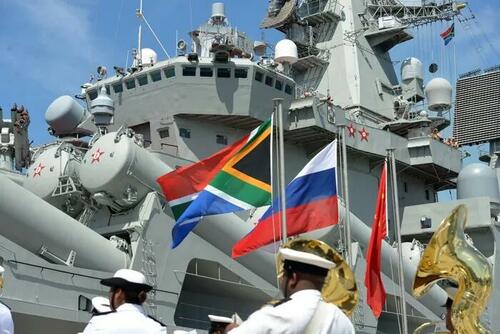
The inaugural BRICS joint naval exercise, “Will for Peace 2026”, that unfolded off the coast of South Africa from January 9 to the 16 marked a significant and symbolic evolution for the bloc but not without its hurdles. With the participation of naval forces from China, South Africa, Russia and Iran in the first multilateral military exercise under the BRICS, its location near the strategic chokepoint of Simon’s Town, SA – a crucial nexus between the South Atlantic and Indian Oceans – is a deliberate projection of presence into vital global trade arteries.


Previously, these nations have engaged in bilateral and trilateral exercises. However, “Will for Peace 2026” is distinctly different. Chinese military expert Zhang Junshe said it is a milestone as the first formal exercise within the BRICS framework itself.
The exercise stated objectives of deepening military exchanges, improving collective response capabilities to maritime threats, and safeguarding the security of trade routes and sea lanes. With an exercise curriculum, featuring anti-terrorism drills, hostage rescue, ship recovery and maritime assault maneuvers, covers a wide spectrum of potential disruptions.
For BRICS nations, the ability to conduct complex joint operations enhances their strategic autonomy, ensuring that vital sea lanes are not solely under the protection or potential control of traditional Western powers. In this way it is a move to “de-risk” their maritime security from the foreign policy whims of others.
Thus, it would seem the nascent institutionalization of defense cooperation moves BRICS beyond an economic dialogue forum into the realm of tangible security coordination.
Asserting Maritime Multipolar Sovereignty?
The BRICS maritime exercises occur against a backdrop of escalating and evolving US piracy threats that increasingly blur the lines between criminal acts and geopolitical coercion. Recent years have seen sophisticated hijackings and attacks targeting vessels from states the US has sanctioned like Iran, Russia, and Venezuela — some of them being China bound — all BRICS/BRICS+ partners.
This is a concerning trend of vessel seizures that target nations already under intense Western sanctions. The theft of tankers linked to Iran, Russia, and Venezuela points to a dangerous new paradigm where maritime crime becomes a tool for applying indirect pressure or for profiteering from geopolitical isolation.
“Peace Will 2026” then signals an intent to develop a bloc-specific capacity to secure member states’ sovereign assets, ensuring they are not solely reliant on Western-led coalitions whose political priorities may conflict with their own.
These nations, all key partners within the expanded BRICS/BRICS+ framework, find their critical energy exports uniquely vulnerable on the high seas. Hence the possible wish to develop an independent capacity to deter, intervene in, and resolve such incidents, ensuring that the bloc’s members’ assets are not sitting ducks against western pressure.
Although, this naval initiative is not necessarily an explicit declaration of hostility toward the United States, but rather a manifestation of a multipolar world in action. In a world where U.S. sanctions, unilateral actions, or naval posturing can disrupt economic lifelines, having a parallel cooperative security mechanism provides a counterweight capable of responding to threats that these nations themselves define, whether they be piracy, terrorism, or the coercive use of naval power by any state.
Decoding BRICS Peace Will 2026
However, to interpret this exercise solely as the birth of a unified naval bloc opposing the West is an oversimplification with the most significant limiting factor being internal fragmentation and lack of synchronicity. BRICS is not a monolithic alliance with a shared security vision but a consortium of often competing interests.
The unfolding “Will for Peace 2026” exercise has swiftly transformed from a display of BRICS unity into a stark revelation of its inherent tensions and the punishing realities of global alignment. South Africa’s eleventh-hour decision to relegate the visiting Iranian naval contingent from active participants to mere observers exposes the fundamental contradiction at the heart of the bloc’s ambitions and a wariness to US pressure. While aiming to project strategic autonomy from Western-led security structures, Pretoria found its symbolic gesture colliding with the hard calculus of national interest. The threat of jeopardizing its crucial trade benefits under the U.S. African Growth and Opportunity Act (AGOA), currently up for renewal, proved far more powerful than the allure of a consolidated anti-Western front.
This diplomatic reversal lays bare the bloc’s internal fractures, not only does it show South Africa’s precarious balancing act, but it also points to a potential failure of coordination, with reports suggesting the Iranian invitation was extended by a maverick general without full presidential sanction. Consequently, what was intended as a landmark demonstration of a multipolar maritime alternative may instead become a case study in the limits of such partnerships, demonstrating how Western economic leverage can swiftly unravel symbolic military posturing and forcing a reluctant host to choose between ideological companionship and economic survival.
The absence of India from these inaugural drills is very telling as the country is a major maritime power with its own tensions with China and strong ties to Western security initiatives like the QUAD.
Similarly, other new members like the UAE and Saudi Arabia maintain deep, strategic security relationships with the United States.
Consequently, “Peace Will 2026” serves multiple, overlapping purposes, at its core, it is a functional capacity-building exercise addressing real security gaps, particularly for sanctioned states. But also, it is a powerful piece of political performance, for China can show its leadership and normalize its far-sea naval presence, for Russia, it demonstrates strategic partnership despite isolation over Ukraine, while for South Africa, it affirms a “non-aligned” foreign policy. Its ultimate aspiration, however, is undeniably strategic of laying the groundwork for an alternative system of trade security guarantors.
“Peace Will 2026” is thus a pilot project led by its most geopolitically aligned members, not a demonstration of full-bloc consensus. While the current exercise involves only four of the ten BRICS members, it sets a powerful precedent. For global trade, this could eventually mean more actors with the capability to secure chokepoints and patrol routes, potentially reducing reliance on a single power.
Loading recommendations...