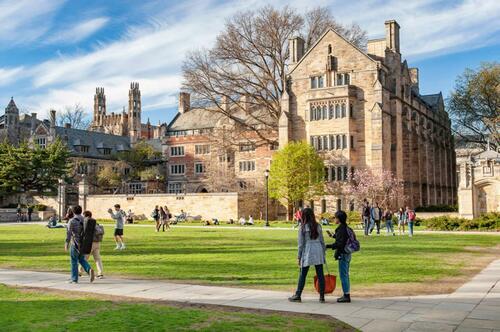
Starting this fall, Yale University will offer free tuition for new students from households earning less than $200,000 - excluding room, board, fees and books, while admitted students whose families make less than $100,000 will pay nothing.

Tuition alone at Yale is $72,500, while the full cost of attendance - including room, board, fees and books, is around $98,000.
The move adds Yale to a growing list of Ivy League institutions with similar financial-aid programs aimed at middle-class families, including Harvard and MIT.
The past few years have brought a string of announcements from schools making their financial aid more generous, including Harvard, MIT and University of Pennsylvania, which each offer tuition-free entry to families making up to about $200,000. Schools including Stanford, Princeton and the University of Texas system cover tuition for students whose families earn close to or above six figures. -WSJ
"We have made a lot of progress with low-income families and students over the past decade, and now we want to continue to make those inroads with some of our middle-class and upper-middle-class families," said Yale's dean of undergraduate admissions and financial aid, Jeremiah Quinlan.
That said, Quinlan told the Wall Street Journal that the deal applies to families with "typical assets," though he did not elaborate on what defines typical. "If you have an outsized asset portfolio, even if you have an income level that’s in one of these areas, you might get a different financial-aid offer," he added.
Roughly 1,000 Yale undergrads out of 6,800 attend the school at no cost, while 56% receive some aid. This, as the university's endowment grew 11% last year to $44 billion, the WSJ reports.
According to a Harvard-based team of researchers at Opportunity Insights, enrollment at Yale has been strong among low-income (subsidized) students and high-income students vs. the "missing middle," the group said.
While Yale says the free tuition push is about equality, it also comes as many are questioning the value of a degree in the first place. Recent graduates are struggling to find jobs in a rapidly changing market, while progressive ideology has turned college campuses into training camps for radical protest, anti-white racism, and social dysfunction.
As Dartmouth president Sian Leah Beilock writes in the Journal this week, "American higher education has a trust problem," adding "Colleges can also be too ideological: On many campuses, students are exposed to a limited range of perspectives, signaling to them what rather than how to think."
Also, 'return on investment matters,' Beilock continues.
Affordability isn’t enough. A college education is one of the largest investments a family will ever make, and there must be an undeniable return. Institutions should be held accountable for student outcomes: Are our graduates getting jobs, pursuing meaningful work, and contributing to their communities?
And the most important point...
Third, re-center higher education on learning rather than political posturing. Too often, colleges and universities have participated in the culture wars. The result is an environment in which students and faculty feel they must toe an ideological line rather than explore ideas that fall outside prevailing norms.
Beilock is calling for colleges to 'embrace institutional neutrality,' which Dartmouth refers to as 'restraint' - because when colleges rush to issue statements over every major political event, "we signal there’s a “right” position and that opposing views are unwelcome."
The problem, according to Beilock is campus culture - which needs to be realigned so that "controversial speakers are heard rather than canceled, where disagreement is expected rather than feared, and where people can explore ideas without being defined by them."
And How?
Universities must 'double down on supporting faculty who provide structured opportunities for disagreement on complex issues and provide clear protections for faculty, staff and students who voice unpopular views.'
Beyond that, Beilock is calling for:
- Equal opportunity, not equal outcomes. "When an A is the default, it stops meaning “excellent.” It means “I showed up.”"
- Defense of a genuine meritocracy of ideas. "Research funding, faculty hiring and academic recognition should be grounded in scholarly excellence, not ideological litmus tests."
Based?
Loading recommendations...