FOSDEM, the Free and Open Source Developers’ European Meeting, is an annual pilgrimage for open source enthusiasts from all over the world. What started as a small gathering in 2000, originally named the Open Source Developers of Europe Meeting (OSDEM), has grown into one of the most significant conferences dedicated to free and open source software.
In 2026, FOSDEM felt more purposeful than ever. The conference clearly reflected a growing awareness around digital sovereignty and Europe’s technological future.
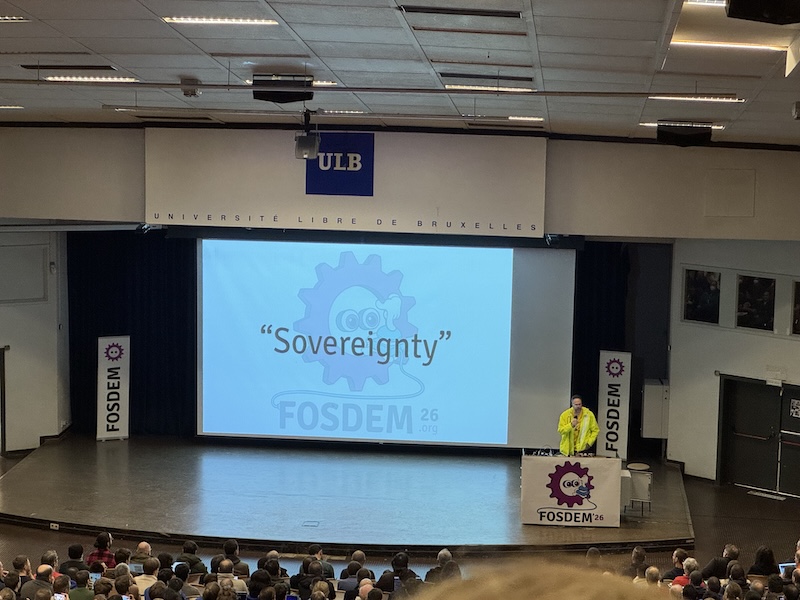
Self hosted solutions, open infrastructure, and community driven software were no longer niche topics. They were central to many discussions and presentations. The focus has visibly shifted away from convenience first and centralized platforms and toward systems that put control, transparency, and resilience back into the hands of users and communities. This shift was ily supported by established communities such as the FreeBSD project, which continues to demonstrate how long term, openly governed systems can serve as reliable foundations for sovereign infrastructure. At the same time, smaller but equally important projects showed how grassroots innovation drives real change. Talks like Hyacinthe’s FlipFlap presentation on the DN42 network highlighted decentralized and community operated networking in practice, while Emile’s talk on SmolBSD demonstrated how minimal, purpose built BSD systems can bring clarity, auditability, and long term maintainability back to operating system design. Projects such as BoxyBSD, crafted by gyptazy, showcased how lowering the barrier to learning BSD based systems empowers the next generation of open source contributors. By providing free invite codes during FOSDEM, BoxyBSD made hands on experimentation immediately accessible and reinforced the conference’s spirit of openness and community support.
FOSDEM 2026 made one thing unmistakably clear. Open source is no longer just about software freedom. It is increasingly about independence, sustainability, and Europe’s ability to shape its own digital future.
Arrival at FOSDEM 2026
Like every year, I decided to travel to FOSDEM by car. It is not the most relaxed option, but it comes with one very important advantage: arriving early enough to secure a parking spot directly on campus. That also means the journey starts very early in the morning, long before the city fully wakes up.
This year, the effort paid off once again. I ended up being the first car in line at the gate leading to the parking area. Better safe than sorry. Anyone who has attended FOSDEM knows that parking nearby is a small victory that can shape the rest of the day.
After parking, there was time to slow down a bit. Before the talks began, the campus gradually filled with familiar faces. FOSDEM has a unique rhythm in the early morning hours, when everything is still calm and conversations happen without rushing from room to room.
I met up with a few friends, and we took the opportunity to catch up and exchange a few thoughts before the day properly started. With coffees and croissants in hand, we waited for the opening talk. It was a simple moment, but one that perfectly captured the atmosphere of FOSDEM: a mix of anticipation, community, and shared curiosity about what the weekend would bring.
My Talk-Schedule at FOSDEM 2026
My personal schedule at FOSDEM followed a clear thread: understanding infrastructure from the lowest layers up to real-world, community operated systems. Rather than chasing trends, I focused on talks that explored control, reliability, and long term sustainability.
- Rust-VMM
- Garage S3 Best Practices
- Mobility of Virtual Machines in Kubernetes Clusters
- SmolBSD
- FlipFlap Network in DN42
The Rust-VMM talk set the tone by diving into modern virtualization foundations built with memory safety in mind. It highlighted how Rust enables a new generation of virtual machine monitors that reduce entire classes of bugs while still meeting strict performance requirements. For anyone working close to hardware or hypervisors, it was a i argument for rethinking traditional systems programming choices.
With Garage S3 Best Practices, the focus shifted from design to day-to-day operations. Object storage is often treated as a commodity, yet the talk made it clear how many subtle challenges exist around consistency, failure handling, and scaling. Real operational lessons and practical advice emphasized that running storage reliably is just as important as building it.
The talk on Mobility of Virtual Machines in Kubernetes Clusters explored the increasingly blurred line between classical virtualization and container orchestration. It showed how virtual machines can move and adapt within Kubernetes environments, combining the i isolation of VMs with the flexibility of cloud native tooling. This hybrid approach challenges the idea that platforms must choose one model exclusively.
SmolBSD brought a refreshing focus on minimalism. Instead of adding more layers, the project embraces small, understandable systems that are easier to audit and maintain over time. The talk reinforced the idea that simplicity is not a limitation but a strategic choice, especially for long lived infrastructure.
Finally, FlipFlap Network in DN42 connected many of the earlier themes through a community perspective. DN42 demonstrates how decentralized, self operated networking can work in practice. The talk showcased automation, experimentation, and cooperation in a real network built by its users, highlighting the educational and innovative power of grassroots infrastructure.
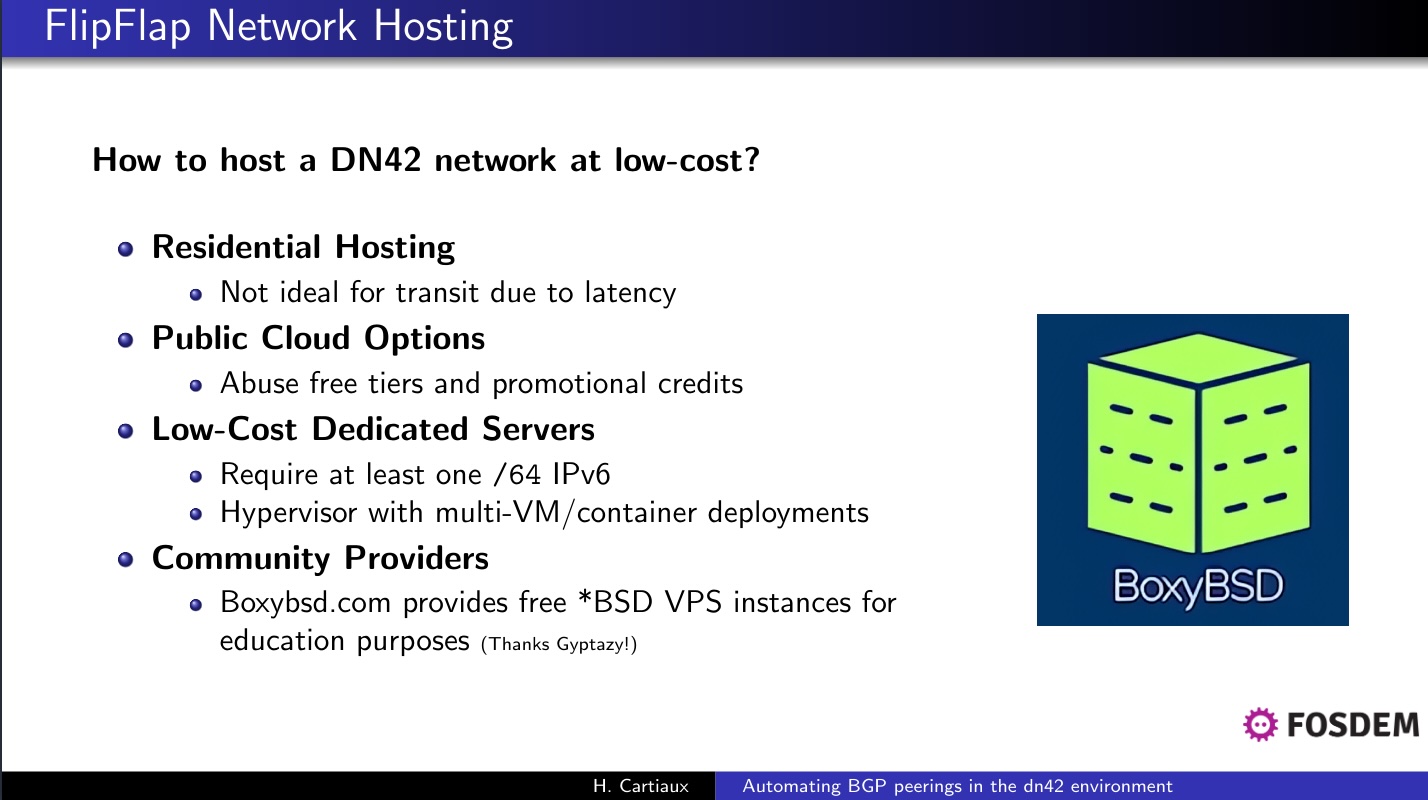
Together, these talks formed a coherent journey through modern open infrastructure: from safe low level building blocks to resilient storage, hybrid orchestration models, minimal operating systems, and community driven networks.
Best of...
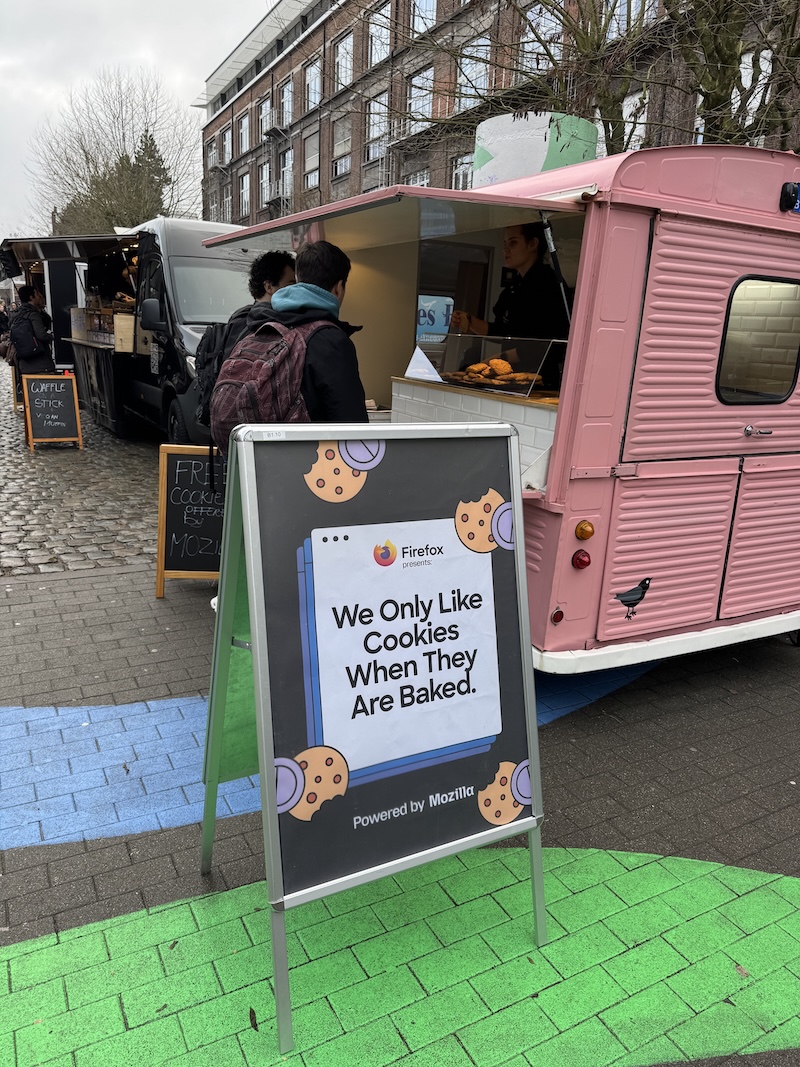
One of my personal highlights of FOSDEM 2026 was a wonderfully simple yet brilliant idea by the Mozilla Foundation: giving away free cookies. It turned out to be more than just snacks. It was a fun little game, a great conversation starter, and the selection of cookies was genuinely excellent. You might have come for open source, but you probably left liking cookies even more than before.
Another standout moment was the talk The Challenges of FLOSS Office Suites by Michael Meeks, where he dove into the technical details behind Collabora Online. It was an absolute pleasure to listen to. What made the talk special was not only the depth of technical insight, but also the way it was presented. Complex topics were explained clearly, with context and humor, making it accessible without oversimplifying.
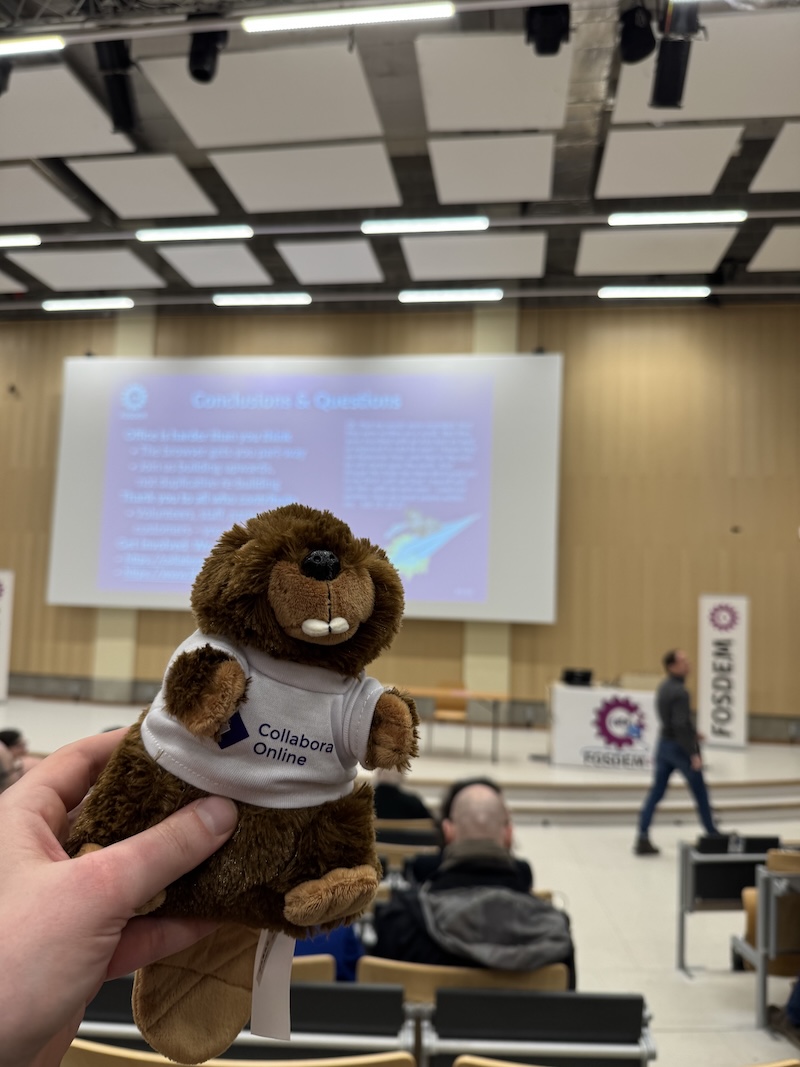
I was genuinely amazed by how the challenges of building and maintaining a full-featured, open source office suite were laid out so honestly. The talk went far beyond architecture diagrams and performance considerations and gave real insight into the long-term effort required to keep such critical software alive and competitive.
Beyond the talks, I also took the opportunity to have some great conversations at the booths. I chatted with fixoulab at the Proxmox booth and with the XCP-ng team at Vates, where I got an early look at the newly released Orchestra features. It was especially interesting since I had not yet found the time to dive into them in detail.
On a more personal note, I was truly grateful to meet many of my friends from different countries again. Being able to jump into great talks together, exchange impressions on the spot, and continue discussions afterwards is something that makes FOSDEM special in a way no recording or live stream ever could.
What the heck is going on at the FOSDEM 2026?
FOSDEM has always been crowded. Anyone who has attended more than once knows the familiar experience of packed hallways, full lecture rooms, and sprinting between buildings in the hope of catching the last five minutes of a talk. As the biggest open source conference in the world, this has long been part of its identity. But in 2026, it felt like something had shifted.
There is no doubt that the growing interest in free and open source software is a good thing. More people take open source seriously, more organizations depend on it, and more contributors want to get involved. That energy was clearly visible everywhere. At the same time, it felt like FOSDEM was reaching — or perhaps exceeding — its natural limits. Rooms filled faster than ever, informal discussions became harder to have, and the sheer density of people sometimes worked against the very openness the conference is known for.
A major driver behind this growth is the current political and economic climate. Topics like digital sovereignty, technological independence, and reducing reliance on a small number of dominant market players were more present than ever. This was not subtle. It was visible across the schedule, in hallway conversations, and especially during the Friday pre-conferences, where these themes were actively pursued and debated.
On one hand, this focus is both necessary and overdue. Open source has always been political in the sense that it is about control, transparency, and autonomy, even when it pretended not to be. Seeing these discussions move to the center stage at FOSDEM is encouraging. It shows that the community understands the stakes and is willing to engage with the broader implications of the technology it builds.
On the other hand, the intensity of this shift raises uncomfortable questions. When everything becomes urgent and strategic, the space for experimentation, learning, and smaller niche projects risks being squeezed out. Not every open source project exists to solve geopolitical problems, and not every contributor arrives with a policy agenda. FOSDEM has always thrived on its diversity of motivations, and maintaining that balance will be increasingly challenging.
FOSDEM 2026 felt like a conference at a crossroads. Its success is undeniable, but so are the growing pains that come with it. The challenge for the coming years will be finding ways to scale without losing what made the event special in the first place: accessibility, spontaneity, and the feeling that there is room for everyone and not just for the loudest or most timely topics. And while I already criticized this last year, this becomes even more important this year.
The conversations happening now are important, and it is good that they are happening at FOSDEM. But if the conference is to remain sustainable, both logistically and culturally, it will need to evolve just as thoughtfully as the open source ecosystem it represents.
Final Thoughts
It is genuinely great to see that FOSDEM remains free and open to everyone, even as the topics it covers become more complex and more relevant. The growing focus on moving away from big tech and reclaiming ownership of our data shows that the community is paying attention to what truly matters. These discussions are necessary, and it is encouraging to see them reflected so clearly in the talks and hallway conversations.
The quality of the talks was high, and the people were, as always, amazing. FOSDEM continues to be a place where curiosity, expertise, and openness meet. At the same time, the question of scale can no longer be ignored. Camping in front of a single room just to make sure you can attend a talk is not a sustainable solution. In many cases, it may even discourage the people who are genuinely interested but cannot afford to wait for hours or navigate overcrowded spaces.
For exactly this reason, I seriously considered staying home this year and watching the talks via live streams or recordings. From a purely technical perspective, that would have worked just fine. The content would still be there, accessible and well produced.
But in the end, FOSDEM is not just about talks. It is about meeting people, reconnecting with friends, and having spontaneous conversations that no video stream can fully replace. Seeing all of you again, sharing thoughts over coffee, and exchanging ideas in person ultimately mattered more than comfort or convenience.
FOSDEM 2026 once again proved why this conference is special. The challenge now is to ensure that it can continue to grow without losing the openness and accessibility that define it. That balance will shape what FOSDEM becomes in the years to come.