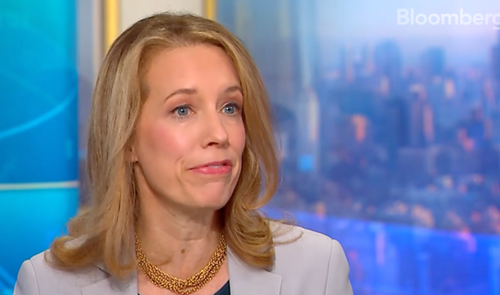
Building on Goldman analyst Brian Singer’s comparison of the AI data-center buildout to the U.S. shale boom, where AI remains in the early "appraisal phase” of the innovation cycle, a stage historically most bullish for infrastructure spending and equity multiple expansion, fresh commentary earlier this week from UBS CIO Americas reinforces the view that bubble conditions have not yet been met.
Ulrike Hoffmann-Burchardi, CIO of Global Equities at UBS Global Wealth Management, spoke at the Latin America Investment Conference, where she said AI remains underhyped in the near term.

Ulrike continued:
AI is underhyped and underappreciated in the short term, and it is one of the biggest investing opportunities in human history, Ulrike Hoffman Burchardi, UBS CIO Americas, said at the Latin America Investment Conference.
She said there are three things needed to be successful in AI:
1) AI algorithmic talent – it is very important to have strong AI researchers;
2) energy to power computers; and
3) chips.
Previously, she was focused on the picks and shovels, or what she calls the AI 7 (three chip companies and four hyperscalers), but now it’s time to move into the application layer of AI – the companies using AI to their benefit.
She said that for AI to be in a bubble, three conditions would need to be met:
loose financial conditions,
a transformational narrative, and
prices becoming reflexive.
She doesn’t think the third box is checked yet, especially not in public markets.
Ulrike noted that valuations are extended, but this is not the key thing to focus on.
On the other hand, she said private markets are bubblier, and that investors need to do a lot of due diligence there.
Circling back to Singer’s note on the shale innovation cycle, that cycle lasted from 2003 to 2020, roughly 17 years.
Read the note here.
Loading recommendations...