Authored by Petr Svab via The Epoch Times,
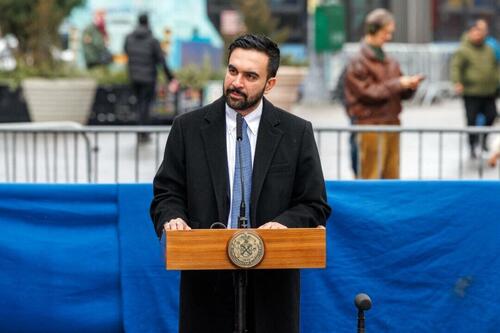
The new mayor of New York City, Zohran Mamdani, has put forward a plan to make housing more affordable, including the government building more housing, freezing rents, and potentially taking over properties from landlords who fail to fix them up.

Affordability is indeed an issue worth addressing, several industry insiders told The Epoch Times. But they weren’t sure how Mamdani could succeed where previous administrations largely hadn’t.
“He’s proven to be really skilled at walking a fine line between opposing parties with different priorities and making each party feel like they’re being catered to,” said Devin Lynch, sales manager at Howard Hanna NYC, a real estate brokerage.
Lynch pointed to the housing ballot proposals that gave the mayor more power over approving housing projects. Many Mamdani voters opposed the measures, worrying they would strip local communities of a voice in the approval process, Lynch said.
“He couldn’t do that because he also courted the union vote, and they all needed the construction and the ‘Yes’ on those ballot proposals for their members. So he’s really threading the needle between these two different opposing goals in his constituency.”
There’s also much uncertainty about the specifics of Mamdani’s plan, given that he has just assumed office, said Michelle Griffith, a real estate agent at the New York City-based Douglas Elliman brokerage.
“We’re all trying to be as optimistic as possible. But the truth is, he’s been mayor for not even four weeks. So we still don’t know what is going to happen,” she said.
“Short term, there’s going to be a rent freeze, so that’s how he’s going to try to soften it for people immediately. And then long term, it’s building more affordable housing.”
Rent Freeze
There are significant caveats to Mamdani’s proposed rent freeze, according to Lynch.
The mayor doesn’t have direct authority to freeze rents city-wide. What he could do is to appoint members to the Rent Guidelines Board, which could freeze rents across rent-stabilized housing units. More than 40 percent of all rental units in the city, almost one million, are rent-stabilized. Their tenants pay rent that is on average about 25 percent below market.
Mamdani can appoint five members of the nine-member board this year, giving him a majority. Whatever decision the board makes would come into effect on Oct. 1 and only for leases that start on that date or later.
However, it’s not just tenants who are struggling with affordability. Costs for landlords have increased, too.
“You already have a lot of landlords that are really struggling to operate in the black,” said Seamus Nally, the chief executive at TurboTenant, a property management platform that caters to smaller-scale landlords.
Maintenance costs have increased by some 40 percent since 2019 and insurance costs skyrocketed by 150 percent, according to a report by the Furman Center, New York University’s housing think-tank.
Meanwhile, New York’s 2019 Housing Stability and Tenant Protection Act not only made it nearly impossible to release rental units from rent-stabilization, but also capped how much landlords can hike rents, regardless of how much they need to invest in renovations.
Since then, net income from rent-stabilized units has dropped by some 12 percent, according to the Furman Center.
Mamdani’s rent freeze would add yet another squeeze.
“The landlords we’ve got an opportunity to talk to in the area, they’re very concerned,” Nally said.
There also appears to be a growing phenomenon in the city, where landlords leave vacated rent-stabilized apartments empty.
There are now estimated 50,000 to 100,000 such empty units in the city now, Lynch said.
Landlords used to be able to release such homes from rent-stabilization and thus have a prospect to recoup the substantial capital investment many require. In some cases, however, that led to abuse where landlords harassed tenants into leaving so they could hike rents. The 2019 law put a stop to that.
However, it now appears that some landlords are stuck with dilapidated apartments that are not worth fixing.
“You’re looking at non-compliant electric, non-compliant plumbing, potentially structural issues that need to be addressed. And that’s in addition to the standard stuff, like replacing floors, replacing appliances,” Lynch said.
Rather than sinking capital in such projects, some landlords bank on the building going up in price over time or that the law will eventually change, he said.
Government Intervention
Mamdani tapped Cea Weaver, a tenant activist, to head his Office to Protect Tenants. Weaver lobbied for the 2019 state law and has proposed that the city buy “buildings where the landlord is no longer interested in ownership.”
In January, Mamdani tried to delay the sale of one such distressed landlord, Pinnacle Group, which went bankrupt after its business model of hiking rents on rent-stabilized units unraveled. However, the sale went through, and Summit Properties USA obtained over 5,000 mostly rent-stabilized housing units for less than $90,000 per unit.
Lynch doubted whether Mamdani would actually pursue the course outlined by Weaver, as it would come with political responsibility for extensive tenant complaints.
It’s easy to be the “knight in shining armor” speaking on behalf of dissatisfied tenants, but “once you directly assume those problems and the realities of addressing the problems, you learn it’s much harder,” he said.
Public Construction
Another aspect of Mamdani’s plan involves substantially increasing the quantity of affordable housing paid for with public funds. He has promised 200,000 housing units in 10 years at the cost of $100 billion.
He proposed financing this by drawing on municipal bonds and hiking taxes on richer city dwellers. Both of those proposals, however, would require state approval.
Mamdani may get some support from Gov. Kathy Hochul, who may be eager to court his voters, Lynch said.
“That will be a big part of her voting base if she runs for reelection” later this year, he said.
Still, the city already carries a substantial debt burden with its interest expenses having risen by more than 20 percent since 2023.
Mamdani promised to expedite approvals of affordable housing projects, while at the same time promising to use all union labor, which would significantly limit capacity.
There’s still much uncertainty about how the plan will look and what aspects of it will materialize, Griffith said.
Mamdani promises that the public will pay, while the previous mayor, Eric Adams, promised the private sector would pay. And before that, Mayor Bill DeBlasio was “somewhat in the middle of those two,” she said.
“And where are we at now? We still have an affordability crisis,” Griffith said.
The next big question is what will happen with whatever housing Mamdani manages to build. The city’s public housing projects have been notorious for slow and inadequate maintenance, even as the city’s housing expenses nearly doubled since 2022.
Nally argued it may be more effective to make it easier for the residents, rather than the government, to build housing. He gave the example of Austin, Texas, where easing regulations helped to spur a housing construction boom.
“I’m skeptical that what will work is more government involvement when some of the petri dishes that we’ve seen work across the United States have actually used less government involvement,” he said.
Loading recommendations...