Submitted by Pascal Lottaz
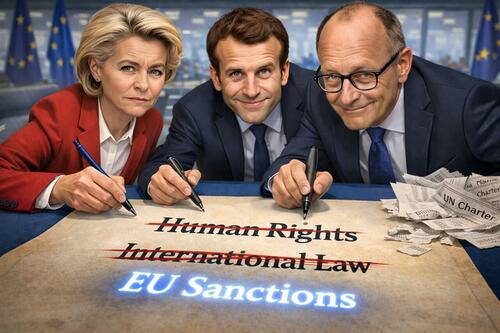
Pascal’s Note: A previous guest on my YouTube Channel, Luis Roberto Zamora Bolaños—the international lawyer who, back in the 2000s, forced his native Costa Rica to withdraw from George W. Bush’s Coalition of the Willing—sent me a short assessment of the legality of EU sanctions. He argues that the Eurocrats are, in fact, grossly overstepping their competencies under international law. Not only are the sanctions in breach of the law between nations, but they are also a heavy infringement on the Human Rights of the targeted people. Here is his verdict.

Unilateral Sanctions against States are Illegal.
Can states do whatever they want within their own borders and jurisdictions? On the one hand, under the Lotus Principle, states (and more generally, subjects of international law) are indeed allowed to act freely as long as they don’t contravene other rules of international law, customary rules, or peremptory norms. Nonetheless, the freedom of action of a subject of international law (IL) is limited by the rights of other States, most notably the principle of sovereignty.
While unilateral acts like sanctions are not explicitly codified in IL, that doesn’t mean they are unrecognized or exempt from scrutiny. The International Court of Justice (ICJ) has dealt with them in several cases, most notably the Nuclear Tests case (also in the UK-NOR Fisheries Case). Moreover, in 2006, the United Nations International Law Commission (ILC) issued its “Guiding Principles applicable to unilateral declarations of States capable of creating legal obligations,” which should be fully applicable to other subjects of international law. Principle 9 establishes that:
No obligation may result for other States from the unilateral declaration of a State. However, the other State or States concerned may incur obligations in relation to such a unilateral declaration to the extent that they clearly accepted such a declaration.
In its commentaries about this principle, the ILC indicated that: “It is well established in international law that obligations cannot be imposed by a State upon another State without its consent.”
The same idea applies to sanctions, which is precisely the reason State consent in the form of jurisdiction acceptance is needed to be subject to a ruling by the ICJ. The UN Charter is less clear about the limits of the United Nations Security Council (UNSC) to impose sanctions. However, it has been widely accepted that the Council has that capacity. The European Union, on the other hand, as a normal subject of international law, shouldn’t have the capacity to create obligations on other subjects of international law.
The issue is further complicated if the sanctions are imposed following a proposal from a member State. Unless the proposing State abstains from voting, the principle of impartiality would be grossly violated.
Additionally, it can be said that the EU, by imposing sanctions against non-member States, would be confiscating functions reserved for international adjudicatory bodies, such as the ICJ or the Permanent Court of Arbitration. It would be highly contradictory, even immoral, if the EU justified its action by pointing to the lack of jurisdiction acceptance by the sanctioned non-member States, since several EU members have not accepted compulsory universal jurisdiction before the ICJ.
Unilateral Sanctions against Individuals are Contrary to International Law
A second level is the human rights question of the people targeted by sanctions. Article 6 of the European Convention for the Protection of Human Rights and Fundamental Freedoms establishes that:
1. In the determination of his civil rights and obligations or of any criminal charge against him, everyone is entitled to a fair and public hearing within a reasonable time by an independent and impartial tribunal established by law.
Although it has been recognized that administrative bodies can impose certain types of sanctions, the right to be heard and to exercise a defense is absolute. No one can be subject to a sanction without an opportunity to exercise a defense or challenge the sanction—before the measures take effect—which doesn’t happen with EU Council sanctions.
Moreover, Article 7 of the European Convention established the principle of nulla pena sine lege previa, meaning that the conduct and its sanction must be clearly established in a law before its imposition. The EU doesn’t have a “criminal code” or anything like that.
Furthermore, EU States (or any State) can create a subject of international law to avoid obligations that they would otherwise bear. This would be fraud on law.
To illustrate with a case, EU member states cannot authorize the EU Council to impose the death penalty, even when the EU itself is not a party to the EU Human Rights regime.
Substantively, depending on the content of the sanctions, they could violate the freedoms of thought and conscience, the right to private property, privacy, movement, and family. It could further be claimed that the conditions imposed by certain sanctions are equivalent to torture.
There is a fundamental distinction to highlight here: between rights and freedoms. Unlike rights, which require positive action by the States for their fulfillment, freedoms demand negative action. States should refrain from intervening in the enjoyment of freedoms unless a lawfully established excess has been committed. Thought and expression are freedoms, not rights, meaning that States (and the EU) should minimize their intervention and limitation, especially sine lege previa.
I think that the issue can be tackled from several fronts. Internationally, in addition to EU internal mechanisms, complaints should be submitted to the High Commissioner on Freedom of Expression and the Committee against Torture. I think this could be a particularly interesting scenario.
Loading recommendations...