Crude oil prices (WTI) are trending moderately lower this morning as traders weigh geopolitical tensions in the Middle East and a report of sharply lower US stockpiles reported by API overnight.
Iranian Foreign Minister Abbas Araghchi and US envoy Steve Witkoff will hold indirect negotiations in Oman on Friday, Iran’s semi-official Tasnim reported, adding talks would be “limited to the nuclear issue and the lifting of sanctions.”
“Geopolitical tensions are really driving it,” Equinor Chief Financial Officer Torgrim Reitan said in a Bloomberg TV interview.
“The underlying balance is a lower price than there is today, but with everything going on it’s very hard to say where this will end.”
We can't help but feel like the API reporting (and very mixed picture) was related to the impact of the freezing weather across most of the country.
API
DOE
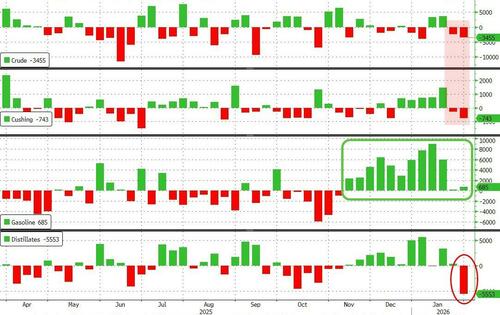
The official data showed a sizable crude draw (but considerably less than API reported) as distillates saw their biggest drawdown since Feb 2021. Bloomberg's Will Zubanskuy notes that the largest portion of that distillates draw came from PADD 1, which includes the East Coast -- where homes in the Northeast lean on heating oil to warm their houses in frigid temperatures. Adding to the demand, diesel and oil-fired power plants start running when the grid comes under strain and some utilities begin pulling from heating oil for certain customers instead of natural gas when supply of the latter gets tight.
Stockpiles at Cushing, Oklahoma, declined for the second straight week, bringing inventories at the storage hub to around 24 million barrels. Despite the draw, levels at Cushing remain several million barrels above where they were this time last year. Gasoline stocks rose for the 12th straight week...

Source: Bloomberg
Crude production in the Lower 48 fell to the lowest since November 2024 as freezing temperatures disrupted drilling in the Permian and Bakken formations.
In the past two months, output is down by 632,000 barrels a day. Overall, production has been shaved off by 4.4 million barrels since early December.

Source: Bloomberg
Bloomberg's Alex Longley also noted another data point showing how much of this storm impact was centered on the gas side of the market rather than oil. While crude production was down 481k b/d versus a week earlier, NGL output tumbled 1.25m b/d. It’s the lowest since 2024 and the biggest weekly decline on record.
WTI prices edged lower, likely driven by the smaller draw than API reported...

Circling back to where we started, the bullish drop in inventories comes as tensions between the U.S. and Iran continue to run hot. While the U..S. Administration said negotiations over Iran's nuclear program will start this week, U.S. naval forces sent to the Arabian Sea off Iran shot down an Iranian drone approaching an aircraft carrier 500 miles off Iran's coast in the Arabian Sea, the BBC reported. As well, a U.S.-flagged merchant ship in the Strait of Hormuz, the choke point for more than 20-million barrels per day of Persian Gulf exports, was harassed by Iranian gun boats.
"Oil would be lower without Middle Eastern sabre-rattling. Post-settlement API figures, faithfully echoing the impact of the cold spell in the US, provide additional support this morning, as crude oil stocks dropped 11 million bbls. These are extraordinary days, weeks and months, in which perceived oversupply has been overwhelmingly overlooked, yet it is still able to set a price ceiling when perceived supply disruptions are in the crosshairs of investors," PVM Oil Associates noted.
Loading recommendations...