Hong Kong’s graduate job market reached its weakest level in five years in 2025, as hiring dropped sharply and wages showed almost no growth, according to SCMP. University data revealed that job openings fell by 55 per cent from the previous year, declining to just over 30,000 positions, even lower than during the pandemic period. This marked a major shift from earlier years, when more than 80,000 graduate jobs were available annually. The steady decline since 2023 suggests that opportunities for young people have been shrinking for some time, rather than collapsing suddenly.
At the same time, salary growth has slowed to a near standstill. The average monthly pay for new graduates rose by only 0.5 per cent to HK$20,961, the smallest increase in recent years. This was a sharp contrast to the stronger wage growth seen between 2022 and 2024. Management trainee positions, which are often viewed as a gateway to leadership roles, were also badly affected. Their numbers fell to the lowest level in five years, and average pay in this category even declined slightly.

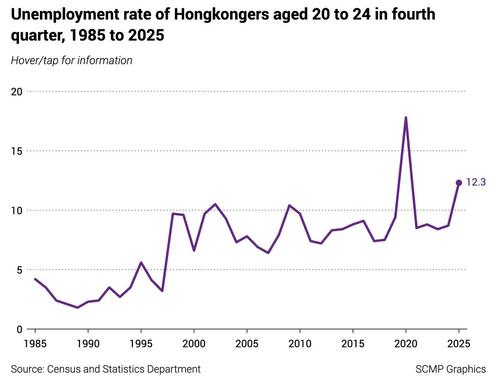
These trends have had a direct impact on youth unemployment. The jobless rate among people aged 20 to 24 climbed to 12.3 per cent, one of the highest levels recorded in decades. More than 17,000 young people were without work during the final months of 2025. For many graduates, this means longer job searches, repeated rejections, and growing uncertainty about their future.
SCMP writes that frustration and anxiety have become common among jobseekers, especially on social media platforms. One graduate wrote, “I am also a graduate from a professional discipline and have been looking for a job since May, but I still have no offer.” Another shared her emotional struggle, saying, “Being unable to secure a job makes me feel very nervous, and my emotions have become difficult to control. When will I get a suitable job?” Some users also complained that available positions often came with low pay and limited prospects, making it difficult to build a stable career.
Experts point to rapid technological change as one of the main causes of the decline in entry-level jobs. Human resources consultant Alexa Chow explained, “The speed and penetration of AI have been so fast that it has created many challenges for jobseekers,” adding that “Jobs like general customer service and translation are quite easily replaced by AI.” As companies adopt automated systems, fewer junior staff are needed to handle routine tasks that once served as training grounds for graduates.

Economic uncertainty has also played a major role. Weak consumer spending, especially in retail, catering, and entertainment, has forced many businesses to cut costs. As a result, employers are more reluctant to invest in fresh graduates who require training and supervision. Management trainee programmes, which demand long-term commitment and resources, have been among the first to be reduced.
Recruiters say companies are now far more selective in their hiring. Jobsdb’s Bill Lee observed, “In the current environment, we observe that employers are more selective in their hiring criteria.” Many firms prefer candidates who can contribute immediately, rather than those who need time to develop. This puts fresh graduates at a disadvantage, particularly those without internship or part-time work experience.
Despite the gloomy outlook, experts stress that graduates are not without options. Developing practical skills, gaining real-world experience, and learning to use digital and AI tools can help improve employability. Some professions that rely heavily on human interaction, such as counselling and psychology, remain less affected by automation. In a tougher job market, adaptability, continuous learning, and resilience may be key to helping young people navigate an increasingly competitive employment landscape.
Loading recommendations...