Well, its been a hot minute since I’ve updated the blog. Life decided that it had other plans for me over the past 18 months or so.
The good news though, dear reader, is that we are back and I have lots in store for 2026!
So let’s kick things off the right way here. I have some incredible and previously unseen footage of Battlezone cabinets being built at Atari from late summer/early fall 1980.
There’s something endlessly fascinating about watching a classic Atari title come together — not so much the design documents or the marketing materials, but the physical act of building the thing. Battlezone is one of those games where the development story and the cabinet itself are so intertwined that it’s hard to separate the two.
Ed Rotberg’s work on the game is well documented: a vector‑driven tank simulation that pushed Atari’s hardware and design philosophy into new territory. Rotberg was able to make a first‑person tank simulation at a time when the hardware barely wanted to cooperate.
Rotberg pushed Atari’s vector technology harder than anyone had before, adapting lessons from earlier games like Lunar Lander and Asteroids but steering them into entirely new territory. He fought for a unique control scheme that felt weighty and deliberate, insisted on a visual style that conveyed depth and motion through nothing but glowing vectors, and worked closely with the industrial design team to ensure the periscope‑style viewfinder wasn’t just a gimmick but an integral part of the experience.
The result was a game that felt impossibly immersive for 1980 — a technical gamble that only came together because Rotberg was willing to challenge both the hardware and the expectations of what an arcade machine could be.
The cabinet itself, was its own engineering challenge. The distinctive periscope viewfinder wasn’t just a stylistic addition — it was a deliberate attempt to immerse the player in a way raster games of the era simply couldn’t match.
The industrial design team had to figure out how to make that idea manufacturable at scale, and the result is one of the most recognisable cabinets of the golden age.
Mike Querio, one of the industrial designers who worked on the cabinet’s design had the following to say when I asked him about Battlezone:
There were some who did not like my periscope vision design. In fact my original design did not even include the acrylic windows on either side. The project manager, Morgan Hoff and others wanted them added so I modified my plastic bezel design. I designed a step to accommodate shorter players and made it removable to reduce the shipping size of the cabinet. It stored vertically inside the cabinet.
The video I’m sharing today comes from inside Atari’s Coin-Op Manufacturing Facility at Sunnyvale, California, and although there’s no narration, it doesn’t need any. The footage speaks for itself.
What you see is the real, day‑to‑day production process behind Battlezone cabinets. The footage shows the later stages of the assembly line, the finishing touches, and packing and shipping. It’s a rare look at how these machines were actually built.
Some 13,000 Battlezone uprights rolled off of Atari’s production lines during the production schedule that lasted from August 1980 to March 1981.
One of the first things that jumps out at me, is just how fluidly the workers are able to move the cabinets around. Anyone who’s ever tried to shift a full‑size Atari cab on their own knows they’re not exactly featherweight. But in the factory environment, you see operators sliding them across the floor, pivoting them into position, and lining them up with a kind of casual confidence that only comes from doing it hundreds of times a week.
The real highlight comes at around the 3 minute 50 second mark. If you’ve ever wondered how Atari managed to ship these things in volume without destroying half of them in transit, this is the bit you’ll want to pay attention to. Two workers approach a finished cabinet with large industrial suction cups — one on each side. They attach them and then, almost effortlessly, lift the entire cabinet off the ground. No straps, no dollies, no awkward tilting. They swing the cabinet over to a waiting pallet, lower it into place, and release the cups.
Once the cabinet is on the pallet, the packing process begins. Cardboard spacers, protective wrap, and finally the outer carton — all designed to keep the machine safe on its journey to arcades around the world.
Anyway – enough chat from me – enjoy the video below:
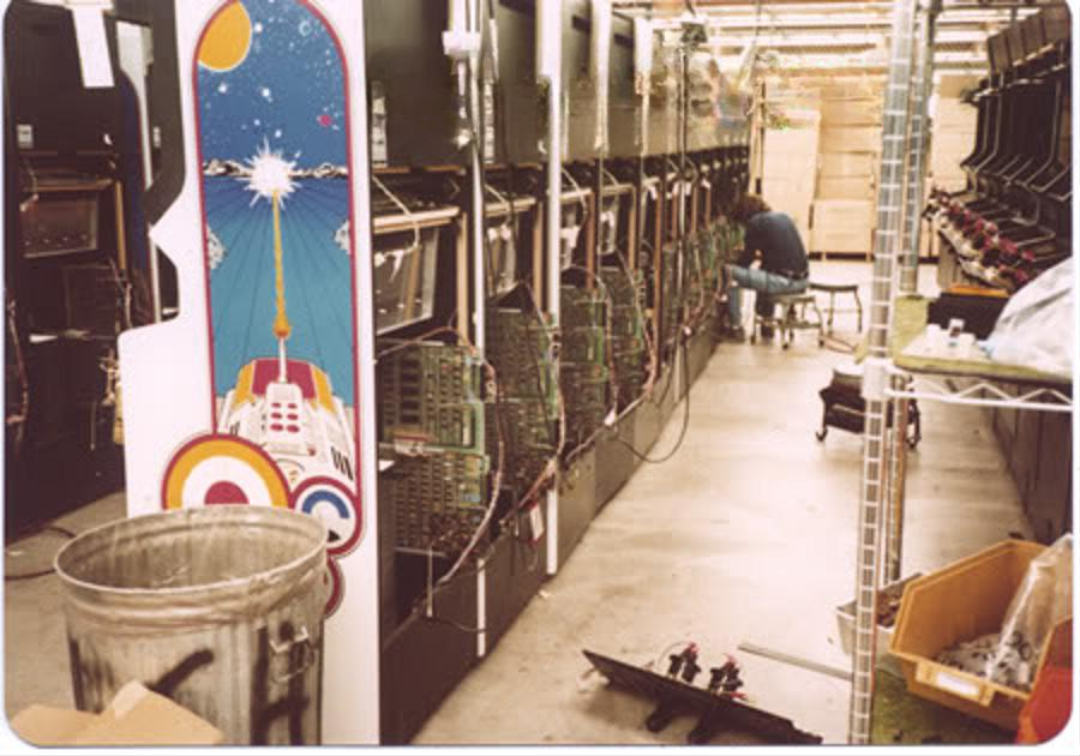
Battlezone shared the production line with Missile Command, itself released at the same time – sadly, we don’t see any MC cabinets in the background in the footage which is a shame. But you can see the two cabinets in this image:
What I love most about this video is that it captures a moment in time when Atari was firing on all cylinders. Battlezone wasn’t just another arcade cabinet release — it was a statement piece. A game that blended cutting‑edge hardware with bold industrial design, and a cabinet that demanded attention on the arcade floor. Seeing it built by hand, reminds us that these machines weren’t abstract products. They were physical objects, crafted by teams of people at the cutting edge of industrial and technical design.
Anyway – I appreciate your patience here. Its good to be back and updating Arcade Blogger again. I have more to come in the weeks ahead.
Thanks for reading!
Tony
If you like what you see, please share this article on your socials!