Submitted by Thomas Kolbe
In Groß-Gerau, Hesse, a billion-euro project has been blocked by citizen opposition and the local council’s majority. The town now seems the epitome of Germany’s decline: backward-looking, stubborn, and hopelessly lost in an era that leaves no room for passive solipsism.
With roughly 27,000 residents, Groß-Gerau benefits from direct connections to Frankfurt and Darmstadt, making it an ideal commuter town. Here lives Germany’s traditional middle class: partly insulated from the nation’s economic and social upheavals, yet close enough to major developments to suddenly find itself in the public eye.
CDU Votes for the Project
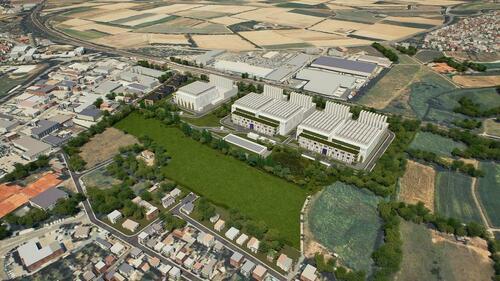
Last week, the town council rejected a data center from the U.S. company Vantage Data Centers following protests from residents. With votes from SPD, Greens, and the Left, the town turned down a private investment of roughly €2.5 billion.

The planned facility would have been part of the Rhein-Main region’s digital infrastructure, anchored by DE-CIX, one of the world’s most significant internet hubs. It’s about the world’s new data highways—AI, autonomous systems, autonomous driving, cloud solutions—all the infrastructure major economies like the U.S. and China rely on to escape economic stagnation.
For Germany, these developments are treated as marginal at best. The prevailing attitude cloaks itself in ideological-moral superiority, using regulation to ensure companies and users do not “go too far.” In European politics, the digital sphere is little more than a playground for polemic opposition and petty criticism of the master plan to build a green-socialist ideal state.
With an 18-14 vote, the town council ultimately opposed the project. Only the CDU, alongside the Kombi-FWG, supported it. This illuminates German political dynamics: absent the AfD, the CDU surprisingly acts independently—even defying the so-called “firewall” party cartel. Could this hint at Germany’s potential political liberation? Or was this local CDU action merely a fluke within the party’s otherwise steadfast Brussels-aligned ideology?
The proposed site would have been a few hundred meters from residential areas, separated by an industrial park. Yet this was enough for alleged noise concerns to dominate local discourse. The Greens argued the data center would create “heat corridors” and depress property values—a concern never applied when building wind turbines. While public interest routinely overrode private property during wind farm construction, here ideology replaced rational risk assessment. From the outset, local politics sought excuses to kill the project—driven by avoidance, fear of responsibility, and bureaucratic inertia.
Excuses and Evasion
Justifications for rejecting the investment were as bizarre as they were German: timid, defensive, and devoid of any vision. Expected tax revenues were deemed insufficient, potential jobs minimal—excuse piled on excuse. Bureaucracy has so deeply entrenched itself that private investment is now perceived as a threat rather than an opportunity.
This system has eroded abstraction skills and converted real weakness into moral superiority. The future is no longer seen as malleable, change is perceived as a burden, and imagination is systematically weakened. People learn to follow rules instead of solving problems.
The solution is breaking free from this iron cage of regulation—reviving innovation and building the infrastructure essential for tomorrow’s economy.
The Gaulish Village of Green Ideologues
German politics has never had a serious problem dispossessing homeowners for wind turbines. So-called citizen participation is little more than soothing ointment over real, material losses imposed on residents. Even symbolic compensation schemes in some states fail to address the structural disregard for property rights. Private property is viewed with suspicion and treated as a fiscal quarry for ideological ambitions.
Groß-Gerau’s project could have been a chance to implement a market-oriented model of fair compensation, putting economic principles above ideological command politics. Instead, Germany remains in a psychological “Gaulish village”: perpetually defensive against modernization, with bureaucracy and NGOs nurturing provincialism.
For U.S. companies, this is standard practice: property rights enforce serious negotiations with affected residents, or litigation ensures balance. France offers a contrasting example: President Emmanuel Macron recently poured €30 million into his nation’s “Silicon Valley,” while U.S. private investment dwarfs such state initiatives by hundreds of billions. The lesson is clear: Europe remains shackled by centralization, unable to compete with more agile, market-oriented systems.
It’s high time Germany abandoned climate-socialist rigidity and started embracing new business models. Stubbornness and timidity should no longer prevent the country from recognizing opportunities for growth and innovation.
* * *
About the author: Thomas Kolbe, a German graduate economist, has worked for over 25 years as a journalist and media producer for clients from various industries and business associations. As a publicist, he focuses on economic processes and observes geopolitical events from the perspective of the capital markets. His publications follow a philosophy that focuses on the individual and their right to self-determination.
Loading recommendations...