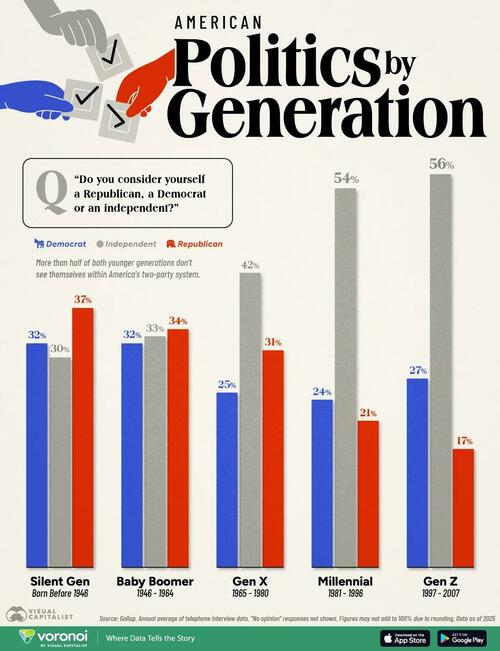
Political identity in the U.S. is changing, and the divide is increasingly generational.
Younger Americans are stepping away from traditional party labels, while older generations remain more closely tied to the two-party system.
This visualization, via Visual Capitalist's Niccolo Conte, shows how political affiliation varies across generations, highlighting the growing role of independents in American politics.

The data comes from Gallup. It is based on annual averages from Gallup’s telephone interviews, asking respondents whether they identify as Republican, Democrat, or independent. “No opinion” responses are excluded, and figures may not total 100% due to rounding.
Younger Generations Favor Being Independents
A majority of both Generation Z and Millennials identify as independents. Among Gen Z, 56% say they are independent, compared with just 17% identifying as Republican and 27% as Democrat. Millennials show a similar pattern, with 54% identifying as independent.

Party Loyalty Rises With Age
Political affiliation becomes more evenly split among older generations. Generation X shows a more balanced distribution, with 31% Republican, 25% Democrat, and 42% independent. Among Baby Boomers, party identification nearly overtakes independence altogether.
The Silent Generation is the most partisan group, with roughly seven in 10 identifying as either Republican or Democrat. This cohort came of age during periods when party affiliation was more stable and closely tied to identity, such as the New Deal era and the Cold War.
Implications for U.S. Politics
The rise of independents among younger generations has major implications for elections and governance. While independents may still lean toward one party, their lack of formal affiliation makes voter behavior less predictable. It also complicates messaging for political parties trying to mobilize younger voters.
If you enjoyed today’s post, check out The Distribution of Income in America (2024 vs 1974) on Voronoi, the new app from Visual Capitalist.
Loading recommendations...