The visible decline in production in Europe’s chemical sector could soon have far more serious consequences. Production capacity is disappearing, and the further consequences will be alarming, warn leaders of the largest companies in an industry that recently experienced a period of prosperity.
They are calling for swift and far-reaching changes to EU law, writes Polish Business Insider.
In just a few years, nearly 10 percent of production capacity on the Old Continent has disappeared. Industry representatives are warning that cheaper products from Asia and the Middle East are taking their place, as European companies suffocate under the weight of energy prices, CO2 costs, and a thicket of regulations. This is the view of both state-owned (Azoty), private (Qemetica), and foreign companies operating in Poland (BASF).
The chemical sector accounts for approximately 7 percent of the EU’s total industry and generates over 1 million direct jobs, with 3-5 times as many indirect jobs, primarily in small and medium-sized companies. Meanwhile, according to Katarzyna Byczkowska, CEO of BASF Polska, over the last three years, approximately 9 percent of chemical production capacity has been liquidated in Europe, and in 2023-2024, the European chemical industry alone will shrink by 14 percent. During this same period, chemical production grew in countries such as China, Russia, and the United States.
“In Europe, we’re playing a different game than the rest of the world, but on the same playing field. We’re starting to lose,” warns Kamil Majczak, CEO of Qemetika (formerly Ciech), during a debate organized by Siemens with other representatives of the chemical sector. In his opinion, Europe still believes it can impose its rules on others, while China, the U.S., and India view the world as a field for expanding their spheres of influence and taking over markets.
“We can’t expect developing countries to suddenly make everything green, three times more expensive, because we think it’s the right thing to do,” he adds.
Majczak emphasizes that the consequences of rising costs are already tangible. More and more plants are closing in Europe, and some companies have survived the last two or three years by leveraging previous profits. “This buffer is running out, and once a plant closes, it won’t reopen. People will leave, production capacity will disappear, and it won’t return after a year or two,” warns the CEO of Qemetica.
In the case of fertilizers, the price of gas accounts for 75-80 percent of the product’s production cost. For years, Europe has been an importer, now forced to use much more expensive sources than before. This poses a significant challenge for fertilizer companies like Azoty.
This is especially an issue for the chemical sector, as it is such an energy-intensive industry, says Paweł Bielski, vice-president of Grupa Azoty.
“At certain points, gas in the U.S. was 4-6 times cheaper than in Europe,” recalls Katarzyna Byczkowska, CEO of BASF Poland. The differences in energy costs are immediately visible in the profit and loss accounts of European and American plants, admits Kamil Majczak, CEO of Qemetica, who compares the results of factories in Europe and the US. CO2 emissions fees must also be added to the total, which, Majczak says, are practically nonexistent outside of Europe, with the exception of a specific system in California.
Industry representatives emphasize that they are not questioning the direction of decarbonization, but the pace, scale, and structure of regulatory burdens in a situation where Europe is already starting from a worse position, because it is more expensive in terms of energy.
Katarzyna Byczkowska highlights two levels of regulatory costs.
First, there are direct costs resulting from regulatory compliance, as in the case of the EU’s CLP regulation. The change in font on chemical labels was reportedly costing her company over €300 million before, after a year of intense negotiations, some of the provisions were withdrawn.
Second, there is the increasing structural burden resulting from the sheer number and volatility of regulations, which generate chaos, reduce predictability, and drain resources from research and development.
“In Europe, we already spend twice as much on regulatory compliance as on research and development,” notes the head of BASF Poland. Across the continent, this translates to an 8 percent decline in R&D spending, while in China and the US, spending is rising year over year.
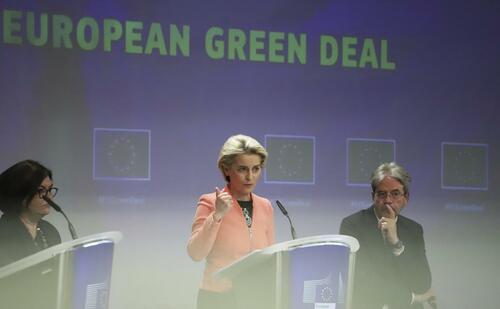
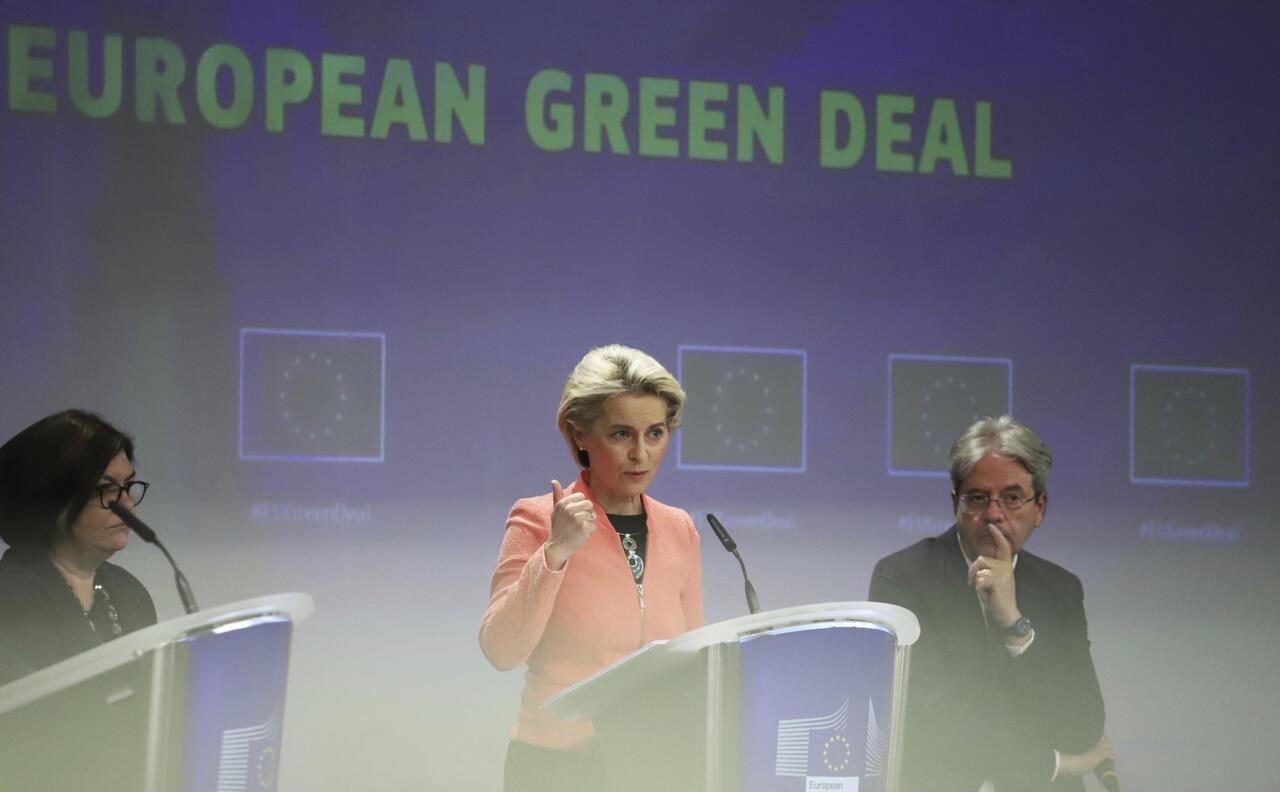
Paweł Bielski, Vice President of Grupa Azoty, points out that the EU climate package and subsequent elements of Fit for 55 were developed under completely different conditions than those in which the industry operates today. “The Green Deal was adopted when no one took into account the pandemic, the war in Ukraine, or the rapid change in Europe’s energy balance,” he argues. In his opinion, the direction of decarbonization will remain unchanged, even if some regulations are formally suspended, but the rules themselves should be improved.
A symbolic example is the ETS system, or emissions trading. Free allowances are shrinking every year, and, as Byczkowska explains, companies are unable to “add” another billion euros a year to purchase certificates in a time of crisis and blocked new investments. “We need someone to stop tightening their grip on us even more,” she says.
The clash between European climate ambitions and the realities of global competition is most acute in the clash with Asian production. “We used to be an exporter, now we’re an importer, and that fundamentally disrupts the balance,” says Majczak. China has built vast, modern production capacities in recent years to satisfy its own market, but the slowdown in demand has freed up a significant portion of this capacity for export.
Taking advantage of cheaper energy and less restrictive regulations, Chinese producers are aggressively entering the European market, from fertilizers to plastics.
Paweł Bielski points out that until recently, Europe had a strong polymer industry, including the production of polyamides for automotive, construction, and packaging. Today, China’s dominance is overwhelming in many segments — in one of them, as he points out, as much as 67 percent of global production capacity is already located in China. He believes a similar trend is visible in fertilizers: Massive installations are being built in Russia, the U.S., and the Persian Gulf countries, which will not consume all of their production domestically, but will instead direct it to Europe, among other countries.
One positive sign is that technological advances reduce costs. “We’re seeing increased activity from companies investing in solutions that enable faster, cheaper, and safer production,” says Maciej Zieliński, CEO of Siemens Polska.