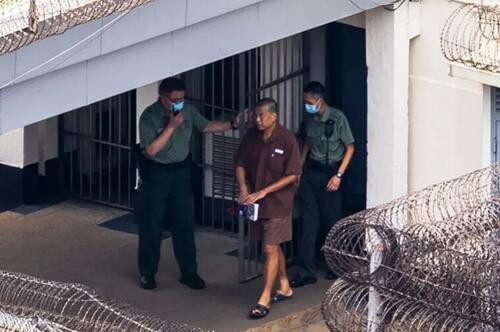
The high profile trial of Hong Kong's foremost pro-democracy media tycoon wrapped up in December, whereupon Jimmy Lai was found guilty of sedition. He had long spearheaded huge protests and local Hong Kong media criticism of Beijing, but came under legal hot water and scrutiny with the passage of the notorious China-imposed national security law.
Finally, on Monday he was handed a very harsh 20-year prison sentence, resulting in outrage and condemnations aimed at China from across the globe. This is effectively life in prison, or even a death sentence, for the 78-year old who also suffers various health problems.

This is after he's already spent over five years in prison, and the trial alone lasted two years. He was first detained in August 2020 under Hong Kong’s Beijing-imposed national security law, in wake of large-scale student protests which at times brought whole sectors of the city to a standstill.
The city’s High Court said in its ruling: "Having stepped back and taking a global view of the total sentence for Lai’s serious and grave criminal conduct ... we are satisfied that the total sentence for Lai in the present case should be 20 years’ imprisonment."
The security law has been widely seen as the final nail in the coffin of Hong Kong's long-running autonomy, and was a response to the major 2019 protests which were widely covered in international press reports.
China had long alleged a foreign intelligence 'hidden hand' behind the protests. This was in part due to student activists being in semi-regular communication with Western officials and NGOs, and sometimes even honored at events hosted in Europe or the US.
Secretary of State Marco Rubio was swift to issue Washington's response to the verdict on Monday, calling the sentencing an unjust and tragic conclusion.
"The Hong Kong High Court’s decision to sentence Jimmy Lai to 20 years is an unjust and tragic conclusion to this case," Rubio said in the statement.
"It shows the world that Beijing will go to extraordinary lengths to silence those who advocate fundamental freedoms in Hong Kong, casting aside the international commitments Beijing made in the 1984 Sino-British Joint Declaration," the US top diplomat added.
Elaine Pearson, Asia director at Human Rights Watch, stated that "A sentence of this magnitude is both cruel and profoundly unjust."
Western leaders, including of the US and Britain, are expected to lobby for his freedom, especially given that this is being viewed as ultimately a crackdown on Western values in influence on one of the world's main financial hubs. But given sentencing has been accomplished, any such action to obtain his release will get harder and harder. China, on the other hand, said he encouraged violence and foreign subversion.
Loading recommendations...