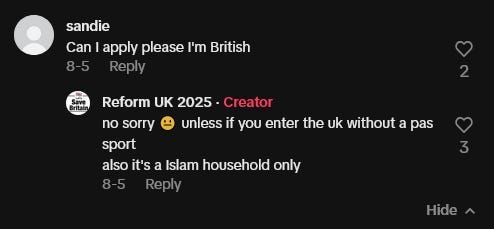
London Centric’s investigation into the TikToker secretly filming fake anti-immigrant videos inside Londoners’ homes generated a huge public response.
Amid the hundreds of comments two major questions remained: Who was the individual behind the TikTok account and what motivated them to make the videos?
Today, we have an extraordinary confession from someone purporting to be the TikToker in question. They are just one person in a sea of online hate content. But their explanation of their actions helps shed light on the motivations behind a wider online trend.
London is being used as the backdrop for inaccurate viral videos that reach enormous audiences around the world by playing into the worst stereotypes about the capital.
See that story – and what Sadiq Khan has to say about our reporting – below.
Read to the end for Taylor Swift’s visit to a forthcoming Croydon mixed-used redevelopment, the growing number of freemasons in the Met police, and what we missed about Jeffrey Epstein’s London.
By Katherine Denkinson and Jim Waterson
The man on the recording is baffled. He can’t understand how London Centric traced his anonymous hate-filled London TikTok account back to his employer by geolocating the wheelie bins in his videos.
“I thought no one’s gonna notice that,” he says. “Why would someone?”
Last summer, the man says, he found himself sitting in his car, analysing trends on TikTok. His day job was conducting viewings for an estate agency but he was trying to come up with an idea for a viral video account that could be run as a money-making side-hustle.
“I was thinking of unique videos I can do for people,” he says on the tape.
That’s when he had a brainwave: “Hate brings views.”
At that time protests outside asylum hotels were spreading across the country. The man says he noticed “far-right people” were among the most engaged on TikTok. They were easy to rile up: “They hate such videos of illegal migrants. I was like, why not?”
The result was the account Reform_UK_2025, which co-opted the logo and name of Nigel Farage’s political movement without permission from the party. It posted video tours of Londoners’ homes accompanied by an AI-generated voice claiming properties in Knightsbridge and Chelsea had been handed over to illegal immigrants for free. It smeared residents, who were visible in some of the videos, as rapists and said that others proclaimed their hatred of the UK while collecting the keys.
It was an instant hit, attracting millions of views. It was also, the man confesses, all lies.
“Dangerous and divisive”
You don’t have to believe London is anywhere near perfect to recognise the increasing divergence between the way the city is portrayed online and the reality on the streets.
Sadiq Khan told London Centric that our latest investigation into this anonymous TikTok account reveals part of a “dangerous and divisive” trend that sees “bad faith actors spreading hate for clicks”.
“Accounts are talking London down because the algorithms reward them for doing so,” said the mayor.
The “one rogue contractor” defence
When London Centric tried to work out who was running the Reform_UK_2025 account, our investigation led us to SmartLet Estates, a north London estate agency.
When we confronted company director Sam Wasserstrum, he said he knew who was running the TikTok account but wasn’t willing to share their name with us. He claimed they were a member of the public who had been looking to rent a flat from his company.
He now accepts that was a lie – and he knew it was a lie when he told us.
Now, Wasserstrum wants to set out a different version of events. He says the person behind the camera was really a “rogue” contractor he employed for two years as a viewings agent to show potential residents around the properties. Wasserstrum says he had no idea that his employee had been running the hate-filled TikTok account until we first approached his company in November. He says the employee was sacked soon afterwards and he regrets ever telling us that a client was responsible.
To back up his case, Wasserstrum provided London Centric with multiple lengthy audio recordings of what he says is him confronting the anonymous employee. One of these tapes, he says, was recorded before he told London Centric he would not reveal the name of the culprit. The other was recorded after we published our article.
Wasserstrum did not provide the name of employee and we have not been able to independently verify the veracity of his story. However, metadata associated the audio files suggests the conversations took place around the dates that London Centric began asking questions.
The extraordinary taped confession is a rare insight into what motivates people to run fake news accounts on TikTok – and how monetising engagement can also effectively monetise hate, with little concern for its real-world impact.
“One day I might make some money.”
The audio on the tape is clear, with Wasserstrum’s voice asking questions in what sounds like an HR-style meeting.
The employee explains his motivation for setting up the anti-migrant fake news account was simple: “One day I might make some money.”
The aim, he explains, was to build an audience and then make cash through TikTok, which allows people to monetise content once they reach a certain number of views and followers on the platform.
He’d previously run a TikTok account that had amassed 24,000 followers. One night, he was astonished to find, he received his first payout from TikTok’s creator scheme.
His head was turned by the substantial sum of money: “I told my wife, wow, it’s £1,000.”
Then, to his annoyance, TikTok immediately deleted his account because he was just stealing other people’s videos and reposting them.
Hooked on the income and in search for a new source of original content, he decided to start filming videos of homes across London while he was hosting viewings.
He added an AI-generated voiceover about asylum seekers, rapists, and illegal immigrants then pressed upload. The audience response was instant and enormous, and TikTok’s algorithm responded by pushing it into the feeds of hundreds of thousands of people. Irate Londoners drove up engagement by complaining they couldn’t afford such properties while illegal immigrants were supposedly getting them for free.
London Centric doesn’t have a marketing team – if you found this article interesting, please forward it to a friend, post it in your WhatsApp group, or recommend it on social platforms.
Last year a report by The Bureau of Investigative Journalism showed AI-generated racist videos amassing millions of views despite breaching TikTok’s guidelines on hate-speech.
A spokesperson for TikTok told London Centric that “hate has no place” on its platform: “Of the content we’ve removed for breaking these rules, more than 94% was taken down before being reported to us, and we work with experts to keep ahead of evolving trends and continually strengthen our safeguards against hate.”
The man on the tape seems to feel otherwise.
“My first video got one million [views],” he says. “Most of the videos got over 10,000… so I thought, one day I might make some money.”
TikTok told us: “This article is based on the opinion of one unnamed individual, and it is not representative of the positive and creative experience that millions enjoy every day on TikTok.”
“I wrote down ‘illegal migrants’.”
The TikToker appears to have no concept of the potential real-world impact of his uploads, instead considering everything in terms of view counts and pieces of content. He even suggests that Wasserstrum should not be concerned by London Centric’s reporting because our own video didn’t attract anything like as many viewers as his original hate-filled fake uploads.
“Their video didn’t even go that viral,” he offers by way of defence, arguing it could therefore be ignored. “They only got like 200,000 views on TikTok. It’s probably gonna die. It’s not gonna last long.”
The man tells Wasserstrum that he does not want to own up to running the account because “it’s going to make it much worse” and could “ruin [his] life”. In any case, he says, journalists would simply think he was a “paid actor”.
Wasserstrum can be heard on the recordings spelling out to the man how London Centric had approached the business. “They came to the office... they had every single fact you can think about,” he says. “They’ve cross referenced everything… We’ve had management companies calling us, councils calling us up, saying you’re putting our clients in danger.”
The man appears confused by the fuss his actions have caused. He gives the impression that he considered TikTok’s algorithm and the site’s content regulation policies to be the ultimate arbiter of whether a video crossed a line.
He insists the impact on tenants whose faces are visible in some of the videos was limited because they “didn’t get a lot of views” compared to his other content.
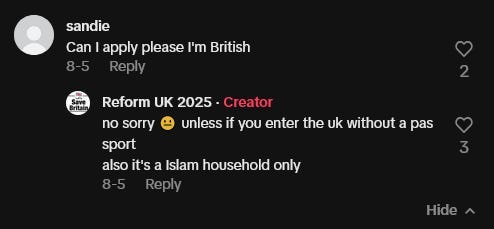
“It wasn’t racist,” the man says of his account. He argues that if the videos had really been racist, TikTok’s algorithm would have downgraded the content. Instead, he was rewarded with millions of views. He was just an entrepreneur following a simple content strategy: “Every single video I would basically copy paste the same thing. I wrote down ‘illegal migrants’.”
“Spreading hate for clicks”
London Centric took our findings to the mayor of London, Sadiq Khan, who recently raised concerns about the growing impact of dubious viral videos on global perceptions of the city.
“While the social media revolution has come with extraordinary benefits, we’re also seeing a surge in misinformation and online abuse, due to a lack of sufficient guardrails,” the mayor told us.
“The large social media companies and regulators need to do much more to prevent algorithms pushing hate and violence and promoting misinformation and disinformation into people’s feeds.
“Our democracies are being undermined by those bad faith actors spreading hate for clicks.”
“We have reported the matter to the police”
On Friday Wasserstrum said that he has asked the police to investigate his former employee.
In a statement issued to London Centric the estate agency boss said: “We are aware of the vile and extremely dangerous TikTok videos that were filmed inside properties let by SmartLet Estates. We recognise the very real threat that these videos posed to the individuals filmed and to whom false views were attributed. We have reported the matter to the police.
“We conducted a thorough investigation as soon as the matter was brought to our attention. We established that the videos were created by a third-party contractor who acted without the authority, knowledge, or consent of the company. We severed all ties with the contractor immediately. We are appalled by his actions and condemn them in the strongest possible terms.
“We are committed to acting transparently and rebuilding trust with our partners and the communities we serve. We are fully prepared to cooperate with the authorities and to assist with any investigation.”
Despite fostering online hatred, the man recorded by Wasserstrum insists he doesn’t personally share the views expressed on his TikTok account. Instead, he suggests his fake anti-migrant house tour videos were just a way to game the algorithm, build an audience, and hopefully make money.
”I didn’t do anything because of hate,” he says on the tape. “I didn’t care. It’s just I wanted the clicks.”
All our reporting is funded by our paying subscribers, who receive exclusive investigations. Your support for original investigative local journalism is very much appreciated.
Click here to read our original investigation into the account, including a film by Jonah Sealey Braverman.
Want to get in touch with London Centric? Send us a WhatsApp or send an email or leave a comment on this piece.
In November Taylor Swift flew 3,500 miles in her private jet to film the music video to her song ‘Opalite’ at one of London’s leading attractions: Whitgift shopping centre in Croydon.
This week the finished video was released, introducing hundreds of millions of Swift fans around the world to Croydon’s forever-awaiting-development mall.
It is not known whether Swift took any time off from filming to examine the long-delayed plans for redeveloping the site, nor whether she has any views on the council-backed proposals which will see her filming location become part of a mixed-used construction project featuring homes and retail.
Her team were able to secure the location for a weekend of filming due to the increasing number of empty units as shops increasingly desert the shopping centre.
When London Centric visited on Friday afternoon locals seemed more interested in restoring pride to their local high street rather than Swift. Passerby Darryl, 34, from Croydon asked: “Why the Whitgift? Is her video supposed to represent a dystopian future?”
When the pop star featured Kentish Delight, a kebab shop in Camden, in her 2018 music video for End Game, the owner said it boosted business. Whether Swifties will descend on the Whitgift – or Stoke Newington’s Mildmay club, which also features in the new video – with the same enthusiasm remains to be seen.
The Met police’s battle to force its employees to register their membership of freemasonry lodges continues. London Centric’s latest Freedom of Information request found that 386 police officers and Met staff have now declared “they are or have been a member of the Freemasonry Organisation” since the rule came into effect at the end of last year. That’s up from the 300 made public last month.
Our story on Jeffrey Epstein’s discussions about buying a central London hotel to host his London “playroom” was followed up in most of the national newspapers. Some of them even kindly remembered to credit London Centric. If you want to read the original, it’s here. As one reader pointed out, we’d failed to note that Dukes hotel has a side entrance onto a narrow road called Little St James’s – which shares its name with the deceased sex offender’s private Caribbean island.
We’ll be back next week with more exclusive original reporting on London.
.