In retrospect, if only Cantor Fitzgerald was called PolyCantor, none of this would have happened.
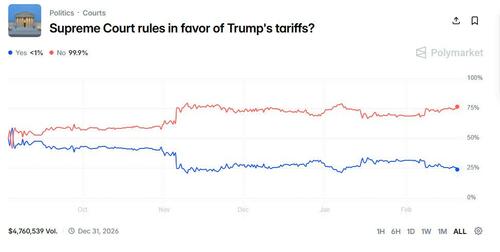
Ever since September, the upstart online betting marketplace PolyMarket has been offering traders the opportunity to make money by betting whether the US Supreme Court would rule in favor or against Trump's tariffs, with millions of bets placed for either outcome (of course, we learned the outcome at 10am ET on Friday, when a 6-3 majority - including two Justices selected by Trump - voted against the president's landmark trade policy).
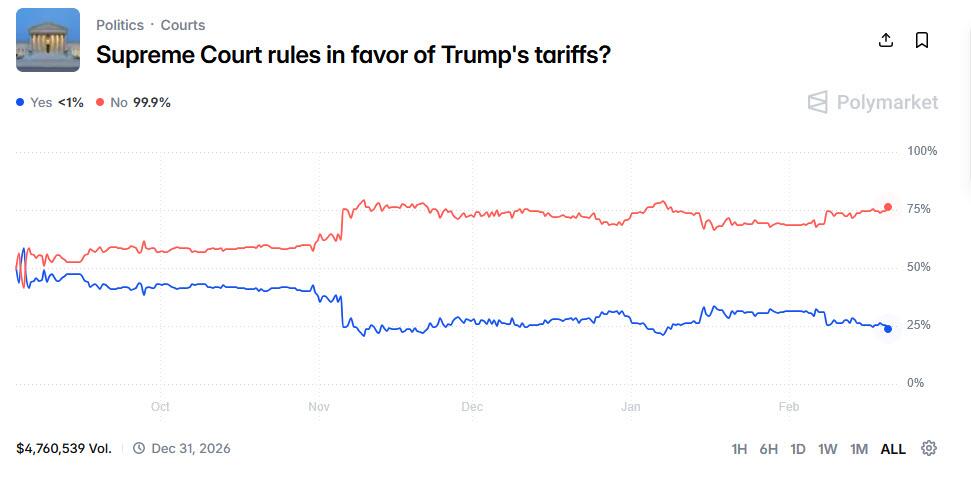
If that's not enough, there were also parallel markets like "Will the Court Force Trump to Refund Tariffs?", "Will the Supreme Court rule on Trump's tariffs by..." and many others.
Of course, there's also PolyMarket's carbon copy, Kalshi, which offered the exact same markets to its own group of traders.
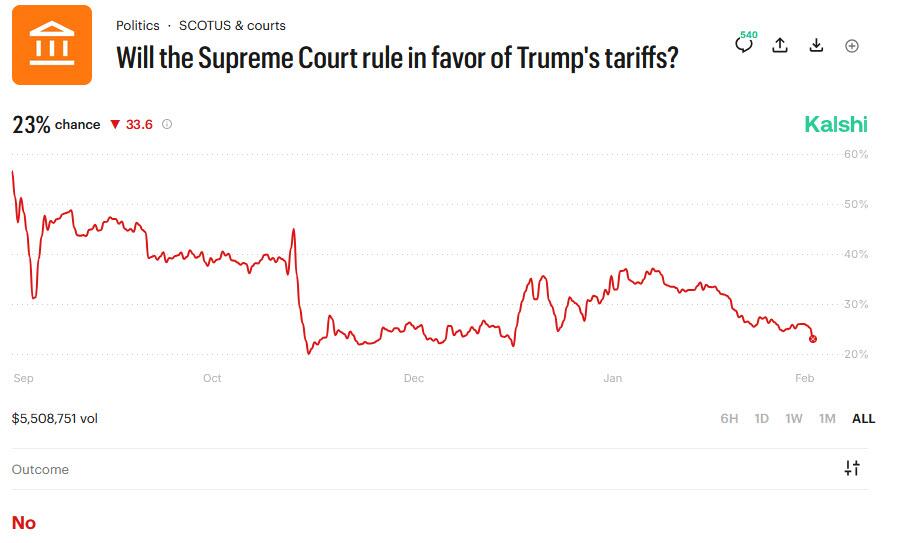
Yet reading the mainstream media or various social network politicized echo chambers, one would have no idea that both PolyMarket and Kalshi, which have revolutionized online betting for ordinary Americans (and as of this week, for institutional clients of both PolyMarket and Kalshi), are letting their clients bet millions whether Trump's tariffs would be struck down in court. Instead, they would be bombarded by headline after headline that Cantor Fitzgerald - the investment bank overseen by the sons of Commerce Secretary Howard Lutnick - is doing just that.
Only in the case of Cantor Fitzgerald, this is 100% fake news.
It all started with a July report by Wired (which once was a great magazine before transforming itself into the modern day version of the Sears, pardon, Amazon catalog with its avalanche of product infomercials) that alleged the financial services company created a “litigation finance” product that brokers bets that the courts will strike down the tariffs.
"Trump’s Commerce Secretary Loves Tariffs. His Former Investment Bank Is Taking Bets Against Them. A subsidiary of Cantor Fitzgerald, which is run by the sons of US commerce secretary Howard Lutnick, is letting clients essentially bet that President Donald Trump’s tariffs will be struck down in court", Wired declared bombastically, adding that...
In a letter seen by WIRED, a representative from Cantor said the firm was willing to trade tariff refund rights for 20 to 30 percent of what companies have paid in duties. “So for a company that paid $10 million, they could expect to receive $2-$3 million in a trade,” the representative wrote. “We have the capacity to trade up to several hundred million of these presently and can likely upsize that in the future to meet potential demand.”
In theory, such trades would connect a company vulnerable to US tariffs with a fund willing to bet that such tariffs might be reversed, or provide a market for two funds who disagreed on what the outcome of the Supreme Court decision would be. Cantor, like PolyMarket or Kalshi, would be the market where such trades would take place.
Always eager to stir up a scandal especially when there is none, Congress's two most vocal, anti-capitalists, Elizabeth Warren and Ron Wyden immediately sent a letter to Howard Lutnick's son, Brandon, who now runs Cantor, demanding full disclosure of transactions or agreements the firm has made relating to products that would let institutions effectively bet on the legality of President Donald Trump’s tariffs.

“Public reporting indicates that Cantor has offered companies the opportunity to trade their legal claim to a future tariff refund in exchange for 20 to 30% of the duties the company paid,” the letter said. “In this scenario, if the courts determine that the tariffs are illegal, the company stands to recover hundreds of millions of dollars.”
Among the questions the senators posed were how many tariff refund agreements Cantor has finalized, whether it created them at the request of a specific client and if anyone at the firm had communicated with people in the US government about the tariffs or related legal cases, including Trump and the Commerce secretary.
Sadly for America's favorite "native American" politician, her fishing expedition went nowhere fast because as Bloomberg reported in August, while Cantor Fitzgerald held internal discussions about facilitating such trades, it - unlike Kalshi, PolyMarket and various of its invesdtment banking peers - "quickly shut down the idea before executing any transactions."
According to the Bloomberg report, Cantor received what is known as a reverse inquiry, which is essentially a client asking whether the firm can facilitate such trades, which are done by larger Wall Street banks, and some staff discussed with potential clients about arranging them before the idea was rejected. As an aside, Cantor takes no directional position on brokered trades, and only pockets a commission when it matches a buyer and a seller, which of course is the business model of online better markets which are now valued in the tens of billions.
“We have not facilitated or executed any trades in that market,” Cantor spokesperson Erica Chase told Bloomberg adding that “what is being reported about our business is absolutely false.”
Why would Cantor decide against matching willing clients and creating a market (where it itself has no position)? Simple: with Cantor founder Howard Lutnick now Donald Trump's Commerce secretary, shaping the president's policies and other potentially market-moving matters, the firm's dealings have been a key area of focus for ethics watchdogs who are on alert for conflicts of interest.
Which is not to say that others haven't been more than willing to jump in and take the spot voluntarily vacated by Cantor.
In a separate report from October, Bloomberg reported that banks such as Jefferies (a portfolio company of none other than Warren Buffett's Berkshire Hathaway), and Oppenheimer "are among firms brokering the deals, matching investors with companies that have paid tariffs to import goods into the US." Or precisely what Cantor has been accused of doing.
Why would Jefferies and Oppenheimer offer to make a market in tariff related litigation finance? Simple: they stand to make a lot of money in commissions as the bid/ask in this illiquid market was so wide. A hedge fund might pay somewhere between 20 to 40 cents for each dollar of claims they could get back in refunds. Most of the trades range in size from $2 million to $20 million, with few over $100 million, Bloomberg sources said.
Additionally, in order to hedge the Supreme Court decision, investment banks had been asking customs brokers in several US states to recommend the deals to clients paying the tariffs. According to one customs broker quoted by Bloomberg, some investors are actively pursuing buying refund claims from importers that are hurting for cash.
In the end, the "cloak and dagger" narrative pushed by Elizabeth Warren was not only fake news, but would have in reality been beneficial to the broader market, as the kind of trades which Cantor was speculated of doing, and which Jefferies, Oppenheimer, Polymarket and Kalshi, have encouraged clients to engage in, was just a way to hedge risk and liquidity exposure.
That's because if the Supreme Court strikes down the tariffs - as it now has - the process of recovering tariffs would be very lengthy and complex even for the importers themselves. For example, it would be particularly complicated for importers using commercial couriers such as FedEx and United Parcel Service to handle paperwork and tariff payments on their behalf. US Customs and Border Protection issues refunds only to the importer of record - the parcel handler, in this case, and not necessarily the ultimate recipient of the imported goods - and it’s likely that paperwork for every single shipment would be required for repayment.
Meanwhile, if a firm that will now wait in line for months if not years to collect its tariff refunds had hedged its exposure with Polymarket or Jefferies, the contract would have already paid out and the money would be in their bank account, no questions asked, making the broader market more efficient and more liquid.
Not even Elizabeth Warren would be able to write a strongly-worded letter complaining about that, especially since only does do markets realize how much more efficient they could have been all along.
As the WSJ wrote ahead Friday's SCOTUS decision, "Salvatore J. Stile II, founder of a customs brokerage firm, expects today’s Supreme Court ruling to create a market for tariff refunds. "My customers are asking what the mechanism is to get their money," said Stile, founder of Alba Wheels Up International. One option will be selling their potential refunds to hedge funds and other Wall Street firms. That would allow businesses to get cash faster.
Stile says he sold an $18 million potential refund claim from an importer to a hedge fund weeks ago, and said he expects to broker more of these transactions. He added that businesses will have to wait for more details to be released on the Federal Register before they can proceed with refunds.
Then again, there is speculation that the entire Supreme Court tariff play was Scott Bessent (and perhaps Howard Lutnick's) best play yet. After all, thanks to that New York Fed paper which Kevin Hassett slammed as the "worst paper he's ever seen" for "calculating" that 90% of the tariff burden was borne by US consumers...
.... all Trump needs to do now is cite that exact same paper and send out $120 billion (or 90% of the $133BN in IEEPA refunds that was "borne by US consumers") in "2026 Trump Tariff Refund Checks" (i.e. stimmies) to US consumers some time before the midterms, boost the economy while blaming the treachery of the Supreme Court for "forcing" him to do this, and tip the midterms in Republicans' favor.
We are confident that countless markets are already connecting buyers and sellers willing to bet on that exact outcome, even if Cantor isn't one of them .
Loading recommendations...