In the year 1960, Tove Jansson was asked to make the illustrations for the new Swedish translation of J. R. R. Tolkien’s book The Hobbit. The request came from the Swedish children’s book author Astrid Lindgren, who at the time was publisher at Rabén & Sjögren. She wrote: ‘God bless you for Toffle!! But who will comfort Astrid if you don’t agree to the proposal I’m now going to make to you?’
Tove Jansson was known world-wide as an author, illustrator, cartoonist and painter with an enormous production of her own, but she also illustrated the books of other appreciated authors. One of her most significant commissions was the making of the illustrations to Lewis Carroll’s The Hunting of the Snark in 1958. The proposal to illustrate the book came from the editor Åke Runnquist and it was the starting point of a meaningful collaboration and friendship. Runnquist asked Jansson to illustrate another of Lewis Carroll’s books in 1965, namely Alice in Wonderland, and even though she at that time was busier than ever, she could not resist the temptation to accept the proposal.
“… this will be the children’s book of the century, and will live long after we are dead and buried.”
Like this wrote Astrid Lindgren to Tove Jansson in 1960. Jansson did not hesitate to take on making the illustrations to Tolkien’s classic. Bilbo – en hobbits äventyr, illustrated by Tove Jansson, was published two years later. As Boel Westin writes in her book Life, Art, Words, the Tolkien project was a unique collaboration between two of the internationally most famous children’s book authors from the Nordics. It was a book that neither of them had written; the illustrations were by Jansson and Lindgren acted as editor.
She drew every character 20 to 60 times in a freehand manner before she was satisfied.
Jansson described to Lindgren how she absolutely wanted to keep apart the illustrations for the Tolkien book and the style she had developed for her own Moomin world. ‘I have tried to free myself from my “Moomin style” with its careful line-drawing and painstakingly filled surfaces,’ Jansson wrote to Lindgren. She strived to interpret Tolkien’s characters in a free way and did not sketch with pencil underneath the felt pen, like she was used to doing in her Moomin illustrations. When she drew the characters of Tolkien, she made up to sixty different versions of every character before she was satisfied. As an illustrator, Jansson trusted that the advanced printing techniques of the 1960s would guarantee that her method of glueing together different drawings to make the illustrations, would not be visible in the final book.
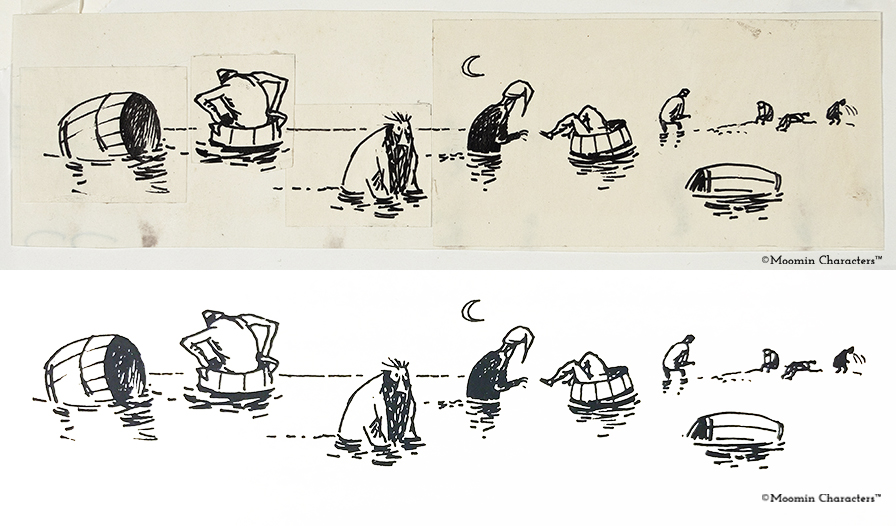
 Some of Tove Jansson’s illustrations for Tolkien’s Hobbit book were created by combining several images.
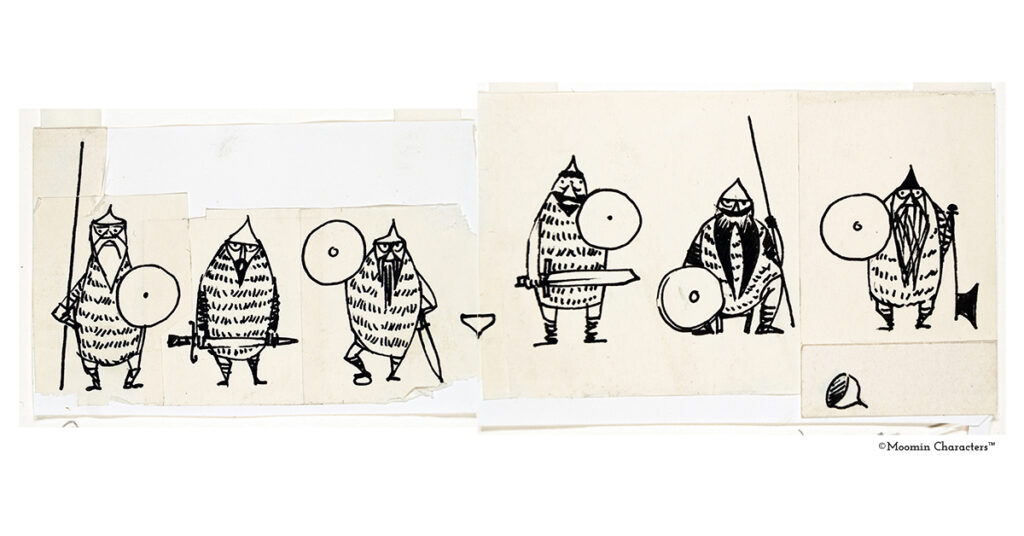 Illustrations by Tove Jansson for the Swedish edition of Tolkien’s The Hobbit
In her illustrations in Bilbo – en hobbits äventyr, Jansson concentrated on the landscapes, she was not as interested in the characters of the story. She even made some of the characters especially tiny to elevate the landscapes. The illustrations consisted more of her impression of the story than literal repetitions, which many Tolkien fans found unsatisfying. According to them, Jansson overlooked many of the central characteristics of the characters. This was one of the reasons why the book did not become so popular, even though the editor Astrid Lindgren had sensed that the book would be the children’s book of the century.
The unanimity between Tolkien’s text and Jansson’s inner world was clearly a reason for the concentration on the landscapes and locations of the story in her illustrations. Jansson saw an opportunity to illustrate the horror of the story, she liked to dramatise catastrophes. In the full page illustrations, Jansson relied on her familiar way of illustrating. Still, she edited the pictures many times to avoid them being too much like the Moomin illustrations. However, the readers saw the illustrations as more Jansson like than truly Tolkien like.
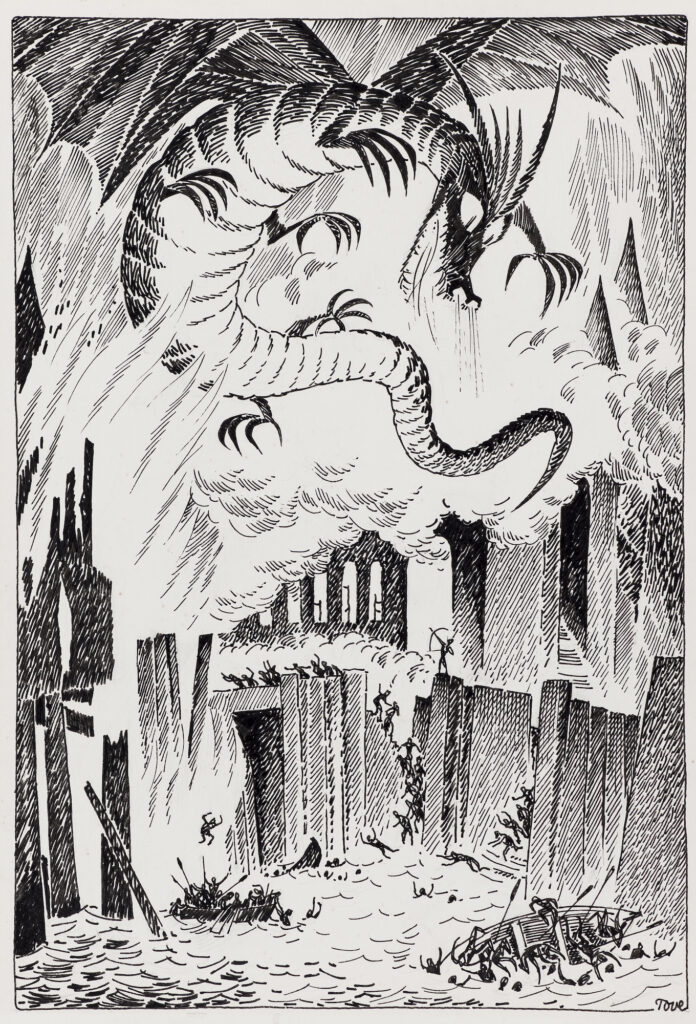 Tove got the chance to realise her own ”horror hobby” in the illustrations of dramatic scenes.
A new book on Tove Jansson’s illustrations contains as much as 106 pictures
In a new book in English, Tove Jansson is presented as a multi-faceted artist with the help of beautiful pictures and inspiring texts. The book is written by comics expert and non-fiction author Paul Gravett and published by Thames & Hudson. Tove Jansson’s life-long production was vast, but in the book, the author concentrates specifically on her illustrations. Paul Gravett writes in his new book about Tove Jansson: ‘Her Gollum towered monstrously large, to the surprise of Tolkien himself, who realized that he had never clarified Gollum’s size and so amended the second edition to describe him as ‘a small,
slimy creature’.
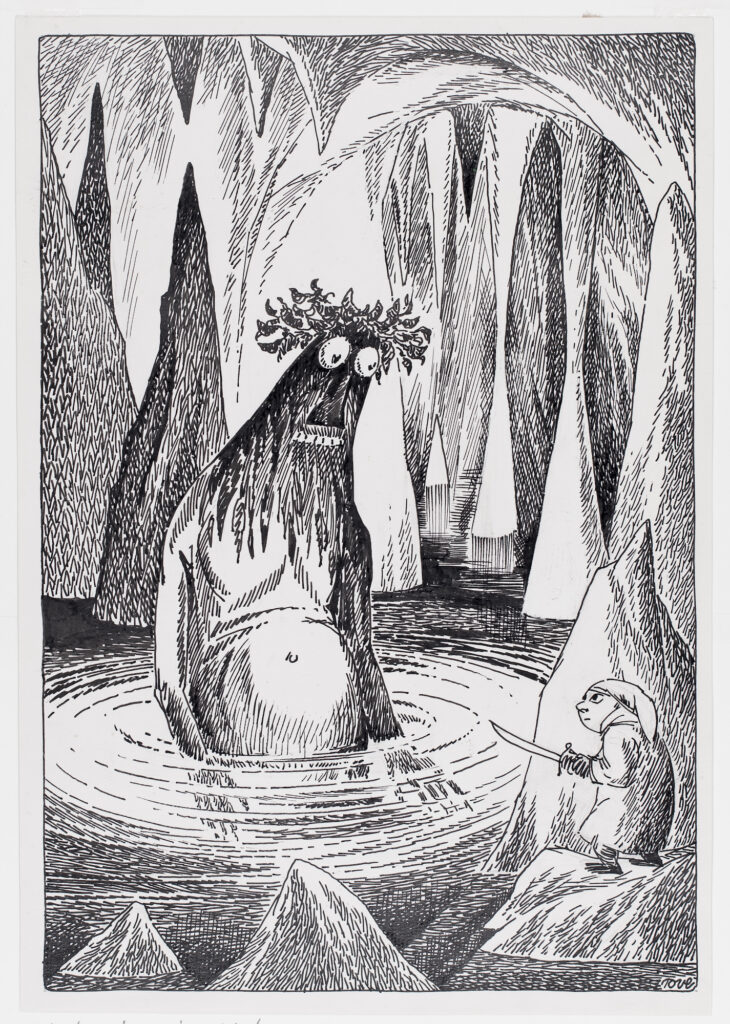 Jansson drew Gollum as massive. The flower wreath on the head of the character was also a familiar sight on the head of Tove Jansson, e.g., during the celebration of birthdays.
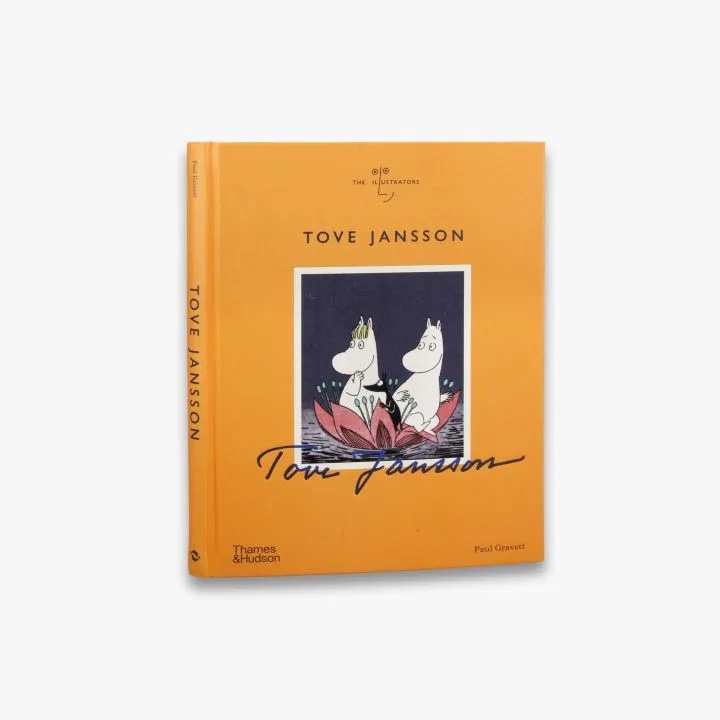 Paul Gravett’s Tove Jansson was published by Thames & Hudson in 2022
Tove Jansson’s illustrations for the Swedish translation of the Hobbit were also used in the Finnish translation Hobitti – eli Sinne ja takaisin. That is why Tove Jansson wrote in 1992 to the chairman of the Finnish Tolkien Society: ”For me it was an adventure to get the chance to illustrate The Hobbit.”
Read more about Tove Jansson’s illustrations for Alice in Wonderland.