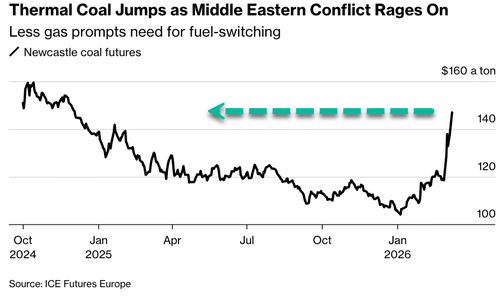
Asian benchmark Newcastle coal prices jumped more than 9% to $150/ton (as per BBG data) at the start of the week, as energy flows across the Gulf area remain disrupted and transit through the Strait of Hormuz has significantly slowed. The rise in coal prices is being driven by a broader energy shock, with surging gas prices making coal a more economical substitute fuel for power generators.

Last week's IRGC kamikaze drone attack, which shuttered Qatar's massive LNG export facility - responsible for roughly 20% of global supply - has been the driving force behind gas-to-coal switching, especially in Europe, as gas prices have soared 50%.
Samantha Dart (Global Co-Head of Commodities Research) penned a note late this weekend on natural gas:
"European natural gas prices (TTF) closed the week up 88% from pre-Iran-conflict levels, at 53 EUR/MWh. For context, approximately 20% of global liquefied natural gas (LNG) volumes flow through the Strait of Hormuz, largely produced by Qatar, and no reroutes exist. This flow is 100% halted at the moment, with Qatari production fully down following a drone attack.
We base-case that Qatari LNG production will be restored by early April, and we have accordingly raised our April TTF forecast to 55 EUR/MWh, well into the 45 EUR/MWh (fuel oil) to 71 EUR/MWh (diesel) gas-to-oil switching range because we think increased fuel switching away from gas will be required to normalize European gas storage ahead of the next winter. We have not changed our 21 EUR/MWh 2027 TTF forecast. In a scenario where the Qatari supply shock lasts over 1 month, we would expect TTF prices to rally further to the mid-70 EURs/MWh, where diesel is currently priced, to incentivize further switching. A scenario where the shock lasts longer than two months would likely lift TTF above 100 EUR/MWh to incentivize broader industrial demand destruction across Europe and Asia."

Notice that Exhibit 2 above shows TTF is already in the coal-switching range. The rest of Dart's note can be read here.
In a separate note, UBS analyst Manik Narain warned of EM energy risks if the Hormuz chokepoint remains clogged:
"EM Asia appears most directly at risk, accounting for ~73% of oil shipped through the Strait of Hormuz. 40-70% of India, Korea and Thailand's oil supply transits this route; while Thailand and Taiwan generate 45-60% of electricity from gas, indicating potential price risks to tech and other industrial supply chains if the conflict doesn't abate soon."
The duration of the conflict is key because higher NatGas prices will only spur continued gas-to-coal switching.
UBS highlighted that EM power generation in countries such as Mexico, Thailand, and Taiwan remains heavily exposed to oil and gas, leaving electricity systems vulnerable as fuel prices surge. Taiwan stands out, given its major role in the global AI chip supply chain, meaning rising power costs there could have implications far beyond domestic electricity markets.

Related:
Operation Epic Fury has been one way to 'Make Coal Great Again'...
Loading recommendations...