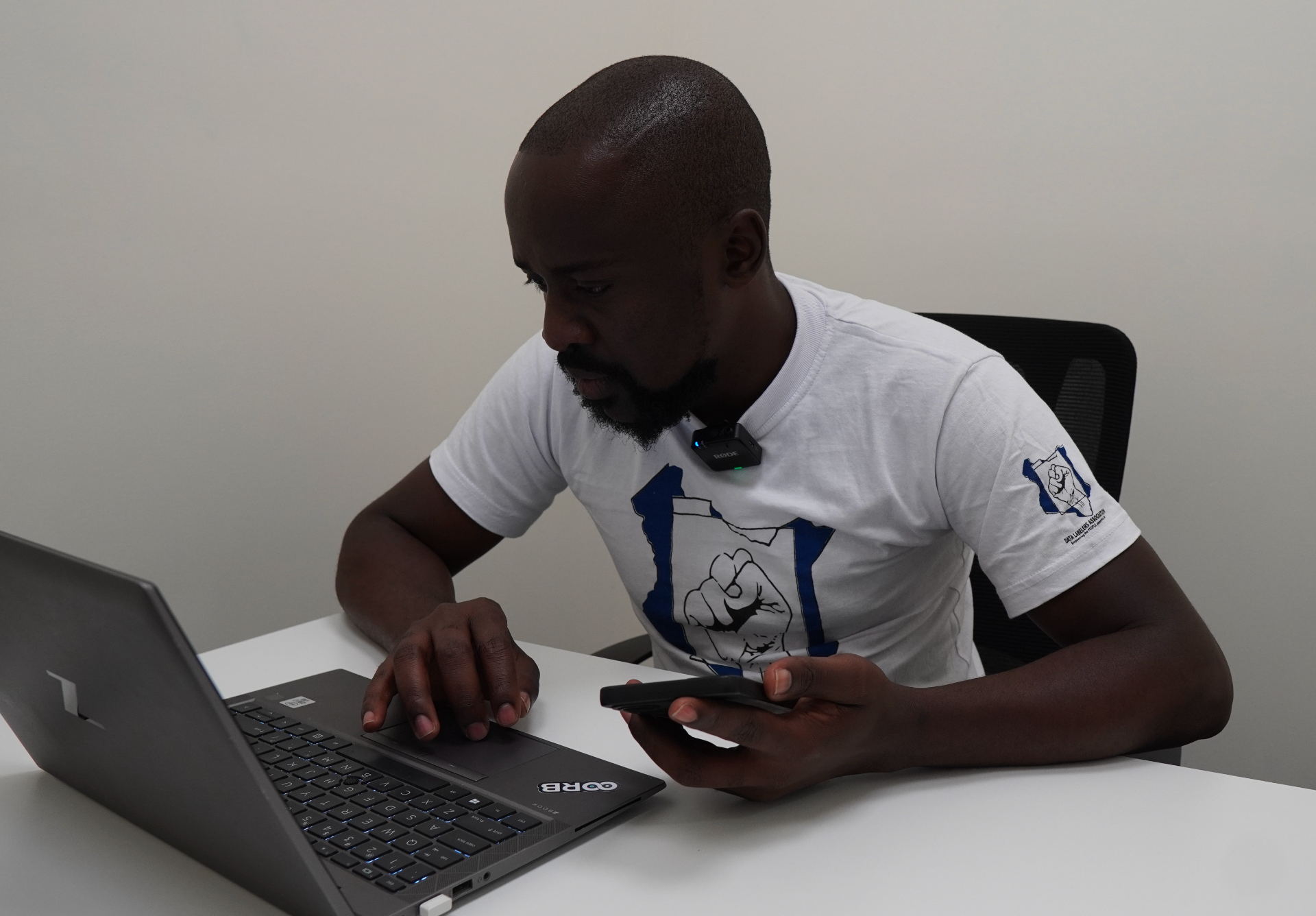
Every day, Michael Geoffrey Asia spent eight consecutive hours at his laptop in Kenya staring at porn, annotating what was happening in every frame for an AI data labeling company. When he was done with his shift, he started his second job as the human labor behind AI sex bots, sexting with real lonely people he suspected were in the United States. His boss was an algorithm that told him to flit in and out of different personas.
“It required a lot of creativity and fast thinking. Because if I’m talking to a man, I’m supposed to act like a woman. If I’m talking to a woman, I need to act like a man. If I’m talking to a gay person, I need to act like a gay person,” he told me at a coworking space I met him at in Nairobi. After doing this for months, he, like other data labelers, developed insomnia, PTSD, and had trouble having sex.
“It got to a point where my body couldn’t function. Where I saw someone naked, I don’t even feel it. And I have a wife, who expects a lot from you, a young family, she expects a lot from you intimately. But you can’t, like, do it,” Asia said. “It fractured a lot of things for me. My body is like, not functioning at all.”
Asia eventually hit a breaking point and stopped working for AI companies. He is now the secretary general of a Kenyan organization called the Data Labelers Association (DLA) and the author of “The Emotional Labor Behind AI Intimacy,” a testimony of his time working as the real human labor behind AI sex bots. As part of the DLA, Asia has been working to organize workers to fight for better pay, better mental health services, an end to draconian non-disclosure agreements, and better benefits for a workforce that often earns just a few dollars a day. Data labelers train, refine, and moderate the outputs of AI tools made by the largest companies in the world, yet they are wildly underpaid and haven’t benefitted from the runaway valuations of AI companies.
Last month, the DLA held one of its largest events at the Nairobi Arboretum, sign up new members, and to help them tell their stories.
These workers are required to stare at horrific content for many hours straight with few mental health resources, are largely managed by opaque algorithms, and, crucially, are the workers powering the runaway valuations of some of the richest and most powerful companies in the world.
💡
Do you know anything else about data labeling or the human labor behind AI? I would love to hear from you. Using a non-work device, you can message me securely on Signal at jason.404. Otherwise, send me an email at [email protected].
“You can’t understand where you’re positioned if you don’t understand your history,” Angela, one of the day’s speakers, told the workers who had assembled there (many of the speakers at the event did not give their full names). “When you think of colonialism, we were under British Imperial East Africa Company […] so literally, we are working under a company. We are just products, part of their operation. Stakeholders, we can say, but we are at the bottom of the bottom.”
“These multinationals are coming to rule and dominate here,” she added. “It’s a very unfortunate supply chain, and my call today as data labelers is to build up on this—as we are fighting for labor rights, we are also fighting for the environment […] we are fighting big companies. We are fighting the British imperialist companies of today. It’s Apple, it’s Meta, it’s Gemini. Those are the ones we’re still fighting. It’s a call for solidarity and expanding our thinking beyond what we are doing, beyond our labor.”
In my few days in Kenya earlier this year, where I was traveling to speak at a conference about AI and journalism, it was immediately clear that data labelers make up a significant portion of the country’s tech workforce. Nearly everyone I spoke to there had either been a data labeler (or a content moderator) themselves or knows someone who has. Leaving the airport in Nairobi, you immediately drive by Sameer Business Park, an office complex that houses Sama, a San Francisco-headquartered “data annotation and labeling company” that has contracted with Meta, OpenAI, and many other tech giants. Sama has been sued repeatedly for its low pay and the fact that many of its workers suffer PTSD from repetitively looking at graphic content. For years, a giant sign outside its office read: “Samasource THE SOUL OF AI.” My Uber driver asked why I was going to a random office building in Nairobi’s Central Business District—I told her I was going to interview a data labeler. “Oh, I do data labeling too,” she said.