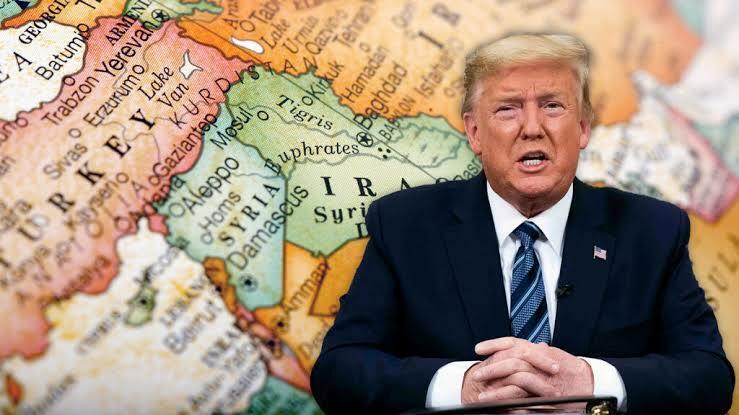
Fresh reports suggest that at least some Gulf states are now egging on the US-Israeli bombardment of Iran, hoping that the Islamic Republic's significant ballistic missile can be blunted forever, after countries from Bahrain to UAE to Saudi Arabia have been target of literally thousands of drones and missiles since Operation Epic Fury began.
"This is not a military exchange. This is an attack on a peaceful nation, a nation that has been working diligently and very hard for diplomacy," Sultan al-Jaber, the U.A.E. minister of industry and advanced technology, was quoted by The Wall Street Journal as saying. Jaber stressed, "Any long-term political settlement must address the full spectrum of threats, including Iran’s nuclear program, ballistic missile capabilities, and their network of regional proxies."
And yet, Israel and the US now extending their aerial attacks to Iran's oil infrastructure has immediately resulted in Iran declaring that it will in turn target oil fields and infrastructure among America's Gulf allies.
As these easily predictable steps on the escalation ladder continue to play out, China is ignoring President Trump's request to help reopen the Strait of Hormuz for vital global oil transit. What Beijing has made clear, however, is that it wants all parties to cease hostilities in an military engagement it believes should have never started.

One analyst, Ali Wyne, senior research and advocacy adviser for US-China relations at the International Crisis Group, has stated: "President Trump’s request to delay his long-awaited summit with President Xi Jinping underscores how significantly he underestimated the fallout from Operation Epic Fury."
"A show of US force that was meant to intimidate Beijing has instead served to puncture the illusion of US omnipotence: Unable to reopen the Strait of Hormuz alone, Washington now needs its principal strategic competitor to help it manage a crisis of its own making," Wyne concludes. So as things stand:
"Arab states are egging the US on to continue its strikes to cripple Tehran so it can never attack anyone again. Europe, with Russia and China, is calling for an immediate ceasefire." - Rabobank
According to more from Rabobank:
After Trump’s appeal for allies to help reopen Hormuz, and no one stepping up, the president was reportedly livid, launching public invective that the US can’t rely on its allies when needed and will proceed with them, also suggesting there’s little point to NATO.
Ominously, the same was implied by the more moderate (in terms of US alliances) Senator Graham. Once this war is over, win or lose, there are likely to be serious geopolitical and geoeconomic consequences and realignments - indeed, that looks the deliberate target.
However, there's another obvious overlooked angle here - and it's where Trump's own rhetorical style starts to have direct repercussions. NATO allies see him saying the US has already 'won' in Iran (which he's declared several times verbally and in Truth Social posts). Trump has also moved between berating NATO allies and proclaiming Washington doesn't actually need their help at all.
Trump could not have been any more emphatic when he posted on the following on Tuesday:
“Because of the fact that we have had such Military Success, we no longer ‘need,’ or desire, the NATO Countries’ assistance — WE NEVER DID! Likewise, Japan, Australia, or South Korea,” Trump writes.
“In fact, speaking as President of the United States of America, by far the most powerful country anywhere in the world, WE DO NOT NEED THE HELP OF ANYONE!”
If there had been any European leaders in fact sitting on the fence and seriously contemplating a decision to commit warships to a US coalition in the Persian Gulf, the above statement alone would be enough to convince them to go the other direction, also not wanting to risk the lives of their nation's men and women in uniform. On top of this is the typical real-time mission creep on display, which has been a clear pattern of all prior major US wars in the Middle East.