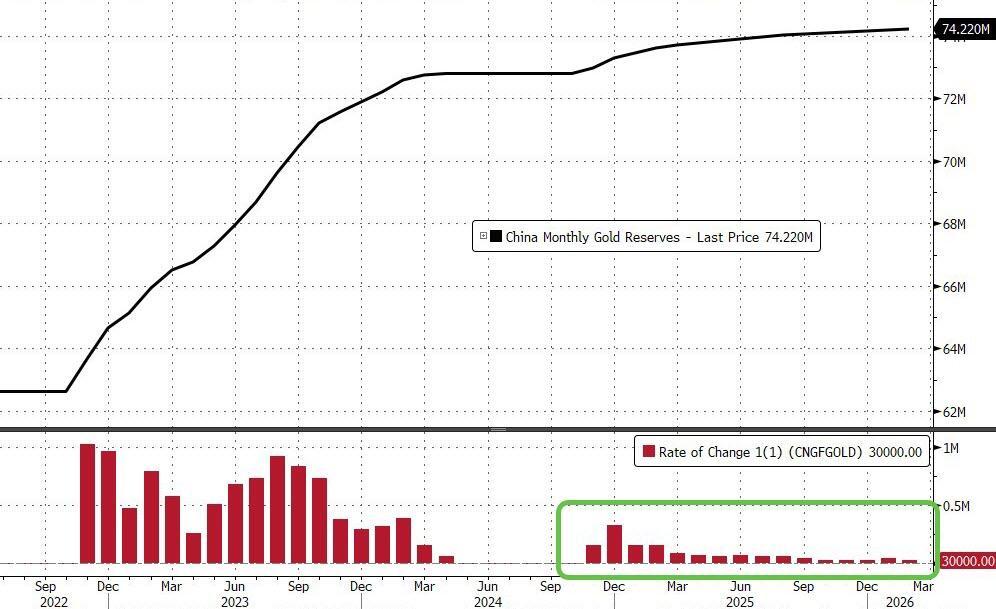
For the 16th month in a row, China bought gold into reserves in February even as bullion prices hovered near record highs.
The People's Bank of China (PBOC) added another 30,000 troy ounces last month, lifting official reserves to approximately 2,309 metric tonnes (74.22 million ounces), valued at $388 billion.
This represents roughly 9-10% of China’s total foreign reserves.
At this pace, China is closing in on the top global holders (still behind US ~8,133t, Germany ~3,352t, but climbing fast).

Since November 2024, the PBOC has increased its gold holdings by a total of 1.4 million ounces.
Central banks are not alone, as CoinTelegraph's Martin Young reports, retail gold purchases have tripled over the last six months, while Wall Street selling has accelerated over the past four months, according to data from the Bank for International Settlements (BIS).

“Retail-driven exuberance,” increasingly channeled through exchange-traded funds (ETFs), “set the stage for outsize moves,” continuing the precious metal rally from 2025, reported the BIS in a quarterly review released on Monday.
Since Q2 2025, retail investors have bought around $70 billion in gold ETFs, and these purchases have more than tripled over the last six months, observed the Kobeissi Letter, citing BIS data on Thursday.
“Retail investors are all-in on precious metals,” it noted.
Gold has surged 60% over the past year, and some crypto proponents have speculated it has come at the expense of Bitcoin, which some argue competes with gold as a store-of-value asset.
BIS data shows cumulative retail inflows effectively tripled from around $20 billion to roughly $60 billion over the six months from late Q3 2025 to the end of Q1 2026.
However, institutional selling started around mid-November and accelerated after the precious metals market began to correct in January, according to the data.

Bitcoin is not the only asset susceptible to high volatility from overleveraged positions.
Prices of precious metals such as gold and silver reversed abruptly in late January and February 2026, while the “daily rebalancing of leveraged ETFs and margin‑triggered liquidations amplified the swings,” particularly in silver, BIS reported.
Smaller speculative derivatives traders, or “non-reportables,” had built up heavily leveraged long positions in silver heading into the crash, it added.
Gold prices are in 'correction' currently, down over 16% from its record highs in January.
The abrupt price drop and the spike in precious metal volatility “point to the role of retail flows, and amplification of price moves due to forced sales by leveraged ETFs, trend-following investors such as commodity trading advisers, and margin dynamics,” BIS stated.