By Benjamin Picton, Senior Market Strategist at Rabobank
Look To America
US equity indices closed lower yesterday but were comparative outperformers against European and Asian counterparts, which were roundly brutalized. The relative performance of equity markets reflects what is happening in oil markets, where the law of one price is being strained by a complete dearth of oil in Asia, a shortage of oil in Europe, and relative abundance in North America. The spread between West Texas crude and the more international Brent crude is now at its widest level since the Covid demand shock of 2020.
At the risk of stating the obvious, the oil market is experiencing unprecedented tightness; the Brent prompt spread is current 4.55 sigma from the long-run mean. Dramatic as this is, it probably understates the severity of the situation in Asian markets where the loss of Gulf cargoes is being felt most acutely. The Wall Street Journal is today reporting warnings from Saudi Arabia that oil prices could spike as high as $180/bbl if disruptions persist into late April, and Reuters reported yesterday that Australia – a net energy exporter, but not of oil – is buying record volumes of products from ExxonMobil, BP and Vitol shipped from the United States.
Usually, Australia buys most of its oil products from Asian countries - especially Singapore. There’s a neat historical parallel here because 75 years ago Australian PM Curtin announced that “Australia looks to America” after the fall of Singapore to the Japanese. This time Australia is looking to America after the fall of the Singapore refining industry and confirmation overnight that the US will not be imposing export bans on oil. This will suit Donald Trump’s trade agenda and his efforts to corral tremulous allies just fine.
Speaking of which, it seems we are once again seeing signs that US allies may soon be doing things that only days ago they were indicating they would not do. Britain, France, Germany, Italy, the Netherlands and Japan have issued a joint statement condemning Iranian attacks on oil and gas infrastructure and the de factor closure of the Strait of Hormuz, while also saying that they are ready to “contribute to appropriate efforts to ensure safe passage through the Strait”.
It’s not immediately clear what this means. Presumably this is not declaring an intention to surrender and acquiesce to Iranian demands to pay a toll on commercial transits, so the most plausible interpretation seems to be that we are witnessing the formation of an international coalition backing American efforts re-open the Strait to shipping. This as news also emerged yesterday that a second US amphibious assault group is now headed to the Middle East, the Pentagon has asked Congress for $200m to fund the war, and as Benjamin Netanyahu said that “there has to be a ground component” to ensure the fall of the Islamic regime.
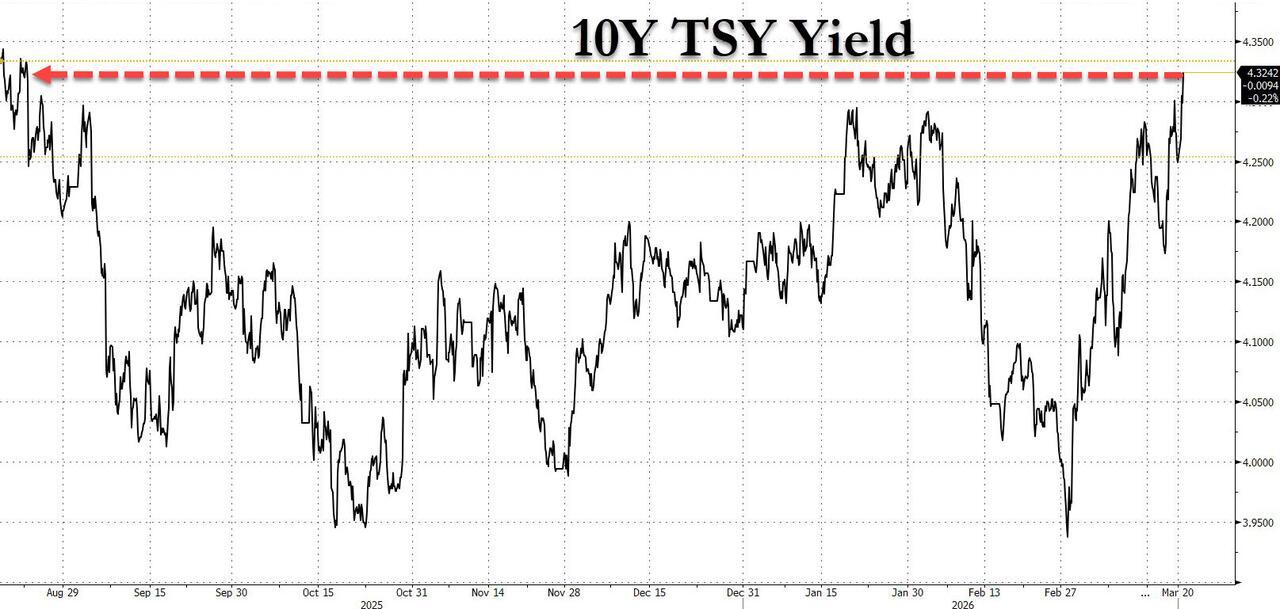
This all sounds like escalation, and bond markets are beginning to fret over the outlook for inflation as predictions over the duration and severity of the supply shock slide further towards the severe end. The Australian 10-year yield rose to its highest level since 2011 but the largest moves are happening at the short end of the curve where the two year yield is now up to 4.69%. Overnight index swaps currently imply a further 70bps worth of policy rate tightening in Australia this year, on top of the 50bps already delivered in February and March. UK 10-year gilt yields rose 11bps yesterday to 4.84% and 2-year gilt yields lifted by an astonishing 30bps.

The Bank of England and the European Central Bank both left policy rates unchanged yesterday, but were clearly hawkish in tone. The BoE said that it was “ready to act” if inflation pressures intensify, while also pointing out that existing slack in the economy means that the starting point for this energy shock is different to 2022. The ECB dropped references to being “in a good place” and reiterated its determination to ensure that inflation stabilises at 2% over the medium term, while making stagflationary updates to its economic projections. RaboResearch has now incorporated a rate hike as early as April in our BoE forecast, and a hike in April with the potential for a summer follow-up for the ECB.
In a meeting with Japanese PM Takaichi at the White House yesterday Donald Trump said that Japan had offered “tremendous support” in the war and reportedly indicated that he would be singing Japan’s praises when he meets with Xi Jinping in Beijing later this month. This is likely to be interpreted as a bolstering of the US-Japan partnership, coming as it does in the context of recent tensions between China and Japan over Taiwan.
Indeed, the China subtext behind recent U.S. policy actions is clear to anyone paying attention. Yesterday, the co‑founder of Supermicro and two other employees were indicted in New York for allegedly violating U.S. export controls by smuggling NVIDIA chip servers into China. On the same day, Trump and Takaichi announced a joint action plan on critical minerals aimed at reducing China’s dominance in global supply chains.
Meanwhile, U.S. Treasury Secretary Scott Bessent suggested that the United States may “un‑sanction” Iranian oil currently on the water that would have otherwise been destined for China, arguing that Beijing has been effectively funding a leading state sponsor of terrorism by purchasing discounted Iranian crude. According to Bessent, removing sanctions would lift Iranian oil prices to market levels and redirect flows away from China and toward other Asian countries who have been “good actors”. That’s as Netanyahu says that oil pipelines from the Arabian Peninsula to Israeli ports should be built in the future to prevent the world from being held hostage by a Hormuz blockade ever again. Needless to say, such a move would be an enormous re-alignment in favour of Washington and its allies.
So, while markets understandably continue to trade based on the day’s headlines, the bigger picture is that the global order is shifting under our feet and ultimately determining the price action. Oil is scarce, alliances are hardening, and central banks are preparing for a world where supply shocks might be structural rather than temporary. Hard power is being used alongside economic statecraft to achieve strategic aims. As our Global Strategist Michael Every is fond of asking: “if lines on a map can move, how much more can lines on a Bloomberg screen move?”