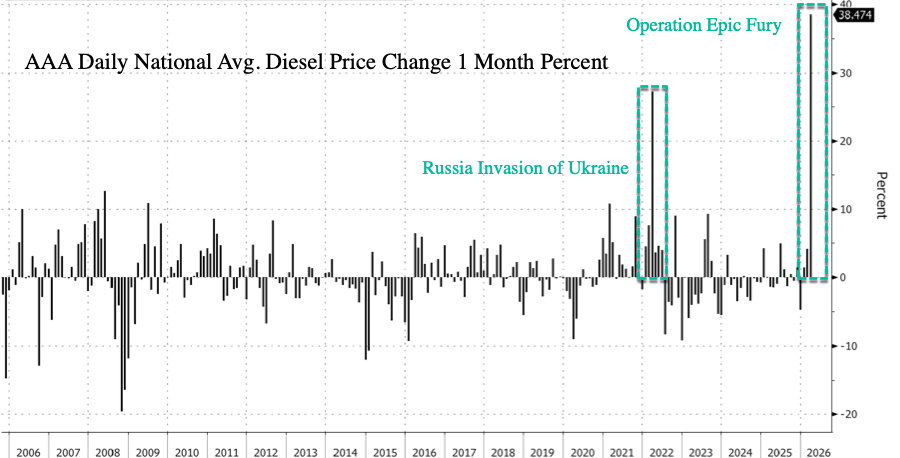
The latest AAA fuel data from across America shows that the national average diesel price at the pump has jumped nearly 40% this month, surpassing the 2022 fuel spike that followed Russia's invasion of Ukraine.

Surging diesel prices are already generating a shock across trucking, rail, shipping, farm equipment, construction machinery, generators, and much of industrial logistics, given that the fuel powers the core of the economy.
Seasonality: AAA Daily National Avg. Diesel 2022 vs. 2026

Companies now face three difficult choices if they did not lock in fuel prices before the spike: absorb the impact and accept margin compression, add surcharges, or raise prices.

Last week, Rapidan Energy's Director of Refined Products, Linda Giesecke, told us that, "unlike 2022, the current tightness reflects physical supply disruptions rather than policy risk and trade reshuffling."
Giesecke warned that if the fuel spike proves prolonged, global economic growth could suffer because of diesel's close link to industrial production and freight activity.
BloombergNEF forecast that $5-per-gallon diesel could inflict a weekly $6 billion or more hit on the US economy because these surging fuel costs hurt truckers, construction firms, and farmers the hardest. With prices at $5.2 as of Friday, that weekly hit is set to rise next week.

Readers are already aware of the dire consequences of spiking diesel prices, as we've laid out in recent weeks (see here & here).
Adding more color to the fuel that underpins nearly every stage of production and transport is a Bloomberg report warning that small businesses are sounding the alarm over surging fuel costs.
Here's one example of a small business being financially crushed by surging fuel costs:
Roger Conner sells firewood for a living, but he might know just as much about another energy source: diesel. The fuel powers every step of the supply chain for his company, RC Conner Enterprises: the megatrucks that carry the logs from suppliers to his facility in Exeter, New Hampshire; the machines that offload and process those logs into kiln-dried residential and restaurant-grade firewood; and the trucks that deliver the finished bundles and cords to customers across New England. In a normal year, Conner spends roughly $6,800 a month on diesel. Now it's about $11,000. To absorb some of the cost, he's added a 5% fuel surcharge; when customers saw that, several walked away.
If diesel keeps rising, "we're going to have to keep going up on our pricing, but we probably won't have any sales," says Conner, 50. "This is going to cripple our economy. I don't think people think about how much the economy rides on diesel fuel."
Across the trucking industry, fuel costs are the second-largest expense after driver pay for carriers, according to Bob Costello, the American Trucking Associations' chief economist. He said that even in non-crisis periods, carriers carefully manage fuel consumption because small changes in diesel costs can erode profit margins.
Surging fuel costs are already pushing up freight rates (e.g., barge transport up 27%) across the economy, leading to fuel surcharges from carriers such as UPS, FedEx, and USPS.
Joe Brusuelas, chief economist at tax consulting firm RSM US, told the outlet that a 10% rise in diesel could lift the CPI by .1%, potentially adding .4%, given the nearly 40% spike in diesel prices this month alone.
The Trump administration is doing a delicate balancing act while attempting to neuter IRGC forces while ensuring domestic fuel prices do not spike out of control. The administration has pulled two of what JPMorgan analysts say are six levers to combat triple-digit WTI prices; those two levers pulled so far include an SPR release and a waiver of the Jones Act to ensure that crude flows from emergency stockpiles move more quickly from port to port.
On Friday, President Trump hinted at "winding down" the Iran war, as CENTCOM on Saturday morning announced its biggest move so far to free up the Hormuz chokepoint by degrading IRGC forces with air-delivered munitions. The administration's current goal is to ensure Hormuz reopens to avert what the IEA head warned last week could be the world's largest energy shock on record.