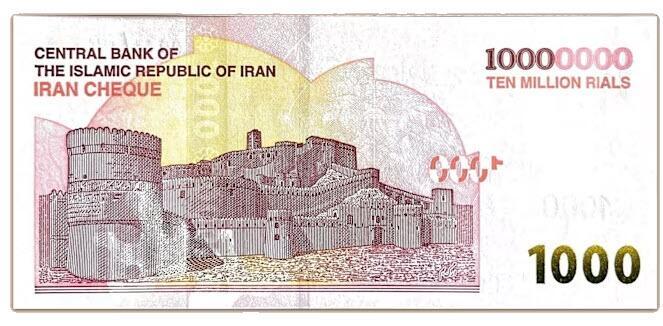
As the Iran war rages, Tehran has rolled out a new 10 million rial banknote, its highest-ever denomination, as authorities seek to "manage" soaring inflation and meet demand for hard cash... but mostly to "manage" soaring inflation, similar to how Venezuela would add a new 0 to its currency every week in the late days of the Maduro ergime before everyone simply gave up.
Banks, which have been targeted on at least one occasion by Western strikes, began distributing the new note this week, which is worth about $7, as Iranians waited in long lines at cashpoints to withdraw currency over fears electronic systems could fail. Many quickly ran out.
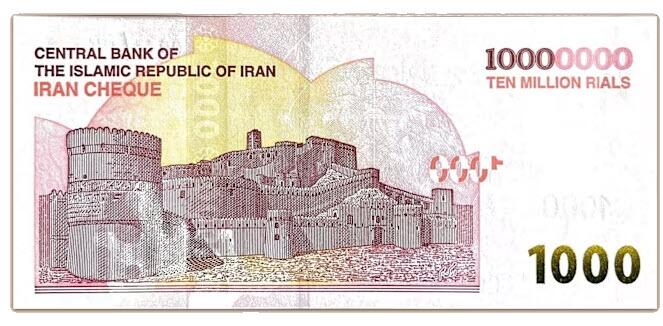
The new pink banknote features a vignette of the 9th-century Jameh Mosque of Yazd, while the back displays an image of the 2,500-year-old Bam Citadel. It is now the highest denomination in circulation, overtaking the 5mn-rial note introduced in early February, which at this rate will be equal to roughly $1 USD in a few weeks.
Iran’s central bank said that the bill was introduced “to ensure public access to cash”, adding that electronic systems - including debit cards, mobile and internet banking - would continue to serve as the main platforms for financial transactions, at least until the Mossad cripples all domestic electronic payments.
Yet despite government assurances of a continuous supply of cash after the war broke out, banks are providing limited currency to clients seeking to withdraw funds.
“I waited my turn for an hour and the clerk said he could only give me 10mn rials. But when I made a fuss, telling them I had no money and needed cash, I got 30mn instead,” Maryam, an 80-year-old resident of Tehran, told the FT this week. “It’s not much but it can sustain me for a few days if the debit cards stop working.”

The new bill is the latest indication of how Iran’s economy is collapsing as the war enters its fourth week.
The US and Israel have targeted infrastructure including a major bank, adding to the strain for businesses already impacted by the constant bombardments and indefinite closure of Iran’s airspace. Imported items have become more expensive as trade routes have closed.
A building of Bank Sepah, which serves Iran’s armed forces alongside the wider public, was hit by a missile on March 11, further compounding public worries.
The bank said on Wednesday that access had been restored, allowing clients to use their cards for in-store shopping and at ATMs. Online banking services, it said, would resume soon.
The economy was already under strain from years of US sanctions, declining oil revenues, persistently high inflation and systemic corruption - factors that have resulted in a steep devaluation of the rial. The currency had lost 40% of its value in the months that followed Israel’s 12-day war in June last year, with the economic malaise fuelling mass protests in January that were crushed in a brutal crackdown that killed tens of thousands
It weakened further to a record low of 1.66mn rials per US dollar ahead of the start of the latest war on February 28, but had strengthened to about 1.5mn as of Friday.
Iran's annual inflation was 47.5% in the month ending February 19, according to Iran’s statistical agency, but the true inflation is said to be orders of magnitude higher.
Food and drink inflation surged to above 105% in the same period, after the government eliminated subsidized foreign currency for essential imports. Instead it started a food voucher program that grants 80mn Iranians monthly credit to purchase staples at designated stores.

In November, Iran introduced a law to slash four zeros from the rial over a five-year period in an effort to simplify transactions and reduce the cost of printing money. On the new 10 million rial note, the final four zeros appear faintly while 1,000 is also printed in bold. This style, used for all new banknotes printed since 2019, is designed to help the transition.
Banknotes printed in Iran in recent years mainly showcase historical monuments. Some of the older, smaller banknotes depict Ayatollah Khomeini, the founder of Iran’s revolution.
Demand for cash is usually already high at this time of year before Nowruz, the Persian new year, when many Iranians gift money to children and family members.
The recent strengthening of the rial comes as foreign trade has reduced, Iranians have cancelled overseas trips and people in need of cash for urgent expenses exchange their foreign currency.
“Only those who have sold property or a car and don’t want to keep their money in rials are buying foreign currency,” one foreign exchange broker in Tehran said. “On the other hand, supply has also decreased a lot. Only those who urgently need money in these conditions are selling their foreign currency.”