Istanbul has never been a city with water to spare. For most of history, water everywhere was not only a necessity but also a marker of status, a matter of discipline, and often an aesthetic pursuit. That’s why, when you look closely at the story of coffee in the Ottoman world, you don’t find only roasted seeds, copper cezves, and foaming cups—you also encounter an unexpectedly refined culture of water. Even today, as specialty coffee digs into water hardness, alkalinity, and pH, it’s tempting to think that some of our “scientific instincts” are, in a way, echoes of the same land.
The arrival of Turkish coffee is usually told like this: beans from Yemen first enter the palace, then the public’s daily life; by 1554, with the opening of coffeehouses in Tahtakale, coffee becomes a drink that sets the social rhythm of Istanbul. But for the palace, coffee was never merely something to drink. At Topkapı, coffee was a performance, complete with dedicated staff, protocol, and ritual. The kahvecibaşı (chief coffee maker) and the attendants under his command worked in seamless order: braziers, roasting pans, finely grinding bronze mills, elegant ewers, and cups housed in silver zarfs. And behind this entire stage—more decisive than one might expect for the era—one quiet element shaped everything: water.
From the beginning of the 16th century, it is thought that the main source of brewing water for the palace was Gümüşsuyu, in the Eyüp district. This was no ordinary spring. At its head stood a special corps of bostancıs known as the Gümüşsuyu Ocağı, tasked solely with drawing water there and delivering it to the palace. Water was filled into large leather waterskins, carried by boat to Sarayburnu, then delivered directly to the Coffee Room at the palace.
In other words, the sultan’s coffee water was not scooped at random from any palace fountain. It was brought from a specific point in the city, through a specific system, by people employed for that single purpose. If we watch a modern barista grind a particular farm’s coffee on a particular grinder and brew it with a custom water recipe as ritual, the Ottoman system for water reads like an early (and surprisingly disciplined) version of the same logic.
The choice of Gümüşsuyu had both practical and cultural roots. It is no coincidence that the valley where Gümüşsuyu lies was known in Ottoman times as a valued mesire, an outing place associated with flower gardens and fruit trees. Among Istanbul’s waters, this one was considered sweeter, clearer, and lighter. Even its name, paired with silver, carries an association: in the Ottoman imagination, silver was not only a sign of wealth but also of cleanliness.

Silver ewers, cups in silver holders, silver sets—these objects carried prestige and the idea of hygiene at the same time. The line “Come, drink the water of life at Gümüşsuyu,” engraved on the inscription of a fountain commissioned by Sultan Abdülaziz, suggests that this water was treated as medicinal and life-giving. So bringing the sultan’s coffee water from Gümüşsuyu wasn’t only a practical reflex of “use the best water,” but also an extension of the spring’s symbolic value.
What becomes truly fascinating is how that water was transported to the palace, and how the method of transport may have preserved what people believed was its quality. In the Ottoman world, water carriers known as sakas moved water from Eyüp in large leather skins called kırbas. Leather, by nature, is porous and prone to holding odors; with prolonged contact, it can introduce flavor transfer and microbial risk.

To manage this, craftspeople lined the inside of the kırbas with tar or pitch (katran/zift), sealing the pores of the leather, improving waterproofing, and reducing the chance that the leather would give the water a smell. That dark lining may even have had a practical benefit beyond waterproofing, helping the water hold up better on the journey. In other words, the wisdom of the vessel mattered nearly as much as the purity of the source.
Inside Topkapı Palace, coffee preparation resembled a small laboratory. There were large brass braziers that held stable heat for long periods; ewers that kept hot water ready; bronze mills that could grind freshly roasted beans to a fine powder; and coffee jars made of rosewood or walnut, inscribed with writing.
The way foam behaved at the boil, how the grounds settled in the cup, how bitterness rounded, how clean the aroma felt—every one of these outcomes was shaped by water. When we talk today about Turkish coffee bars benefiting from water that isn’t overly calcareous, with lower alkalinity and a pH close to neutral, it’s not hard to imagine palace kitchens arriving at a similar ideal—not through meters and test kits, but through repeated trials, tasting, and a lived archive of experience.
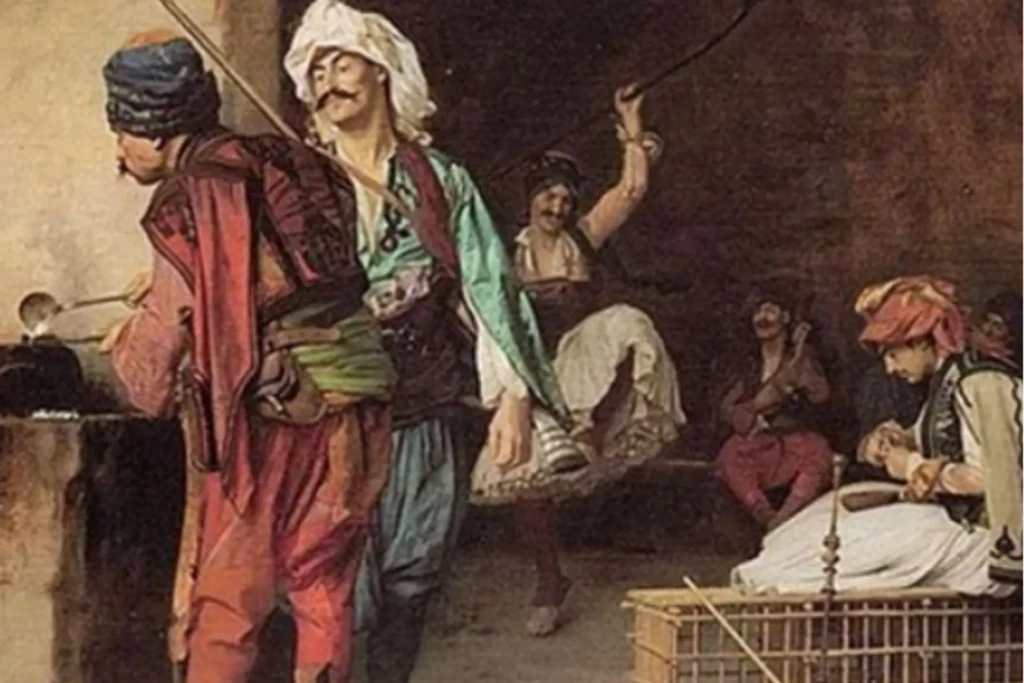
Coffee service itself was stagecraft. The coffee pitcher would be set inside a sitil, a brazier-like vessel with chains for carrying, holding ash or embers to keep heat steady. Sitils were made of tombak, silver, or brass, then decorated with satin or silk, embroidery thread, sequins, or sometimes even pearls and stonework.
During service, one person carried the cups and another carried the sitil set. A third took the porcelain cup, poured coffee from the pitcher, set the cup into a holder made of gold, silver, tombak, or porcelain, and offered it to the guest, held delicately from the base with two fingers. The spectacle was grand, but its quiet lead actor was still water.
Water is indispensable to coffee’s presentation as well. In Ottoman tradition, Turkish coffee is almost always served with a glass of water: first the water, to neutralize the mouth, then the coffee. The practical explanation is to clean the palate so the coffee’s aroma can be perceived more distinctly. But when it comes to the sultan’s coffee, this water is not merely a palate cleanser. It is the backbone of the ritual.
The palace took this distinction seriously. The organization responsible for carrying water from Gümüşsuyu appears to have operated with strict oversight; the bostancıbaşı supervised, and the kahvecibaşı placed that water at the heart of the Coffee Room.
Perhaps this is why, when we move through modern coffee bars with TDS meters, debate mineral recipes, and adjust alkalinity with droppers—arguing even over the ions in the water—we are continuing an old reflex: for good coffee, take water seriously first. The selection of Gümüşsuyu for the sultan’s coffee is not merely a charming historical anecdote. It reads like the trace of an intuitive understanding of purity of taste, the weight of water, and health.
That invisible line running from Gümüşsuyu in Eyüp to Topkapı’s Coffee Room is a small piece of history that whispers something we often forget: water has far more say in coffee than we like to admit. And perhaps the real secret of Turkish coffee is not in the foam rising in the cezve, but beneath it—in the story of water carried, protected, and honored over centuries.
Duygu Kurtuluş is the co-founder of Meet Coffee Lab in Istanbul. This is Duygu Kurtuluş’s first feature for Sprudge.