Authored by Chris Morrison via DailySceptic.org,
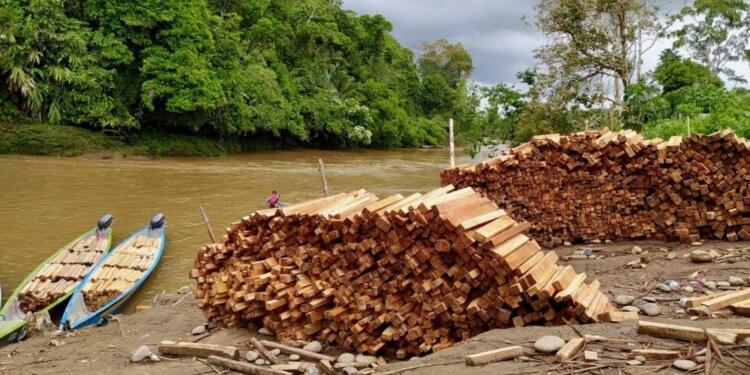
Over half a million balsa hardwood trees are being illegally logged in the Amazon rainforest every year to feed the massive demand for wind turbines in many parts of the world. Balsa is a lightweight but strong wood that is commonly used in the core of giant turbine blades. It can make up around 7% of the blade and each set of three can use up to 40 trees.

This discovery is a genuine shock and follows an exclusive investigation by the Daily Sceptic. It adds to the huge ecological toll that the ‘green’ wind turbines are taking on the natural environment.
These inefficient, unreliable, unsightly monsters require a large footprint on land and sea, kill millions of bats, decimate raptor populations, sweep the air of quadrillions of insects and alter local ecology on both land and sea.
Nobody would install one in a free market, so they require vast financial subsidies to produce expensive electricity.
Given what is known about annual balsa production, the scale of illegal logging and the demands of wind turbine manufactures, it is not difficult to arrive at a possible Amazon forest yearly loss of over half a million trees. Most commercial balsa is exported by Ecuador and it has produced approximately 500,000 cubic metres annually in recent years, or about 80,000 metric tonnes. Around 55% of production is thought to end up in wind turbines and each group of three requires about 10.5m3 a set. Each set requires about 40 trees so annual balsa consumption for wind turbines equates to 1,047,619. Balsa is a relatively fast growing tropical wood and until the soaring demand from turbines kicked in, it was harvested in sustainable plantations. But since the turn of the decade, this sustainable harvest cannot keep up with demand. In a damning survey, the Environment Investigation Agency (EIA) found that exports were boosted by up to 50% following illegal logging in virgin rainforest.
Halve the turbine consumption of 1,047,619 trees and the illegal logging amounts to around 523,810 mature specimens. This figure is likely to be controversial so the Daily Sceptic has shown its workings-out in full. But any substantial annual cull is horrific, and far outstrips the one-off loss of 100,000 tropical rainforest trees logged to build a convenient road for delegates attending the recent ‘save the forest’ COP30 meeting in the Brazilian city of Belém.
Blind eyes are of course turned to the illegal logging, and have been for some time.
In 2020, it was reported that 20,000 balsa trees were illegally felled between March and September in the Achuar indigenous territory along Ecuador’s Copataza River. Other reports refer to intense illegal logging, with some estimates noting the removal of 75% of the trees in some areas.
The EIA report that was published in 2024 was damning. Investigators toured many of the illegal logging sites and charged that most, if not all, exporters turned to natural forests as a “convenient and immediate replacement” when plantations were quickly depleted of older trees. The areas under attack were noted to be some of the last intact forest landscapes in the country. They were said to be unique protected areas and emblematic indigenous territories. Traders are said to have told the EIA that the logging of balsa was taking place “from north to south across most of the Amazonian provinces of the country”. It is estimated that at least 50% of production is currently being supplied by these illegal means. Blending of plantation wood with illegal logging is thought to vary between 10% to 70% depending on the exporter.
The EIA report gained little mainstream media or political attention when it was published, although the body is an established NGO, founded in the UK in 1984 with offices in the UK and Europe. For the narrative-driven mainstream, this type of upsetting news is simply too hot to handle.
However there have been attempts by turbine manufactures and supporters to suggest that balsa is being replaced in parts of the turbine core by various synthetic polymer foam substitutes. This is true, but balsa remains in popular use due to its excellent strength-to-weight ratio. Hybrid designs are said to have become more common, with balsa used in high-shear and other critical areas. In these areas it still holds an advantage over foams. But overall production figures suggest wind turbines are still using a great deal of the wood. Ecuadorean production is said to have spiked around 2020 with a previous sustainable total of 33,000 tonnes rising to 75,000, driven by Chinese turbines manufactures. It is a little difficult to get exact production figures but sources such as the EIA and UN Comtrade suggest exports of 80-100,000 tonnes in 2021, 60-80,000 in 2022, and 50-80,000 in 2023 and 2024.
After the spike, production has stabilised but at levels that can only have been possible by massive looting of the rainforest. It is obvious that a great deal of this is supported by huge increases in Chinese wind turbine manufacture. Overall figures for both domestic and export production are not available in one place, but credible estimate suggest monetary total of $8-12 billion in 2021 has risen to nearly $16 billion in 2024 with the projection for 2025 edging towards $18 billion.
The annual loss of balsa trees in virgin rainforests is unnecessary ecological rape traceable back to ideologues driving a hard-Left Net Zero fantasy. The Daily Septic has attempted to put an annual number on the loss using known figures. Our workings-out are supplied so others, if they wish, can contest our assumptions and maths and arrive at different conclusions. But few will be able to cover up the fact that there are very significant and continuing annual illegal logging balsa losses.