March 23, 2026 | Breaking & Developing
What Happened
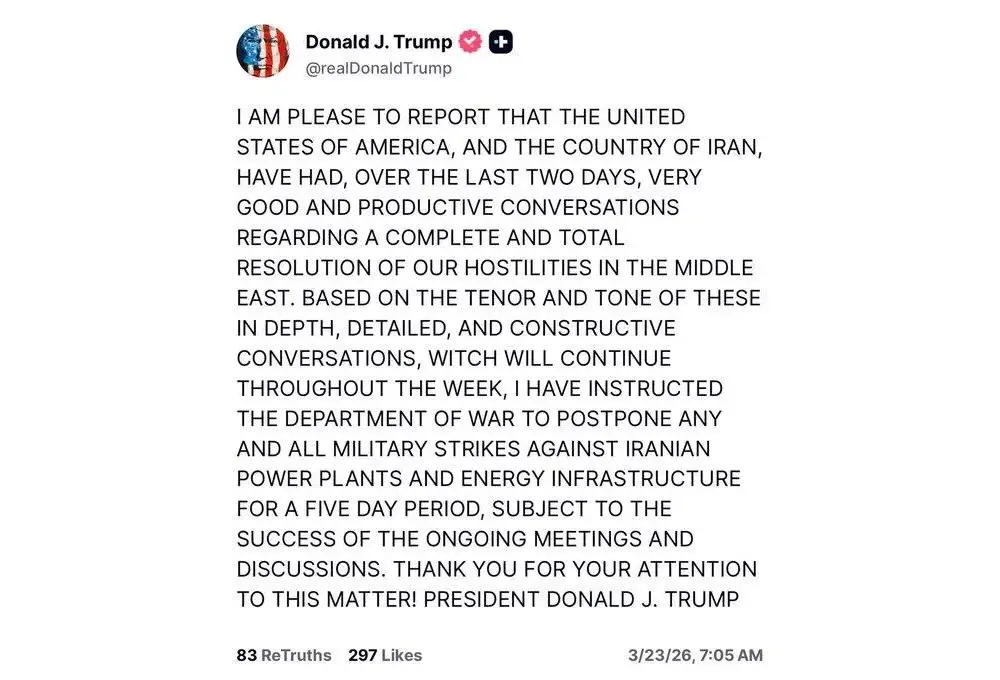
Market sentiment shifted dramatically toward optimism on Monday morning after President Donald Trump posted on Truth Social announcing a significant de-escalation in the US-Iran conflict. Trump stated that the US has had "good and productive conversations" with Iran and that he would order the military to postpone any and all military strikes against Iranian power plants and energy infrastructure for five days.
In his characteristic all-caps style, Trump wrote: "I AM PLEASED TO REPORT THAT THE UNITED STATES OF AMERICA, AND THE COUNTRY OF IRAN, HAVE HAD, OVER THE LAST TWO DAYS, VERY GOOD AND PRODUCTIVE CONVERSATIONS REGARDING A COMPLETE AND TOTAL RESOLUTION OF OUR HOSTILITIES IN THE MIDDLE EAST. I HAVE INSTRUCTED THE DEPARTMENT OF WAR TO POSTPONE ANY AND ALL MILITARY STRIKES AGAINST IRANIAN POWER PLANTS AND ENERGY INFRASTRUCTURE FOR A FIVE DAY PERIOD."
The postponement is explicitly conditional — "subject to the success of the ongoing meetings and discussions" — and conversations between the two countries are expected to continue throughout the week.
Background: How We Got Here
The announcement comes just hours before a critical deadline. Trump had given Tehran a 48-hour ultimatum on Saturday evening to reopen the Strait of Hormuz — the critical trade route through which approximately 20% of the world's oil passes — threatening to target Iran's energy infrastructure if the demand was not met.
Iran has effectively blockaded the strait since the US and Israel launched coordinated attacks on the country on February 28, sparking swift retaliation from the Islamic Republic and triggering a wider regional war.
Iran refused to back down. Iranian military spokesman Col. Ebrahim Zolfaqari warned that "if Iran's fuel and energy infrastructure is attacked, then fuel, energy, information technology systems and desalination infrastructure used by America and the regime in the region will be struck." The Iranian parliament speaker went even further, warning that "critical infrastructure, energy and oil across the region will be irreversibly destroyed and oil prices will rise for a long time" if US strikes proceeded.
The Human and Military Toll So Far
Iran's death toll in the war has surpassed 1,500, according to its health ministry. In Israel, 15 people have been killed by Iranian strikes, with more than a dozen civilians killed in the occupied West Bank and Gulf Arab states.
Over the weekend, Iran launched missiles at the southern Israeli cities of Dimona and Arad — areas close to Israel's main nuclear research center. The Israeli military reported around 180 people injured, some severely. Prime Minister Netanyahu called it "a very difficult evening" for Israel. Netanyahu later said it was a "miracle" no one was killed.
Market Reaction
The de-escalation announcement triggered immediate and sharp moves across global markets:
- Crude Oil: West Texas Intermediate (WTI) futures fell 8% to $90.10 per barrel, while Brent crude dropped roughly 8% to $103.91 per barrel.
- Equities: Stock markets rallied, though they remain below pre-war levels as investors weigh the conditional nature of the pause.
Global Context
The conflict has rattled the global economy. The International Energy Agency warned that the global economy faces a "major threat" and that the current energy crisis is worse than the oil shocks of the 1970s.
In response to soaring prices, the Trump administration temporarily lifted sanctions on some Iranian oil, a move Treasury Secretary Scott Bessent said was expected to quickly add about 140 million barrels to the global oil market. The sanctions relief applies to Iranian oil currently loaded on ships and will last until April 19, 2026.
China also weighed in: China's special envoy to the Middle East, Zhai Jun, stated that non-military targets, including energy infrastructure, "must not be attacked," adding: "This is a war that should never have happened."
What to Watch
- Whether Iran reciprocates with restraint or continues Strait of Hormuz pressure during the five-day window
- The outcome of the ongoing US-Iran diplomatic conversations this week
- Oil prices, which remain highly volatile and well above pre-war levels
- Any response from Israel, which has been conducting its own strikes independently
This is a rapidly developing story. Key details may change.