Submitted by Thomas Kolbe
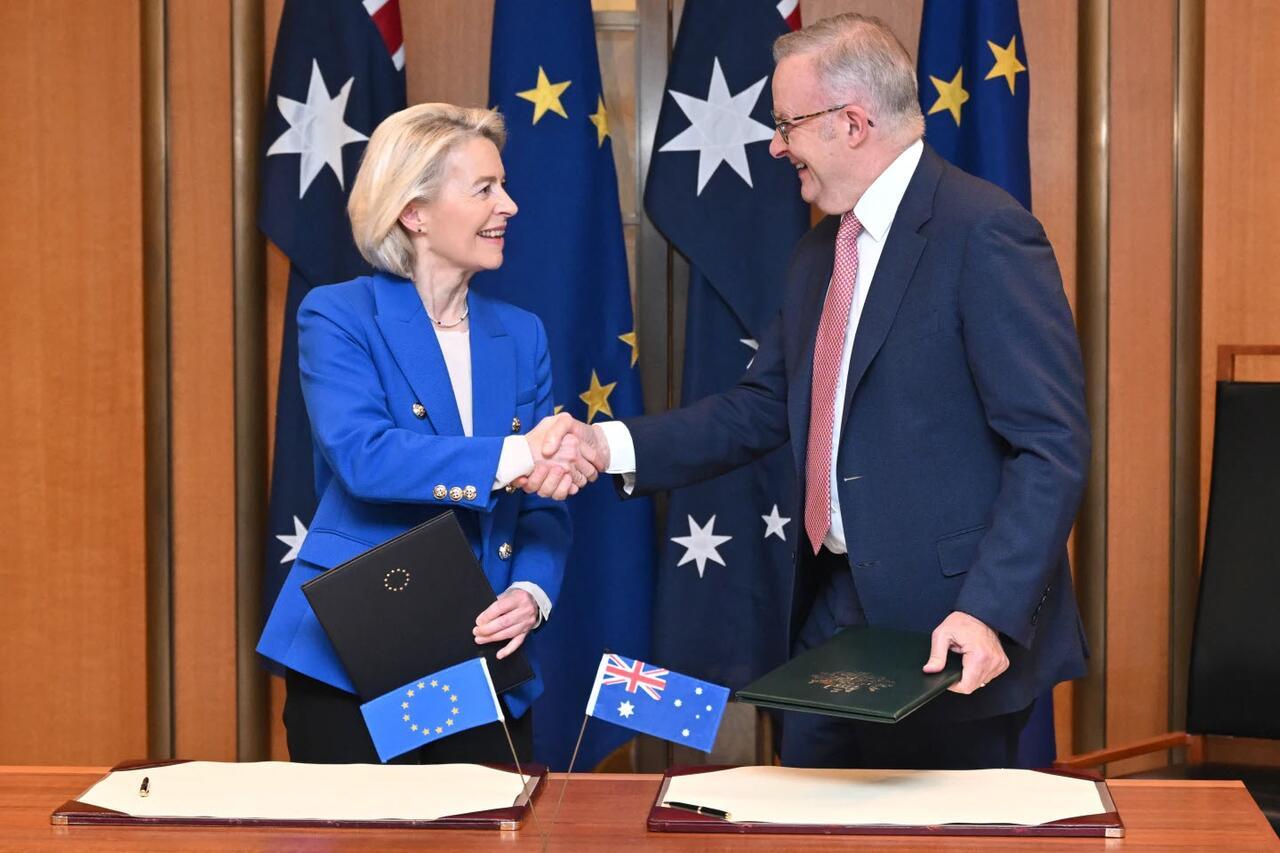
It took an astonishing eight years before the European Union and Australia were able, at the beginning of the week, to agree on a joint trade agreement. What EU Commission President Ursula von der Leyen and Australian Prime Minister Anthony Albanese presented in Australia’s capital Canberra represented a far-reaching reduction of direct tariffs over a medium-term period.
Over 90 percent of goods will be able to circulate freely between the two continents, of course always under the application of common harmonization regulations and, above all, European climate protection rules. This must be taken into account in every so-called free trade agreement. The regulations do not disappear for businesses. In the case of agreements with the EU, they are largely extended to the trading partners.
In every trade agreement where the European Union is a signatory, Brussels tries to weave massive climate protectionism into global trade. In a sense, a kind of postmodern climate colonialism. That is the concept of free trade as Europeans practice it.

The agreement to be signed is expected, according to participants, to increase EU exports to Australia by up to one third and expand investments by European companies in Australia by up to eighty percent. The strategic direction is clear: the EU is attempting to free itself in the critical area of raw materials, such as rare earths, from China’s grip. And Australia indeed has a rich catalogue of resources to offer.
Trade agreements like the one with Australia follow a very clear strategy. On one side, awareness seems to be growing of supply issues caused by the Iran war. On the other side, European industry is pushing to open new sales markets and strengthen the relative competitive position of companies, which have been under heavy pressure in Germany’s industrial heartland, especially during the energy crisis.
Clearly, Brussels is ready to combine gains in manufacturing with a corresponding reduction of protectionist rules in agriculture. This creates potential conflict, as seen with the EU’s Mercosur agreement with the South American countries Argentina, Uruguay, Paraguay, and Brazil in recent weeks.
The agreement, following a similar spirit to the one with Australia, is provisionally set to take effect in May. This occurs despite major political players such as France and Italy already announcing strong opposition to the pact, which will particularly place European farmers—and thus European agriculture—under severe competitive pressure, since South America follows a very different regulatory framework than the EU.
In the case of the Australian agreement, there was largely calm on this front; the Australian market is too small for the potentially imported volumes of beef, which are to be quota-shipped to Europe, to cause major concerns.
From the perspective of the German economy, the Australian trade contract can be roughly outlined as follows: while the crisis sectors of the automotive industry, mechanical engineering, and the chemical industry will benefit from a radical reduction of Australian import tariffs, the EU will gain access to rare earths, cobalt, and lithium mined in Australia and must accept that beef production will increasingly reach the European market.
Ultimately, Australia accounts for only around one percent of EU trade. The country ranks twentieth among the EU’s most important trading partners.
And yet, it is a small step toward freeing itself from China’s grip, which, as seen last year, does not hesitate for a moment to leverage its geopolitical tools in raw materials like rare earths, positioning its politically controlled export engine in trade policy.
Diversification is everything. Building reserves is all the more important, as we know today, given dwindling gas storage and missing petroleum reserves.
Strategic reserves are a political acknowledgment of reality. The fact that European policy once allowed itself the luxury of prioritizing climate ideology and transformational fantasies over real-world necessities now exacts a bitter price.
Trade competitors such as China or the United States hold reserves in fundamental areas of energy and raw materials that can secure the supply for the economy and society for more than a year. Acute crises, such as the current closure of the Strait of Hormuz, thus appear comparatively easier to manage and control.
Fundamentally, European trade policy must follow this path. It must clearly focus on the strategic interests of its own economy and overcome ideological missteps if it still wants to save what can be saved in the severe crisis of European industry.
Supply chains and the fundamental supply of raw materials and energy must be central topics on the European political agenda. Reintegration of Russia as a gas supplier, the development of domestic resources—whether fracking gas, North Sea gas, or domestic coal deposits—should buy time to develop a pan-European nuclear strategy, which would take many years.
As long as these considerations are not incorporated into a comprehensive overall strategy, the Australian trade agreement remains piecemeal—a small, hardly relevant move on the geopolitical chessboard, dominated by the Washington-Peking duopoly.
* * *
About the author: Thomas Kolbe, a German graduate economist, has worked for over 25 years as a journalist and media producer for clients from various industries and business associations. As a publicist, he focuses on economic processes and observes geopolitical events from the perspective of the capital markets. His publications follow a philosophy that focuses on the individual and their right to self-determination.