By Michael Every of Rabobank
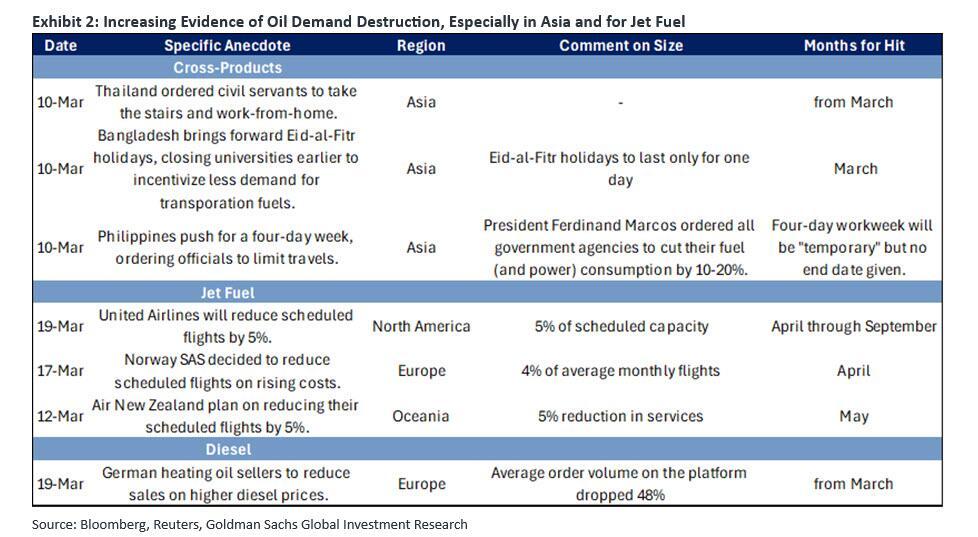
Today starts with markets in a positive mood, stocks up in Asia, bond yields down slightly, and Brent oil down around 7% to $97.5. Yet don’t screen yourself from reality. As underlined before, the price of energy on a screen currently has no relation to its actual availability in different forms in certain geographies. The Philippines just declared a national emergency to conserve fuel; South Korea is curtailing private driving; Slovenia has introduced rationing; and the boss of Shell is quoted saying Europe will face fuel shortages within days (see "Where Demand Destruction Is Greatest ").

Iran, via its parliamentary speaker Ghalibaf, whom the US is now negotiating with, also makes this clear: “We are aware of what is happening in the paper oil market, including the firms hired to influence oil futures. We also see the broader jawboning campaign. But let’s see if they can turn that into "actual fuel" at the pump - or maybe even print gas molecules!”
That said, Iran has stated “non-hostile” ships can now transit Hormuz if the vessels co-ordinate with it. That would mean this crisis is essentially already over, albeit with Iran de facto taking control of Hormuz as a toll-way: only the US and Israel are ‘hostiles’, and they don’t use the Strait. But haven’t we seen this on our screens before? Did you notice any change in energy flows?
Indeed, looking at your screens won’t tell you what’s going to happen in this war. For example, the New York Times reports Saudi’s MBS is still pushing Trump to continue fighting due to the “historic opportunity” to remake the region; officially, Saudi rebuts these claims. Israel says it backs any US efforts to start talks with Iran but privately feels otherwise - and Israel is hitting Russian-Iranian weapons smuggling routes in the Caspian Sea, expanding the war to a new geography that links it back to the one in Ukraine.
Positively, and showing official denials don’t mean much, the US is negotiating with some in Tehran - though do they speak for a fracturing regime? It has sent a 15-point plan to end the war, according to Reuters, with Ghalibaf and foreign minister Araghchi reportedly told they won’t be killed while talks are ongoing(!) The first round is pencilled in by Thursday in Pakistan: Iran just said they don’t want to talk to Witkoff and Kushner, preferring anti-neocon VP Vance.
However, both sides’ starting positions are: ‘We won, you surrender.’ The US is offering a one-month ceasefire, with Iran: dismantling its nuclear capabilities; vowing to "never seek" nuclear weapons; stopping the enrichment of nuclear material; delivering its enriched uranium to the IAEA; decommissioning and destroying Natanz, Isfahan and Fordow; granting the IAEA full access; stopping funding and arming its proxies; stepping back from its ballistic missile program, keeping them only for defence; and promising to keep the Strait of Hormuz open. This is in return for US support for the development of a civilian nuclear program in Bushehr and lifting all sanctions. By contrast, Iran is demanding an apology from the US, reparations for wartime losses, guarantees against future US or Israeli military action, the removal of US military bases in the region, no restrictions on its ballistic missile program, no shift in its proxies approach, and formal control over the Strait of Hormuz.
Where is the workable compromise?
Yet, again, is there more going on in reality? What Iran says its positions are may not be what they actually are – and the same could be true for the US, to a lesser extent, given the deal on the table is a more muscular version of the much-derided Obama-era JCPOA.
In that regard, Trump says Iran has given the US a gift “worth a tremendous amount of money” which isn’t nuclear, but energy related: what might that be? Trump says it shows he is “dealing with the right people.” That implies the wrong people are there too, so Iranian factions are forming, which implies any deal may not hold for everyone who can shoot a missile or drone.
Iran is singing “Won’t get fooled again” over the negotiations. After all, new US military power allowing for boots on the ground will arrive in Hormuz after markets close on Friday. What position does the US intend to take? Doing nothing? Or seizing Iran’s enriched uranium? Or Kharg island, which wouldn’t reopen Hormuz, but would stop most Iranian oil flows, choking the regime while exacerbating the global energy crisis? Or smaller islands in and parts of the shoreline of Hormuz to ensure the Strait reopens? Inaction is pointless, but all actions risk Iran escalating against Gulf energy facilities. Or could the ‘gift’ Trump referred to be linked in some way, e.g., “Kharg-a-Lago”? Maritime expert John Konrad also floats an addition to his earlier hypothesis that the unstated US aim here may be to not reopen Hormuz and use the leverage it achieves as a result. Pick a US position, then pick a market position, then watch your screen.
Meanwhile, it’s not exactly quiet elsewhere:
- The USS Nimitz aircraft carrier, on its last hurrah, is to be sent to SOUTHCOM (LatAm) not CENTCOM (the Middle East): does that point to geopolitical action in that region - like Cuba?
- The EU said it won’t reverse its Russian gas ban or slow down its green transition, despite the current crisis – but a Russian oil import ban has suddenly dropped off of Brussels’ short-term agenda.
- The EU’s enlargement chief said the bloc needs to change its rules to enable a new wave of countries to join and called on member states to present their own plans after they rejected proposals by the Commission to streamline the process.
- EU lawmakers told the US to give up trying to change EU tech rules as the UK wants to bring back 76 EU laws, according to the Telegraph: new legislation is planned to allow Labour to transfer Brussels powers back onto the UK statute book.
- Germany’s VW is in talks with Israel’s Iron Dome maker to shift from making cars to missile defences in one of its factories, which underlines the shift in political economy underway. So does Anduril and Palantir developing the US Golden Dome missile shield’s software.
- Denmark’s centre-left PM won her snap election with 38% of the vote and is now trying to put together a new coalition, but notably the far-right Danish People’s Party rose to 16%, continuing a similar trend seen in many European polities.
- The US is reportedly looking at trying to reform the WTO along its own lines rather than just ignoring it entirely. But for now, world trade revolves around what happens in Hormuz far more: no bunker fuel, no ships carrying cargo, not much trade at all.