Authored by Nick Giambruno via InternationalMan.com,
When Zimbabwe makes the news, it’s rarely for good reasons.

There’s a good reason for that.
The country has spent years in a state of perpetual crisis.
Hyperinflation obliterated its currency and decimated the economy.
Yet beneath the surface lies extraordinary wealth.
Zimbabwe is rich in natural resources: gold, platinum, diamonds, and some of the most fertile farmland on Earth.
That’s what led me to organize a research trip there about 10 years ago alongside legendary investor Doug Casey.
We also sat down with Gideon Gono, the former head of the central bank, who made everyone “trillionaires.”

From left to right: Nick Giambruno, Doug Casey, Gideon Gono
Gideon Gono was Zimbabwe’s central bank chief during the infamous hyperinflation of 2008–2009.
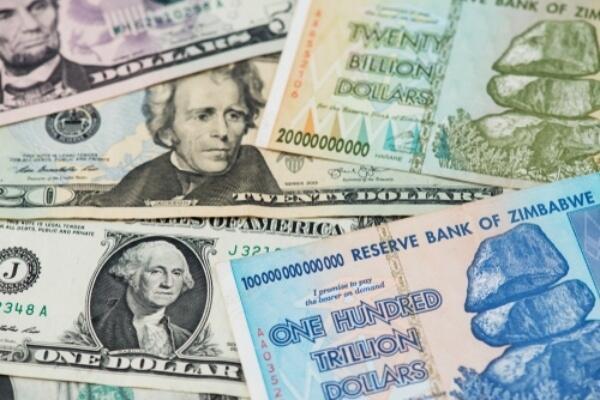
His signature appears on the now-iconic 100-trillion-dollar Zimbabwe note—the highest denomination of any currency ever printed.

Today, that bill is completely worthless… except as a novelty or collector’s item.
During our meeting, Gono recounted his impossible position as Zimbabwe’s central banker in the 2000s.
The country was flat broke—and it needed to pay the army.
In any country, failing to pay the military spells trouble. But in Africa, it almost guarantees a coup.
So when the Zimbabwean government ordered Gono to print money to pay the army and its other bills, he obeyed. There was no alternative.
He described it as “being in a car without gas,” yet being ordered to drive from point A to point B.
Everyone—Gono included—knew exactly where this was headed.
You didn’t need to be a financial genius to understand that printing currency to fund soaring deficits would end in hyperinflation.
And that’s exactly what happened.
The Gono episode lays bare the uncomfortable truth about central banks.
Central banks were never truly “independent.” It was always an illusion—a societal myth. They exist to siphon wealth from the public through inflation and funnel it to the politically connected.
What Gono did is no different from what the Federal Reserve is doing right now.
Just as the Zimbabwean central bank’s independence was always a sham, so too is the Federal Reserve’s. It’s a mirage—and it’s now fast disappearing.
Even establishment stalwarts like the Bank of England have explicitly recognized this. Here’s what they recently wrote:
“Central bank operational independence underpins monetary and financial stability. A sudden or significant change in perceptions of Federal Reserve credibility could result in a sharp repricing of dollar assets, including US sovereign debt markets, with the potential for increased volatility, risk premia and global spillovers.”
The Federal Reserve maintained its mirage of independence for over 110 years. But that’s changing as an increasingly imminent debt crisis forces the US government to fund itself more explicitly through the Fed’s printing presses.
Trump is simply doing what any leader in his position would do. No one believes China’s central bank is independent of Xi. If any nation faced a similar situation, its central bank would fall in line with government demands for easy money.
What is happening in the US is not that different from what happened in Zimbabwe—or in any other country where government finances became desperate. They always turn to the central bank to print currency to help finance their spending.
As the issuer of the world’s reserve currency and the most powerful government in the world, the US can extend the charade of solvency longer than any other entity on the planet. However, even the mightiest empires in human history couldn’t do so indefinitely—especially once they begin to struggle to service their debt.
One of the most potent and underappreciated forces responsible for the downfall of the most powerful empires throughout history has been debt.
While military defeats, political upheavals, and external invasions often dominate historical accounts of the fall of great powers, excessive debt—the “Empire Killer”—has quietly but relentlessly eroded the foundations of empires across the centuries.
From Rome to the Soviet Union, the over-extension of resources, poor financial management, and the inability to service massive debts have led to economic collapse, social unrest, and, ultimately, the demise of these once-mighty empires. The same pattern is playing out in the US right now.
In short, the US government cannot stop spending, which means deficits cannot stop growing, which means more debt must be issued, which means the government leans on the central bank to help ease the debt burden, which means the illusion of central bank independence evaporates.
And once that happens, ever-increasing currency debasement becomes unstoppable. That’s where we are today. But it won’t end with just higher prices. Capital controls, people controls, price controls, tax hikes, wealth confiscations, and countless other destructive government interventions are all on the menu.
The Gideon Gono story isn’t just a Zimbabwean cautionary tale—it’s a clean, unvarnished look at what happens when a government hits the point of no return and the central bank’s “independence” gives way to political necessity.
That same endgame is now advancing in the US, and when the “reset” phase arrives, the biggest losses will hit those who wait for official confirmation.
To help you prepare, I’ve put together a free special report, The Most Dangerous Economic Crisis in 100 Years… the Top 3 Strategies You Need Right Now, outlining the key trends unfolding now, what they could mean for your money and personal freedom, and the three strategies to consider immediately. Click here to download the free PDF.