Authored by Peter C. Earle, Ph.D,
Artificial intelligence may well be the most important technological development of the coming decade-and that is exactly why the current capital surge around it warrants skepticism. History is littered with transformative innovations that were nonetheless disastrously overbuilt and mispriced in their early phases. Austrian Business Cycle Theory was never a children’s story in which every boom ends with clowns, ashes, and worthless machinery; its real claim is subtler and nastier. When the price of time is falsified-when interest rates are pushed below their natural rate-often proxied, however imperfectly, by modern estimates of the neutral rate-entrepreneurs are encouraged to undertake projects that are more roundabout, more capital-intensive, and more time-sensitive than underlying saving and final demand can actually support. The neutral rate is a policy construct; the natural rate is an economic reality. Some of those projects may still embody genuine innovation.
The problem is not that AI must be fake; it is that a very real technological advance can be financed, priced, and physically built in ways that are wildly uneconomic.

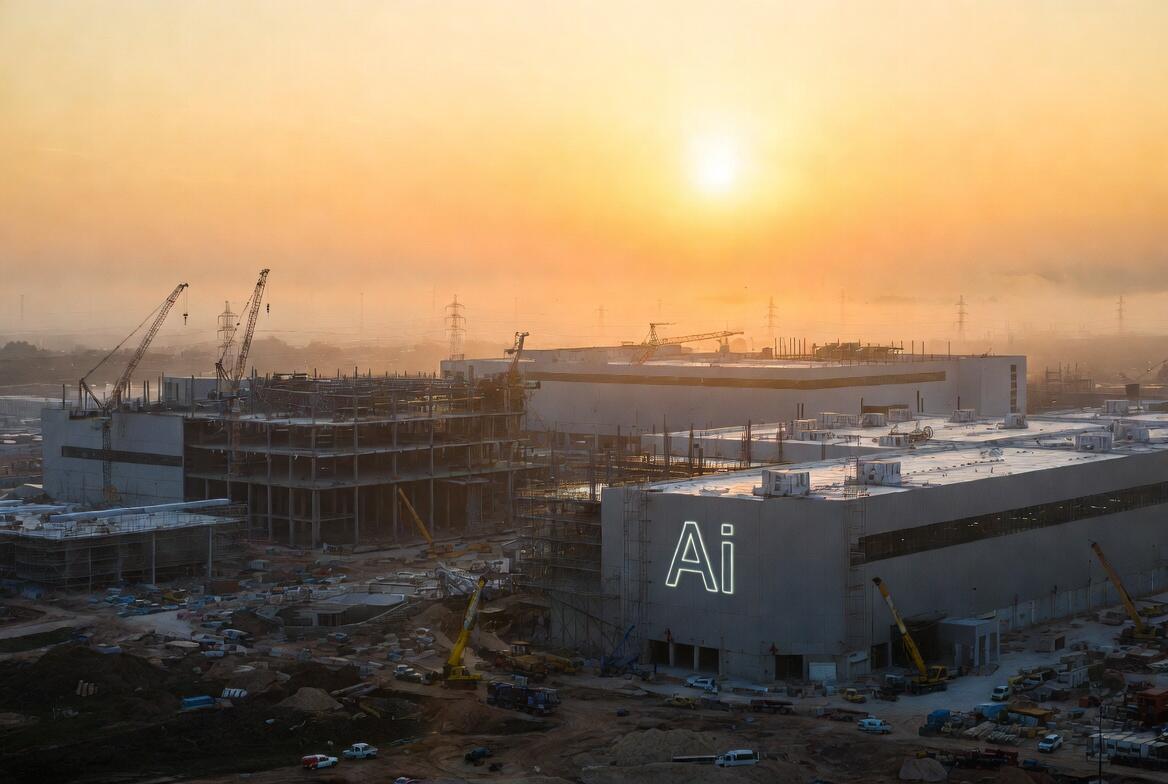
That distinction matters because AI is about as roundabout as modern capitalism gets. This is not a boom in apps and slogans alone; it is a boom in data centers, power, cooling, transformers, specialized semiconductors, fiber, land, and the commodities and construction needed to house and feed all of it. Reuters reports that Alphabet, Amazon, Meta, and Microsoft are expected to spend more than $630 billion combined on AI-related infrastructure in 2026, up sharply from 2025, while separate Reuters reporting says Amazon alone projects roughly $200 billion of 2026 capex. Analysts also expect the hyperscalers’ debt issuance to keep climbing, with BofA lifting its 2026 forecast to $175 billion after Amazon’s jumbo deal and Reuters noting that these firms issued $121 billion in bonds in 2025 versus a 2020–2024 annual average of just $28 billion. In Austrian terms, this is not consumption drunkenness; it is higher-order production marching deep into the structure of capital with a flamethrower and an Excel model.
Now add the monetary backdrop. The Fed cut the federal funds target range to 0 to 0.25 percent in March 2020 and kept it there until liftoff began in March 2022. By contrast, the New York Fed’s r-star framework defines the natural rate as the real short-term rate consistent with full employment and stable inflation, and its recent research says global and U.S. r-star rose by about 1 percentage point after COVID; the New York Fed’s DSGE model in late 2025 put the short-run U.S. real natural rate around 2.0 percent for 2026. Today the policy rate sits at 3.5 to 3.75 percent, but that is after the incubation period. The relevant Austrian point is that the seedbed for this boom was years of money priced as if capital were infinite, patient, and nearly free: precisely the sort of signal that makes entrepreneurs think the economy has more real savings available for long-gestation projects than it actually does.
That does not prove AI is all, or even mostly, malinvestment. It does, however, establish favorable conditions for it. The most charitable case is that AI is a genuine general-purpose technology whose economics are merely messy in the early innings. OpenAI says ChatGPT had more than 900 million weekly users as of late February, and Bloomberg reports OpenAI’s annualized revenue topped $20 billion in 2025 while Anthropic is tracking near that level as well. There are also signs of real productivity gains in narrow use cases, especially coding and selected support tasks. But the bill is arriving much faster than the profits: Bain estimated the industry would need roughly $2 trillion in annual revenue by 2030 to support projected compute demand, yet expected a gap of about $800 billion. That is not a business model; that is a promissory note written in GPU ink.
The more worrying Austrian angle is not simply overvaluation in public equities, but miscoordination in the capital structure. If chips depreciate economically faster than accountants admit, if grid interconnections lag by years, if open models compress pricing power, and if customers love AI demos more than they love paying enterprise invoices, then the industry has a classic ABCT problem: complementary capital arrives in the wrong proportions and at the wrong times. And though not easily captured in formal models, technological history is clear: infrastructure-heavy systems rarely stay that way for long, and early capital often pays the price. The New York Fed warns that r-star is an estimate, not an oracle, but the larger point survives that caveat: if market rates were held too low relative to the economy’s true intertemporal balance, then the resulting investment pattern will look profitable only until bottlenecks, replacement cycles, and cost of capital reassert themselves. Bloomberg reports OpenAI has discussed infrastructure commitments above $1.4 trillion, while Anthropic has announced a $50 billion U.S. data-center push; meanwhile, the IEA has warned of grid-connection queues, transformer shortages, and permitting delays for the power build-out data centers require. A boom can survive many indignities, but not all of them at once.
So: does AI constitute malinvestment? The best answer is that AI almost certainly contains both real innovation and a large malinvestment component. The technology is plausibly important enough to reshape production (and possibly upend labor markets) but that does not mean that every dollar spent on it is wisely spent, that every hyperscaler moat is durable, or that every valuation can be rescued by the word “transformational.” Austrian theory would suggest that when cheap money meets prestige competition, fear of missing out, and the intoxicating moral cover of “the future,” capital does not merely flow-it stampedes. AI may yet justify a great deal of what is being built. But prices, debt, and capex have very likely run ahead of demonstrated end-user value, which means the eventual disappointment-if and when it comes-will not prove AI was imaginary. It will merely prove that even a brilliant technology can be overcapitalized, overpromised, and purchased at a monetary hallucination.