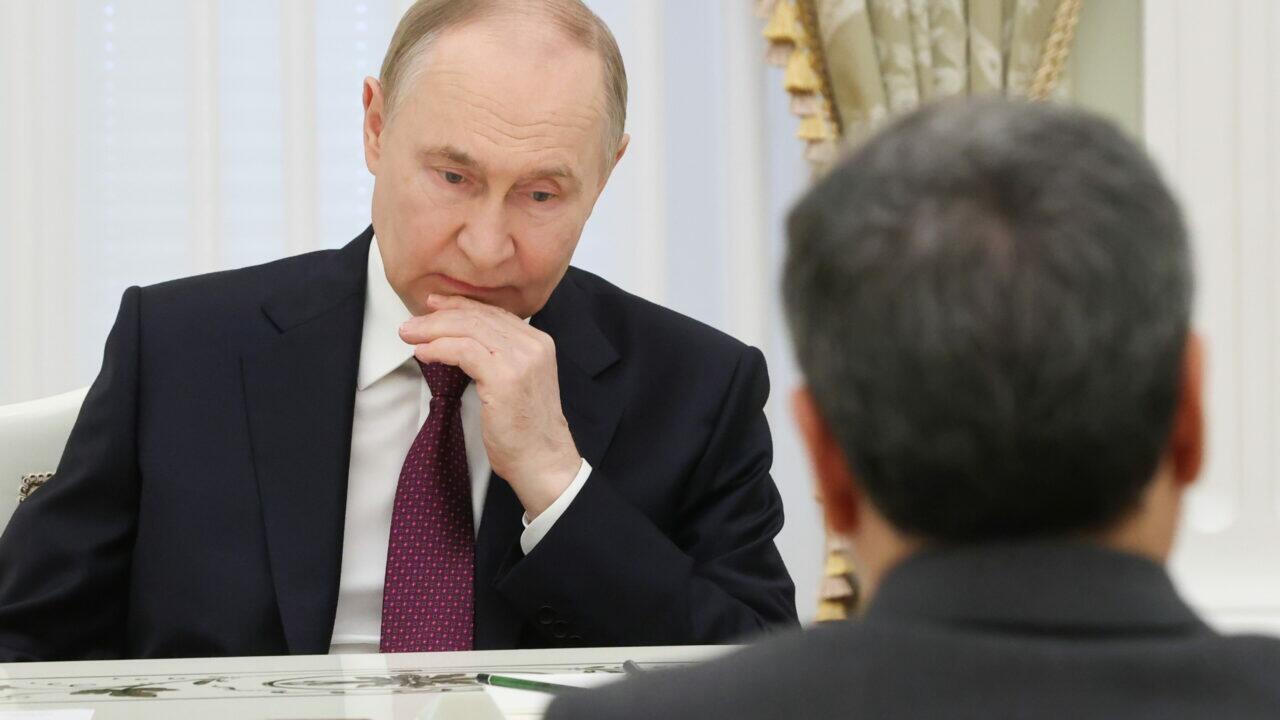
Russian President Vladimir Putin on Thursday delivered some rare, wide-ranging and frank commentary on the US-Israeli war against Iran.
He compared the war and the Hormuz Strait closure, and subsequent impact on global energy, to the massive widescale impact of the Covid-19 pandemic. But he also stated that outcomes to the war are at this point too hard to predict.

The conflict, Putin explained, is now resulting in significant damage to international logistics, production and supply chains while putting intense pressure on hydrocarbon, metals and fertilizer companies - according to a translation in Reuters.
"The consequences of the conflict in the Middle East are still difficult to accurately predict," Putin said before a conference of business leaders in Moscow. "It seems to me that those who are involved in the conflict cannot predict anything themselves, but for us it is even more difficult," he observed.
"However, there are already estimates that they can be compared with the coronavirus epidemic," Putin said. "Let me remind you that it has dramatically slowed down the development of all regions and continents, without exception."
There are reports circulating that earlier this week Putin highlighted the West's double standard when it comes to Ukraine, in comparison to raging Iran war, which is about to reach its first month.
In refence to the Western allies, Putin stated: "They signed all sorts of letters at the start of the Ukraine conflict. Yet these lovers of the epistolary arts haven't written anything about the current tragic events."
Putin's spokesman has meanwhile on Thursday addressed many of what he called "lies" related to Moscow's role in the Iran war.
"There are so many lies being spread by the media... Do not pay attention to them," Kremlin spokesman Dmitry Peskov told reporters in response to an AFP question on Russia supplying Tehran with drones.
Peskov also took the opportunity to address media claims being made about Moscow's approach to peace talks and Ukraine, in connection to the Iran war. The transcript from the audio exchange is below:
REPORTER: A question about the New York Times editorial published yesterday. You may have seen it. It says Putin was close to reaching a peace agreement with Ukraine back in February, but that the US and Israeli operation against Iran changed everything, and now he’s no longer interested in peace. How would you respond to that?
DMITRY PESKOV: "No, that's completely false and doesn’t reflect reality. It’s true that during the rounds of trilateral talks there was some movement toward a settlement. But the key issues that matter critically to Russia still were not agreed. From the very start, it was clear, and we’ve said this many times, that this includes territorial questions. That's the main issue under discussion. There has stolen been no progress on that. At the same time, that doesn't mean Russia has lost interest in negotiations. On the contrary, we remain open to talks, we're in contact with the Americans, and we expect the next round of negotiations to take place as soon as circumstances allow.
Meanwhile, numerous headlines in Western media have continued to say that Russia has been the real winner as a result of Washington's latest regime change adventure in the Middle East, describing that Putin raking in at least $760m a day amid soaring demand for Russian oil.
This also amid the US sanctions waivers, with The Telegraph reporting that "Kremlin sales from oil and gas will double from about $12bn to nearly $24bn this month as Putin profits from an enormous price surge and Donald Trump’s sanctions waivers, according to the Kyiv School of Economics (KSE) Institute."
* * *
