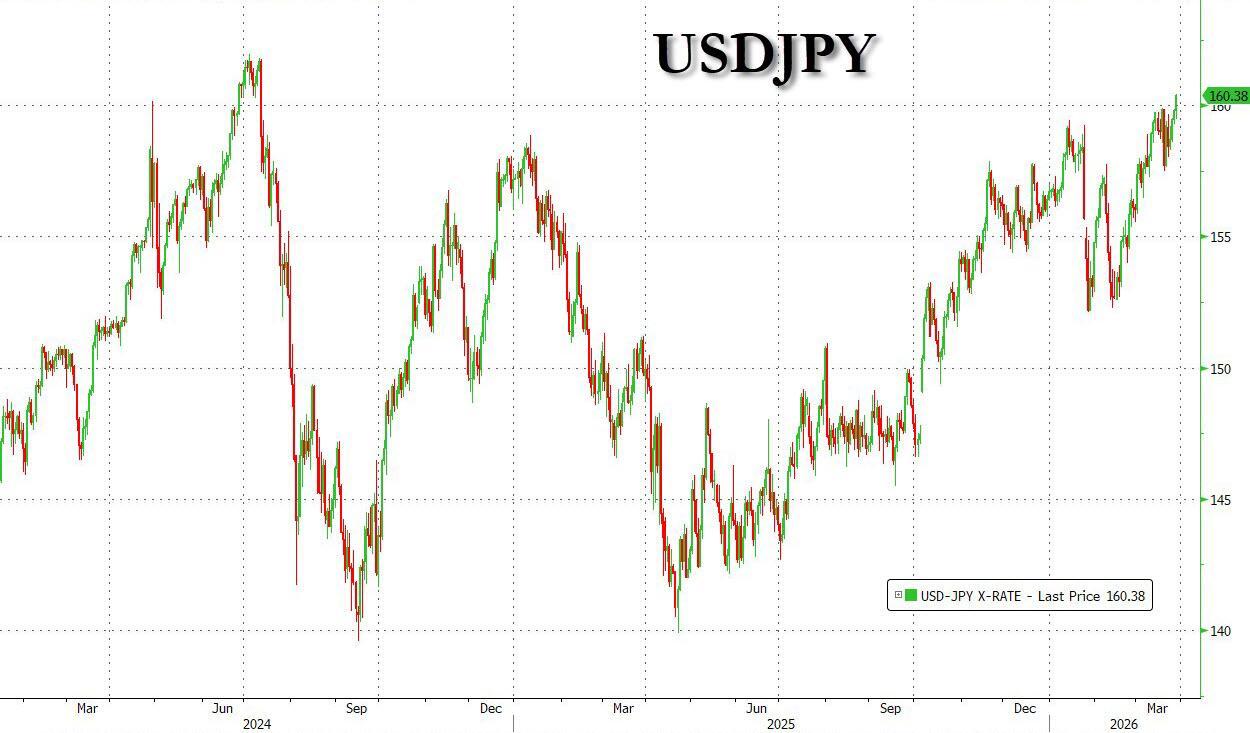
With the yen collapse accelerating, and pushing the USDJPY above 160 for the first time since 2024, markets are on edge expecting a BOJ intervention at any moment as this was the price when the BOJ intervened last time.

However, with BOJ interventions having been consistently proven futile with a half life of just weeks if not days, Japan - facing soaring inflation yet desperate not to raise rates as that would crash the stock market - is weighing a controversial (some would say idiotic) new plan to arrest the yen's slide: stepping into oil futures markets.
Reuters was informed by "market sources" that Japan's government is considering intervening in the crude oil futures market as the Middle East crisis drives energy prices up sharply. Under the scheme, Japan would tap its $1.4-trillion foreign exchange reserves and build short positions in the oil futures market by selling futures contracts to push down prices.
By dampening demand for dollars to buy oil, the "brilliant" thinking goes, Tokyo can ease selling pressure on the yen.
The oil futures and currency markets (which in turn are driven by soaring yields) have recently moved in tandem, with the Middle East conflict pushing oil prices higher while lifting safe-haven demand for the dollar.
Details of the proposal remain scant, after Reuters reported on Monday that it was under discussion, but the idea underscores Tokyo's mounting frustration. Policymakers increasingly see speculative surges in energy prices as a major driver of the yen's weakness against the dollar - and a problem monetary easing and verbal intervention no longer seem able to contain.
Of course, anyone with even half a brain - which unfortunately excludes everyone at the BOJ these days - including analysts and even some in the government, are questioning whether such a strategy would have any meaningful impact in arresting the yen's current weakness, which they mostly attribute to dollar strength, rather than speculative yen short-selling.
"The government must be aware that the impact would inevitably be temporary," Shota Ryu, FX strategist at Mitsubishi UFJ Morgan Stanley Securities, said. "They would likely use it mainly to buy time till the Middle East situation improves."
Japanese law allows use of foreign exchange reserves, preserved as a war chest for direct currency-market intervention, to take positions in futures markets if the objective is to stabilise the yen. After all, the BOJ is one of the few central banks that takes pride in directly manipulating the stock market through purchases of ETFs. Might as well start shorting oil too.
The idea is being contemplated within the government, though there is no consensus on its feasibility, said three government sources with knowledge of the deliberations.
"I personally wonder whether it would mean anything if Japan did it on its own," one of the sources said, casting doubt on whether Tokyo can get much bang for its buck without joint action with other countries.
The unconventional step has emerged as policymakers privately worry that conventional yen-buying intervention could prove futile under current circumstances, as any such action could be blunted by a surge in dollar demand that could intensify if the Middle East conflict drags on.
The shift in the government's tactics has been signalled in government officials' recent comments. Instead of warning against speculative trading in the foreign exchange market, Finance Minister Satsuki Katayama on Tuesday blamed speculative moves in crude oil futures markets for swaying the foreign exchange market.
"The Japanese government is determined to take thorough action at all times and on all fronts," she said, signaling the possibility of being more creative in propping up the yen as the currency approached the psychologically important 160 line.
There was no immediate clarity on which international platform Japan may intervene - NYMEX, on which WTI crude oil futures trade, ICE, where Brent trades, or the Dubai futures trade, a benchmark for Asia. Not that Japan has even thought ahead that far.
But no worries, "as with currency intervention, such an operation could be made on any platform," a second source said. Just brilliant.
Any such move would follow Japan's decision to partially release its oil stockpiles, in coordination with the International Energy Agency and on its own, to soften the supply disruptions which started to hit end-users.
But analysts are skeptical whether the move would pay off.
"The government's strategy is likely aimed at dampening near-term volatility more than anything. It's not possible to financially engineer a way out of a physical oil shock," Yuriy Humber, CEO of Tokyo-based consultancy Yuri Group, said. "If officials want intervention to make an impact, it must be synced with an inflow of real barrels of oil, and ideally, it should be an international effort."
On March 5, a senior White House official said that the US was considering potential action involving the oil futures market, but the idea was promptly shot down by Scott Bessent.
Of course, holding large short positions could also potentially cause losses if the market continues to move higher, and could even force a state-wide margin call on Japan especially if oil hits $200 as some speculate, resulting in total fiscal destruction, something never seen before.
Japan burnt through more than $10 billion in foreign reserves per round of intervention in its most recent currency actions in 2024.
Tony Sycamore, market analyst with IG in Sydney, suggested Japan would need to spend at least $10 billion to $20 billion for the effects to be noticeable.
"I don't think it makes sense at all irrespective of whether Japan does it alone or it teams up with other nations," Sycamore said. "The key to all of this is opening the Strait of Hormuz."