Submitted by Tsvetana Paraskova of OilPrice.com
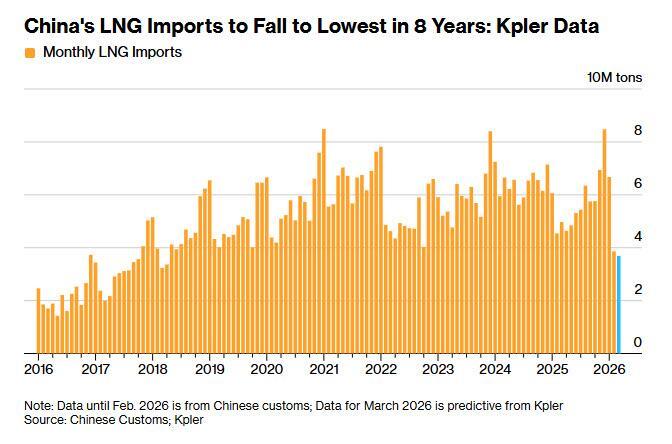
Surging LNG prices amid the war in the Middle East are set to lead to the lowest monthly LNG imports into China in eight years as Qatari and UAE supply is off the market and Chinese buyers look to raise supply from domestic gas production and pipeline deliveries.
China is on track to import about 3.7 million tons of LNG in March, per tanker-tracking data by Kpler cited by Bloomberg. That would be the lowest monthly import level in the world’s top LNG importer since the spring of 2018, as well as a 25% slump compared to March 2025, according to Bloomberg data and analysis.

The de facto closure of the Strait of Hormuz has stranded all Qatari and UAE supply of LNG. Additionally, Qatar’s LNG capacity has been severely damaged by Iranian missile attacks, which forced state firm QatarEnergy to declare force majeure on contracts and start quantifying the losses.
The Iranian missile attacks on Ras Laffan Industrial City (RLIC) dashed hopes of quick resumption of Qatari LNG flows even if the Strait of Hormuz were to open to unimpeded and safe traffic today. QatarEnergy last week said the damage from Iranian missile strikes on the Ras Laffan LNG complex, the world’s single largest LNG-producing facility, would cost it about $20 billion per year in lost revenue and to take up to five years to repair.
As a result, Asian LNG prices have nearly doubled this month and Asian buyers are outbidding Europe for spot supply.

China had some buffer to allow itself not to spend too much on costly LNG imports this month. The country’s LNG storage was estimated by Kpler at about 51% by end-March, and this buffer allows Northeast Asian buyers to draw on existing inventories.
The effect would shift peak restocking season in China, Japan, and South Korea to June–July rather than April–May, according to Kpler.