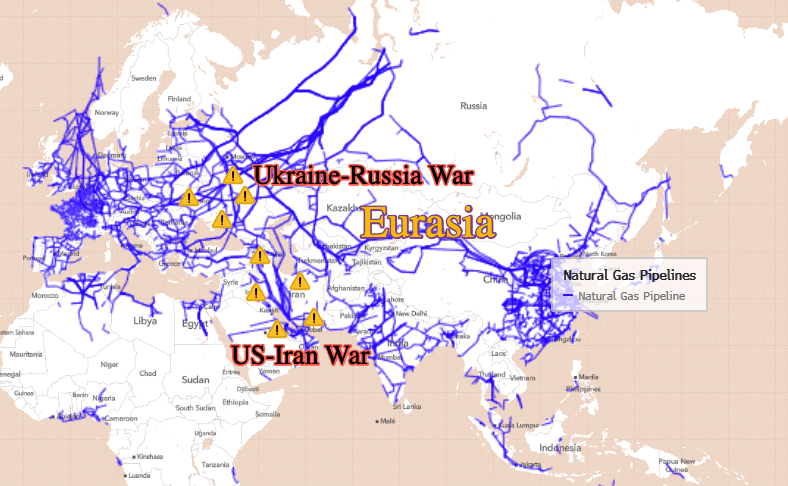
Four years of hyperdevelopment, battlefield testing, and deployment of FPVs, ground robots, AI-enabled kill chains, and soon humanoid robots have permanently altered the course of the modern battlefield, as war technologies once viewed as 2030s-era weapons are being pulled forward into the present day and are now proliferating across battlefields stretching from the Eastern European theater to the Gulf theater, as Eurasia appears to be at war.

The latest reminder is that, regardless of the battlefield across Eurasia, there will increasingly be large swaths of land, miles deep, effectively forming a new kind of no-man's-land controlled by FPVs and ground robots operating with AI kill chains. In Ukraine, that no-go zone stretches 15 miles wide and already means a quick death for any biological soldier, with FPVs able to detect, track, and strike.
A new form of attritional warfare is emerging in which FPVs and robots are cheap and disposable, while soldiers are mainly exposed only when they have to hold, clear, or occupy terrain.
China occasionally likes to flex its dual-use robotic ground systems, with the latest footage showing quadruped machines that act as "robot wolves" with machine guns mounted on top, being trained for street battles.

X account "Sinical" posted the viral footage, viewed 2 million times in just a few short days, that shows several new developments in China's race to weaponize robot dogs:
Heavier loadouts: can be equipped with micro-missiles, grenade launchers, and more
Strong mobility: carries up to 25 kg and clears 30 cm obstacles with ease
"collective brain": real-time data sharing enables them to coordinate, decide, and act together
Sinical continued in a linking post:
The system comes from the Southwest Automation Institute, an organization with longstanding People's Liberation Army ties. Developers call it 100% indigenously designed and 100% domestically produced. What's interesting is that, the institute is openly listing a "non-military version" on http://JD.com—one of China's biggest e-commerce platforms—for $73.5k. However, how closely it matches the military-grade model is unclear.
Here's the counterintuitive fact: on tomorrow's battlefields, war robots may not be the ultimate killing machines—they could actually reduce casualties. They spare human troops the need to storm positions directly, pushing more engagements into "drone v.s. robot" territory. And unlike two groups of soldiers grinding each other down in brutal close-quarters fighting, troops facing robots know the machines cannot be outfought. A handful of robots can clear and secure an entire street in minutes. The clash ends fast, and both sides bleed far less.
The real battlefield is far more complex than any training exercise. The ultimate test for these Machine Wolves will be whether they can reliably distinguish friendly troops from enemy forces—and, most critically, identify civilians who suddenly appear in the chaos.
To sum it all up, the battlefields across Eurasia are becoming machine-on-machine conflicts, with humans operating farther back on second and or third lines (or maybe even remotely overseas), if at all.