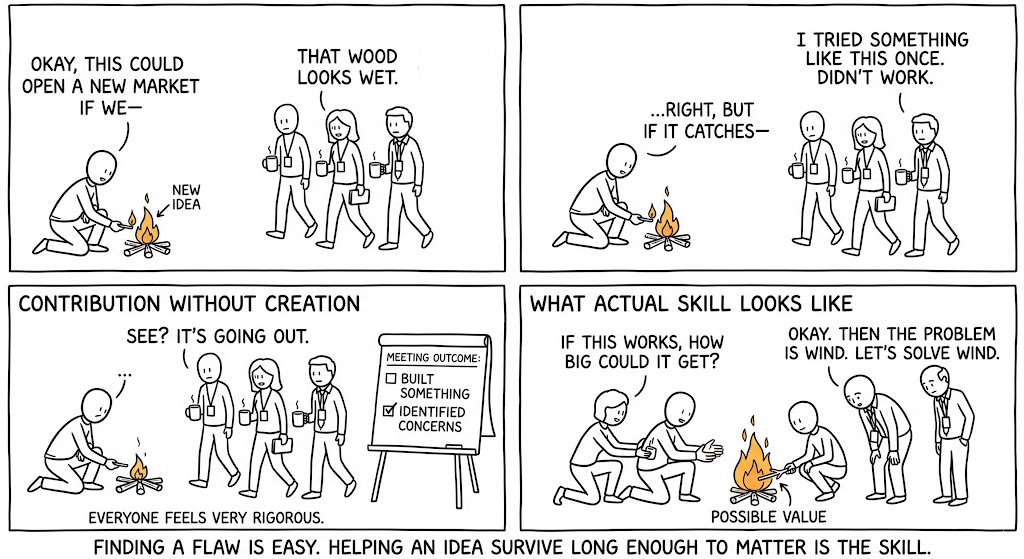
Someone proposes an idea in a meeting. It's new, it's different, and it would take effort. Before they've finished explaining it, three people have already thought of reasons it won't work.
"I haven't heard any customers request this." "We can't use Python for that, it's too slow." "That introduces too much complexity." "We tried something like that before and it didn't work." "DevOps won't want to support another service." "People are used to the way it works now."
None of these people are wrong or stupid. And none of them have added any value.

The Uphill Battle
There is a fundamental asymmetry between proposing an idea and shooting one down. Proposing requires imagination, courage, and the ability to see something that doesn't exist yet. Shooting one down requires a single sentence and no imagination at all.
It takes five minutes to explain how an idea could open up a new market segment. It takes two seconds to say "that sounds risky." But in a meeting, the two feel equivalent.
No amount of criticism, objection, or risk identification will ever, by itself, create value. Criticism can prevent mistakes, and that matters. But it is fundamentally about preservation, not creation. The only thing that can create value is an idea. If all you ever do is shoot ideas down, you have never added value. You have only avoided losing it.
It follows a predictable pattern. The first step is to hear an idea you don't fully understand. The second is to find a flaw. The third is to assume the flaw outweighs the potential you never explored. The fourth is to kill the idea. The fifth is to walk out feeling like you contributed something valuable.
The Campfire Critic
The campfire critic isn't trying to put out your fire. They're just standing over you, hands in their pockets, observing that the wood is wet, the wind is picking up, and they once tried to start a fire like this and it didn't work. They're not malicious. They're not even wrong. But while they're talking, the flame you were sheltering just went out.
This isn't because people are lazy. Our brains are wired for it. Negativity bias, loss aversion, status quo bias, our brains are built to find threats, overweight losses, and resist change. Put all of this in a meeting where people want to feel like they're contributing, and the result is predictable. As Austan Goolsbee's father put it: "Fault-finder is a minimum wage job." Anyone can do it.
The person proposing has been thinking about this for weeks or months. They've tested pieces of it in their head or even built proofs of concept. They understand things about the idea that aren't obvious yet. And they're trying to explain all of this to a room full of people encountering it for the first time. Understanding the upside is hard. Spotting a flaw is easy. So the discussion gravitates toward downsides, and the person proposing walks out feeling like they failed to communicate, when the real problem is structural. And the cost compounds. The person whose idea gets killed once will think twice before proposing again. The worst damage isn't the one dead idea. It's the ten ideas that were never brought up afterward.
Early ideas are fragile. They're incomplete by definition. Judging them at this stage is like pointing at a caterpillar and declaring it to be a bad butterfly. If you don't understand why a rational, intelligent person thought it was worth proposing, you don't know enough to comment.
What to Do Instead
Edward de Bono described this problem decades ago with his Six Thinking Hats framework. The core insight is simple: optimistic thinking and critical thinking are both valuable, but they need to happen separately. When you mix them, critical thinking always wins because it's cognitively cheaper. You need both optimism and pessimism. Just not at the same time.
Next time someone proposes an idea, try this:
First, put on the Yellow Hat: "how big could this be?" Spend real time on the upside. What would the world look like if this works? Who benefits? What does it unlock?
Then, put on the Black Hat: "what could go wrong?" Only once you genuinely understand the potential value. Now stress test it. But if you still can't articulate why the person proposed it, you're not ready. You'd be shooting a sitting duck.
Finally, weigh them: "is the upside worth the downside?" You've now considered both sides and can make a reasoned decision.
And change some habits:
Stop thinking that finding a flaw is a contribution. It's half of a contribution at best. The other half is "and here's how we might solve that." If you're pointing out a problem without offering a path through it, that's not contributing.
Frame concerns as conditions, not verdicts. "This works if we can solve X" is useful. "This won't work because of X" is a conversation ender. One says "I'm on board if we can overcome this obstacle", the other closes a door.
Build It Up Before You Tear It Down
Shooting down ideas is easy. The hard part is sheltering the flame long enough to see what it becomes.