For weeks, we mapped out for readers how the Gulf energy shock dominoes would fall, spreading outward from the Middle East and striking Asia first through tightened energy-product flows that risk destabilizing the global economy. That transmission of tightening energy flows is now becoming alarmingly visible on factory floors across Asia.
Goldman analysts, led by Georgina Fraser, warned clients on Monday that the petrochemical shock is worsening across Asia, with textile and packaging plants emerging as the first major downstream casualties.
"The supply shock is transmitting faster and at a greater magnitude than we had anticipated," Fraser emphasized in the note.
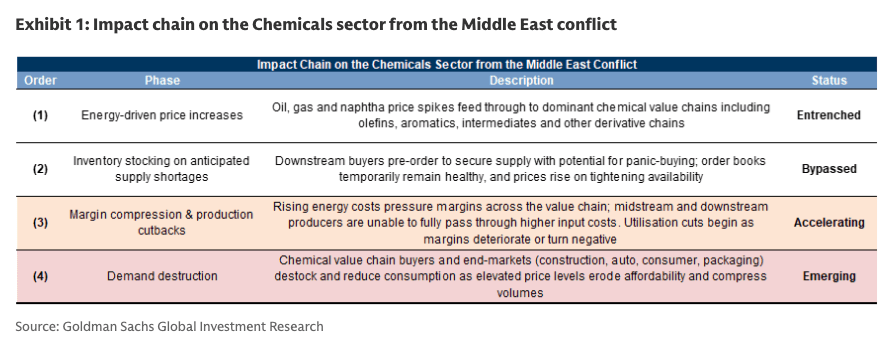
She said the supply shock is moving beyond higher energy prices into production cuts, margin compression, and early demand destruction, adding that "signals are materializing fastest, with textiles and packaging among the first downstream sectors affected."
Impact chain on the Chemicals sector from the Middle East conflict

Last week, supply chain disruptions in critical plastic feedstocks began to emerge, with several producers of monoethylene glycol (MEG) and purified terephthalic acid (PTA) declaring force majeure, while tanker flows through the Strait of Hormuz remained heavily disrupted. These feedstocks are essential in the production of plastics, the very material that is core to the modern economy.
Fraser noted that China's PTA supply chain accounts for roughly three-quarters of global PTA capacity. She said spot PTA prices have jumped by more than 30% since the U.S.-Iran conflict began.

At the same time, about 15% of China's PTA capacity and 11% of global capacity have been taken offline due to shutdowns and curtailments.

For context, MEG and PTA are the two primary feedstocks used to produce polyethylene terephthalate (PET) and polyester fibers. These petrochemicals are essential to the production of everyday consumer goods that make life in the developed world convenient, including plastic bottles, food packaging, clothing, home furnishings, and a wide range of consumer and industrial goods.
The analyst then shifted focus to India, where she said the first signs of a petrochemical supply shock are already emerging: In Surat, the country's main synthetic textile hub, producers have reduced operations to a single 12-hour shift, halving output as soaring plastics costs collide with weak demand.
She noted that for apparel and textiles, where petrochemical-linked inputs account for 50% to 65% of the cost of goods sold, the latest moves in raw material spot prices imply a 17% COGS shock, enough to idle less efficient plants.

Packaging is also at risk. While demand is lower for discretionary goods than for clothing, elevated price pressures in PTA and related petrochemicals threaten to spill over into food, beverage, and consumer goods packaging, increasing the odds of inflationary pass-through.
Circling back to JPMorgan's commodity expert on how the energy shock dominoes fall: Asia first (happening now), then Africa and Europe, before settling on the US - primarily California.

"Even an imminent end to the conflict would not fully unwind the supply chain disruption already in motion," the analyst warned.
Professional subscribers can read the full "Petrochemical supply shock hits textiles and packaging faster and harder than anticipated" note here at our new Marketdesk.ai portal. Fraser