
Chimpanzees in Uganda locked in vicious 'civil war', say researchers
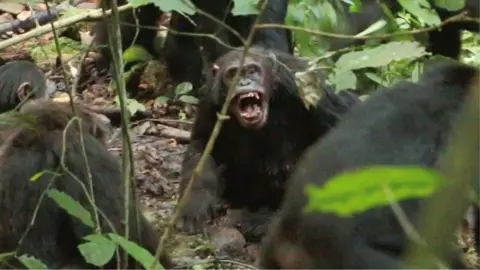 Aaron Sandel via Reuters
The world's largest known group of wild chimpanzees has split and been locked in a vicious "civil war" for the last eight years, according to researchers.
It is not clear exactly why the once close-knit community of Ngogo chimpanzees at Uganda's Kibale National Park are at loggerheads, but since 2018 the scientists have recorded 24 killings, including 17 infants.
"These were chimps that would hold hands," lead author Aaron Sandel said. "Now they're trying to kill each other."
The study, published in the journal Science, says the intensity and duration of the violence may inform how early human conflict developed.
Sandel, an anthropologist from the University of Texas in the US, and co-director of the Ngogo Chimpanzee Project, says chimpanzees are "very territorial", and have "hostile interactions with those from other groups".
"[It's] like a fear of strangers," he told the Science podcast.
But over several decades, Sandel said the nearly 200 Ngogo chimpanzees had lived in harmony.
There were divided into two sets - known to researchers as Western and Central - but they had existed overall as a cohesive group.
Sandel said he first noticed them polarising in June 2015, when the Western chimpanzees ran away and were chased by the Central group.
"Chimpanzees are sort of melodramatic," he said, explaining that following arguments there would ordinarily be "screaming and chasing" and then later, they would grooming and co-operating.
But following the 2015 dispute, the researchers saw that there was a six-week avoidance period between the two sets, with interactions becoming more infrequent.
When they did occur, Sandel said they were "a little more intense, a little more aggressive".
Following the emergence of the two distinct groups in 2018, members of the Western group started attacking the Central chimpanzees.
In 24 targeted attacks since the split, at least seven adult males and 17 infants from the Central chimps have been killed, the study found, although the researchers believe the actual number of deaths are higher.
The researchers believe many factors such as the group size and subsequent competition of resources, and "male-male competition" for reproducing may be to blame.
But they say there were three likely catalysts:
- The first, were the deaths of five adult males and one adult female - for reasons unknown - in 2014, which could have disrupted social networks and weakened social ties across the subgroups
- The following year, there was a change in the alpha male, which the study says coincided with the first period of separation between the Western and Central groups. "Changes in the dominance hierarchy can increase aggression and avoidance in chimpanzees," it explained
- The third factor was the deaths of 25 chimpanzees, including four adult males and 10 adult females, as a result of a respiratory epidemic, in 2017, a year before the final separation. One of the adult males who died was "among the last individuals to connect the groups", the research paper said.
Sandel and his colleagues said their findings encourage people to rethink what they know of human conflict and warfare.
"In the case of the Ngogo fission, individuals who lived, fed, groomed and patrolled together for years became targets of lethal attacks on the basis of their new group membership," they wrote in the paper.
If chimpanzees - one of the species closest to humans genetically - could do so without human constructs of religion, ethnicity and political beliefs, then "relational dynamics may play a larger causal role in human conflict than often assumed", they added.
James Brooks, a researcher at the German Primate Center in Germany, said it was a "reminder of the danger that group divisions can present to human societies".
Commenting on the study in Science, he wrote: "Humans must learn from studying the group-based behaviour of other species, both in war and at peace, while remembering that their evolutionary past does not determine their future."
 Getty Images/BBC
Go to BBCAfrica.com for more news from the African continent.
Follow us on Twitter @BBCAfrica, on Facebook at BBC Africa or on Instagram at bbcafrica