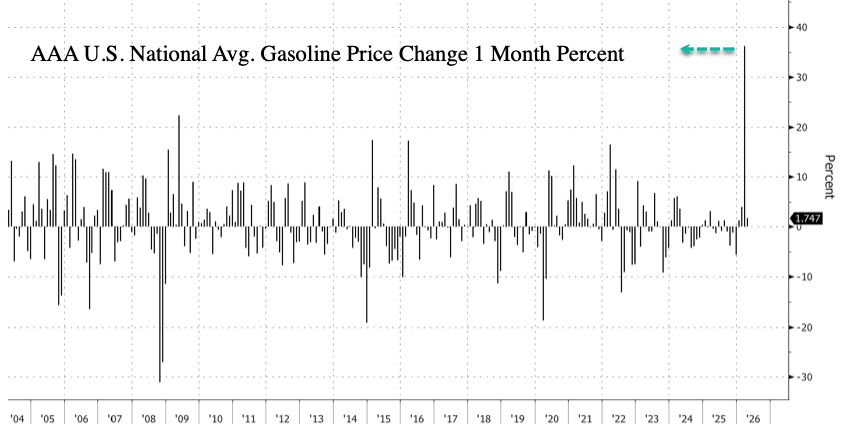
March brought the biggest fuel price shock Americans have experienced on record, or at least according to AAA data going back to the early 2000s.

A fuel price shock changes consumer behavior, especially for low-income households, by forcing folks to drive less, combine trips, cancel discretionary travel, or shift to carpooling and public transit.
For those who have the financial flexibility to do so, a fuel price shock may push some consumers toward smaller cars, hybrids, and EVs and away from large SUVs and trucks, because fuel economy suddenly matters much more.
The Wall Street Journal reports that a $4-per-gallon national average for gasoline, a politically sensitive level, is the threshold at which some consumers are beginning to think about EVs again.

Online car-shopping platforms such as Cars.com and Edmunds have reported a modest uptick in EV interest among users on their platforms in recent weeks.
Edmunds pointed out that interest in EVs on its website has returned to where it was before federal tax incentives expired late last year.
"In the short term, a lot of Americans, and this has nothing to do with regulations, are coming back to EVs because of the cost of ownership," Hyundai Motor Chief Executive José Muñoz told the WSJ. "Basically, the fuel costs are making them change their decision."
Muñoz said that EVs are finding a place in the driveways of households in states like California because it makes economic sense to commute to work during the week in EVs rather than gasoline-powered cars.
He said the thinking in some households is: "I have one car from Monday to Friday, another car for the weekend."
We must point out that far-left states like California suffer from state-killing climate policies and terrible energy policies that are crushing households on the pocketbook level.
Data from Cox Automotive shows that EV sales jumped 12% in the first quarter as a flood of off-lease EVs swamped the market, pushing prices lower and making them more affordable.
Edmunds data show that EVs accounted for roughly 6.2% of new-car sales in March, up from 6% in February, but this is noticeably down from September, when EVs accounted for 11.5% of sales. Higher EV sales last year were mostly driven by consumers seeing that federal tax credits were expiring at the end of the year, think of it as demand pulled forward.
Stephanie Valdez Streaty, director of industry insights at Cox Automotive, said the surge in gasoline and diesel prices at the pump during the six-week U.S.-Iran conflict led to "an uptick in consideration" of EVs. She said driving habits are hard to change, considering Americans enjoy the luxury of large SUVs and trucks.
Meanwhile, Chinese EV exports soared 140% in March, driven by surging demand outside the US amid Gulf-related energy shocks.