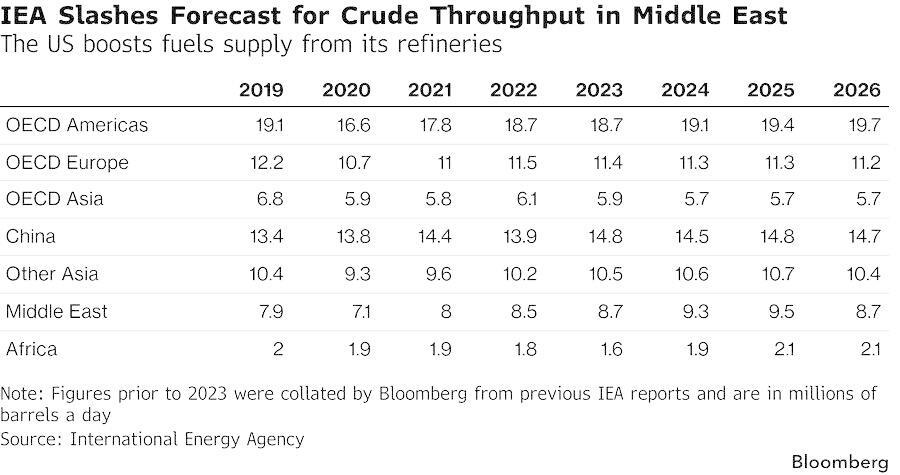
The global demand destruction playbook we outlined last month, describing how the Gulf energy shock would spread across continents, is now materializing on a large scale. The International Energy Agency said in a Tuesday update that global oil demand will decline this year for the first time since 2020.
"The Iran war has thoroughly upended the global outlook for oil consumption," the IEA wrote in its Oil Market Report. "Demand destruction will spread as scarcity and higher prices persist."

The IEA said the US-Iran conflict and the disruption of the Hormuz chokepoint have flipped the global oil market from a growth year to one of demand destruction, with world oil demand now expected to decline by 80,000 barrels per day rather than expand by 730,000 bpd as previously forecast.
Tanker flows through the world's most critical waterway collapsed to around 3.8 million bpd in early April, down from more than 20 million bpd pre-conflict, while alternative export routes, mainly pipelines from Saudi Arabia, the UAE, and Iraq, only partially offset the disruption. The end result is an overall export loss of a staggering 13 million bpd.
Physical oil markets have tightened significantly worldwide, with spot crude and refined product prices rising above futures prices. North Sea Dated crude traded near $130 a barrel, and physical cargoes briefly approached $150.
IEA noted that the wave of demand destruction hit the Middle East and Asia-Pacific hardest, especially in naphtha, LPG, and jet fuel, as petrochemical plants slashed operating rates, flights were canceled, and households and businesses faced fuel shortages and price shocks.
Strategic reserves are being drained to cushion the shock. Global observed oil stocks fell by 85 million barrels in March, with large drawdowns outside the Gulf, while crude and product storage jumped in the Gulf area because of the Hormuz disruption.
Two weeks ago, JPMorgan's top commodity expert described how the demand destruction crisis would spread from the Gulf area, hitting Asia first, then Africa and Europe, before ultimately affecting the US, especially California.

Last week, IEA boss Fatih Birol warned in an interview with Financial Times about countries' panic hoarding crude and crude products.
"I urge all countries not to impose bans or restrictions on exports," Fatih Birol emphasized in the interview. "It is the worst time when you look at the global oil markets. Their trade partners, their allies and their neighbors will suffer as a result."
The FT noted that Birol was "careful not to name China directly," but made very clear his warning was likely aimed at Beijing, which has already moved to restrict exports of critical refined products, including gasoline, diesel, and jet fuel.
Jeff Currie of Carlyle recently outlined the hoarding risks in a note titled "A Crude Awakening": "The physical shortfall is the trigger; the behavioral response is the multiplier."

The IEA's base case in today's new report assumes tanker flows from the Gulf region will begin to recover by mid-year, though not return to pre-war levels. It also warned that if the conflict drags on, energy markets and countries highly exposed to Gulf flows should brace for even more severe disruptions in the months ahead.