April 16, 2026
When Duke University launched its new Masters in Game Design, Development, and Innovation (GDDI) program, the faculty faced a challenge familiar to anyone who has taught creative technical disciplines: how do you get students making real things, fast, when the tools themselves are a challenge to master?

The GDDI curriculum is built around Unreal Engine — industry-standard game creation software that takes months to learn. Which is fine for advanced coursework, but in an introductory class focused on game design fundamentals, students can’t afford a long learning curve.
The original workaround was a low-tech industry standby: index cards with hand-sketched game screens, passed around to prospective game players for quick feedback.
But a better solution came in the form of a quirky, yellow, handheld game console: Playdate.
“Because of the simplicity of the [Playdate] tools and because of the portability; because of the constraints; it allows for this iterative loop to be very quick,” says Ernesto Escobar, GDDI’s executive director. That feedback loop — design, build, test, revise — is exactly the mindset a working game designer needs to develop.
Playdate is made by Panic, a 30-year-old Portland, Oregon-based software company. Playdate was Panic’s first dive into the hardware business. Playdate fits in a jacket pocket, sports a sharp 1-bit display, and features an unusual input mechanism: a fold-out crank that serves as a controller. It launched in 2022 and has inspired the creation of nearly 2,000 games by an enthusiastic independent developer community.

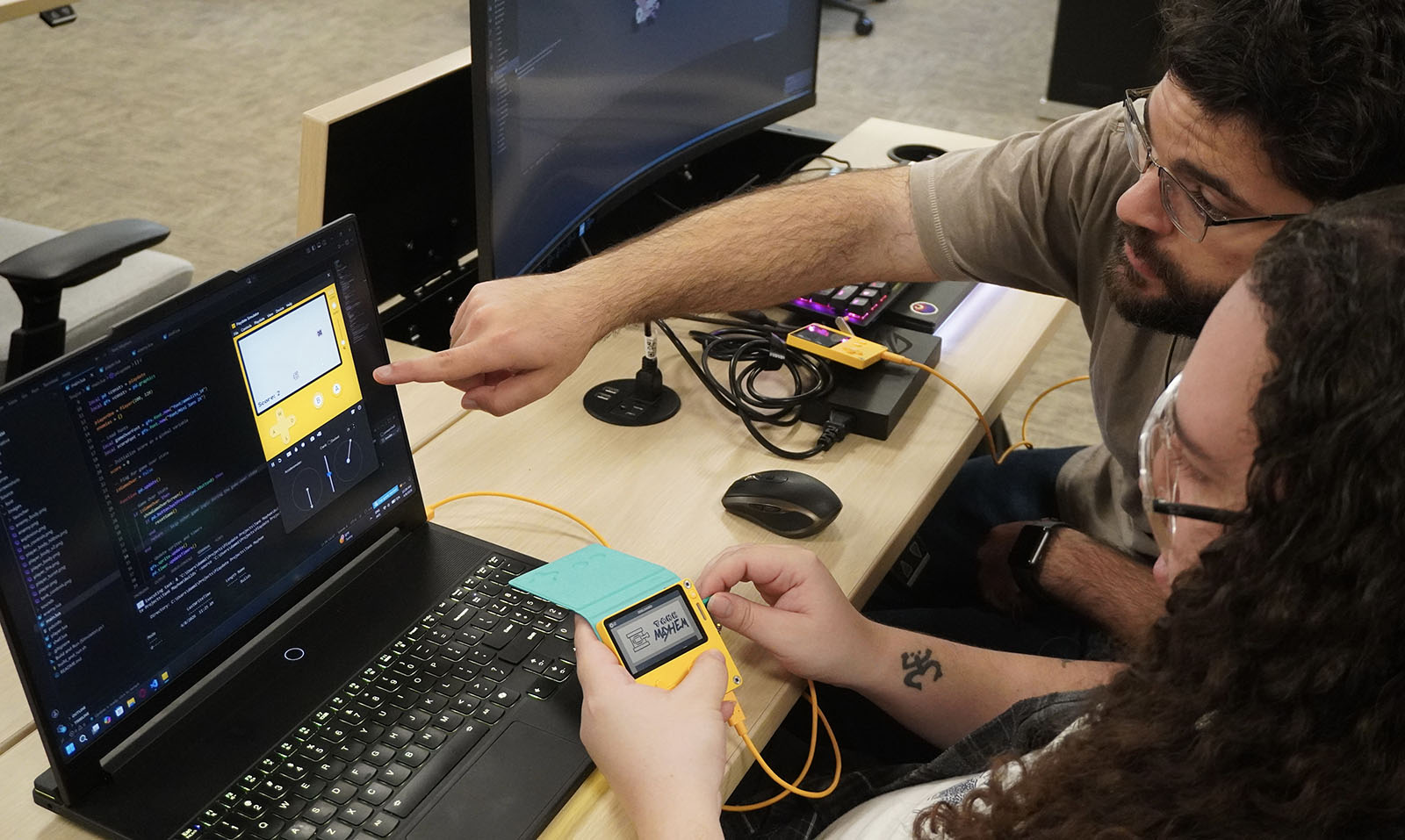
What makes Playdate particularly well-suited for education is its approachability. Playdate’s development kit is free — something nearly unheard of in the world of video game consoles. Panic also offers Pulp: a browser-based game builder that requires no programming experience at all. Crucially, a free Playdate Simulator that runs on PCs and Macs means students don’t even need to own a Playdate to begin writing games. (And when they do have a device in hand, deploying a game to it takes just seconds.)
Escobar connected with Greg Maletic, a Duke alumnus and head of the Playdate project at Panic, through the GDDI program’s advisory board. Maletic introduced him to Playdate’s educational potential, and starting in Fall 2024, the device became a key part of GDDI’s introductory game design course.
Constraints are a proven catalyst: they force designers to make deliberate compromises rather than get lost in infinite possibilities. Playdate’s black-and-white display and modest processor push students to think carefully about what their game actually needs. Not to mention Playdate’s unusual input method. GDDI student Diego Medina Molina built a tank game around exactly that: “I was inspired by the crank being able to actually aim the turret, and that was really fun.”

The portability factor adds another dimension that’s hard to replicate in a traditional lab setting. A student can finish a prototype in the afternoon, walk across campus, and have a dozen people playtesting it before dinner. “The Playdate is so small and it looks so friendly,” notes Escobar. “[It’s] really easy to just go to the food court and say, ‘Hey, can you play my game?’ and people would say, ‘Yeah, I’ll play it!’”
The proof is in what students actually built. In their intro class they were given an unusual jumping-off point: make a game incorporating the word “owl.”
Omar Masri, who came to the program after two years in data science with no prior game development experience, built Owl Invasion — an endless wave-based action game with tower defense mechanics. Brandon Huffman, an artist and Army veteran, created Owlphabet Soup, a spelling game in which players use the crank to ladle letters out of a bowl of soup and arrange them to spell assigned words.

“What blew me away was how intuitive [the development kit] is,” says Huffman. “So simple to just create games with. The fact that you can create … for the console and not even own the console is like, that’s crazy. Never would have imagined that I would actually have a game on a little portable console like that, but I do now, and I’m really excited about it.”
Since Duke’s game design program launched, more than 50 Playdates have been provided to students. And that’s just the beginning. “Playdate is flexible enough that we can teach very different things with it — from design, to development, to playtesting — depending on the course,” says Escobar. “We want to bring Playdate into more classes as we discover new ways to use it.”

If Duke could have this experience with Playdate, Panic realized, other schools could, too. And thus was born Playdate for Education, an initiative to get Playdates — at a discount — into the hands of educators and their students.
The key insight from Duke’s experience: Playdate doesn’t ask students to master it before they can use it — they can be prototyping a real, playable game on physical hardware within hours of picking it up. Students aren’t waiting to do game design someday; they’re doing it now.
Panic’s Playdate for Education program supports institutions looking to incorporate Playdate into their curricula. More information is available at play.date/education. The Masters program in Game Design, Development and Innovation in the Pratt School of Engineering at Duke University can be found at masters.pratt.duke.edu/gddi.