Saunas have been around since the primitive years in ancient Finland, and have always been considered to have a therapeutic effect[1]. Saunas are a hot, dry environment used to stimulate our cardiovascular system. During extreme heat exposure, our heart rate rises and our vessels dilate to increase the delivery of blood volume in order to protect the body[2].
This extra pressure on the heart is known to have long-term health benefits[3]. The heat exposure also promotes sweating and therefore the elimination of toxins, including those generated in the process of repairing small muscle tears after exercise[4]. It is for this reason that saunas are also considered great for recovery. All of this is no news, at the end of the day isn’t that what roman baths were built for? For recovery after battle[5]!
However, most studies have looked at the benefits of frequent sauna bathing and the impacts on long-term health. Motivated to understand the immediate physiological response to saunas, we looked at the same-day effects across ~59,000 daily records from 256 users.
Same-day Effects of Saunas
We used simple paired t-test evaluations to assess the immediate same-day effects of saunas.
Sauna days were associated with:
- Higher activity (longer activity time and greater distance)
- Higher maximum and average heart rate
That fits our intuition: many people sauna after a workout.
Sauna days also showed lower minimum heart rate compared to non‑sauna days. Importantly, this effect remains even after controlling for activity, which suggests the lower nighttime heart rate isn’t simply due to exercise. The difference between sauna and non-sauna days is on average 5% (3bpm) which is a noticeable physiological change.
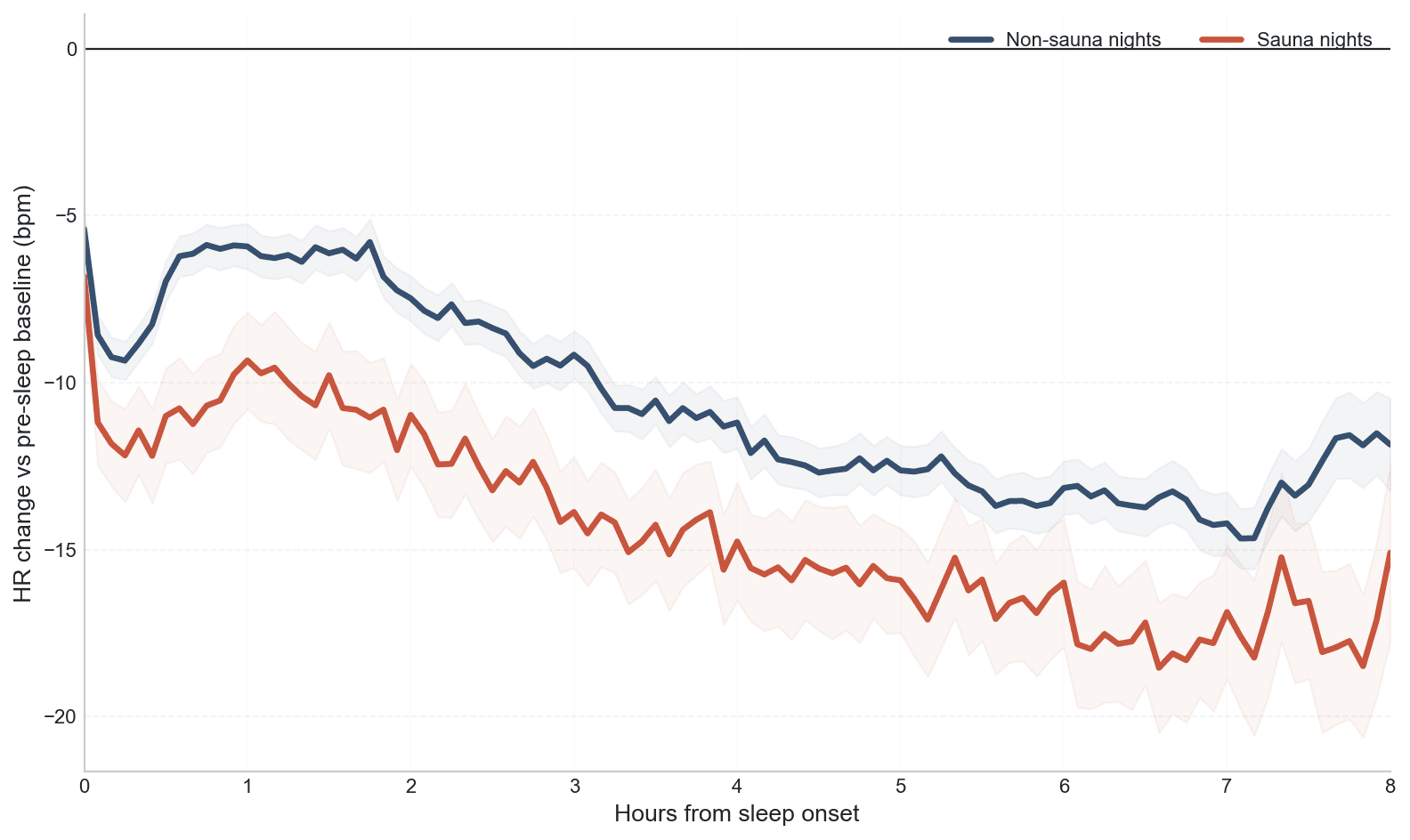
These results were statistically robust (FDR‑corrected p < 0.05 and Cohen’s d > 0.2), supporting the idea that sauna use may be linked to better same‑day recovery.
Do Saunas Affect Women Differently?
Females showed larger activity increases on sauna days, which may reflect more consistent sauna use on workout days. However, females showed a smaller drop in minimum heart rate than males on sauna days.
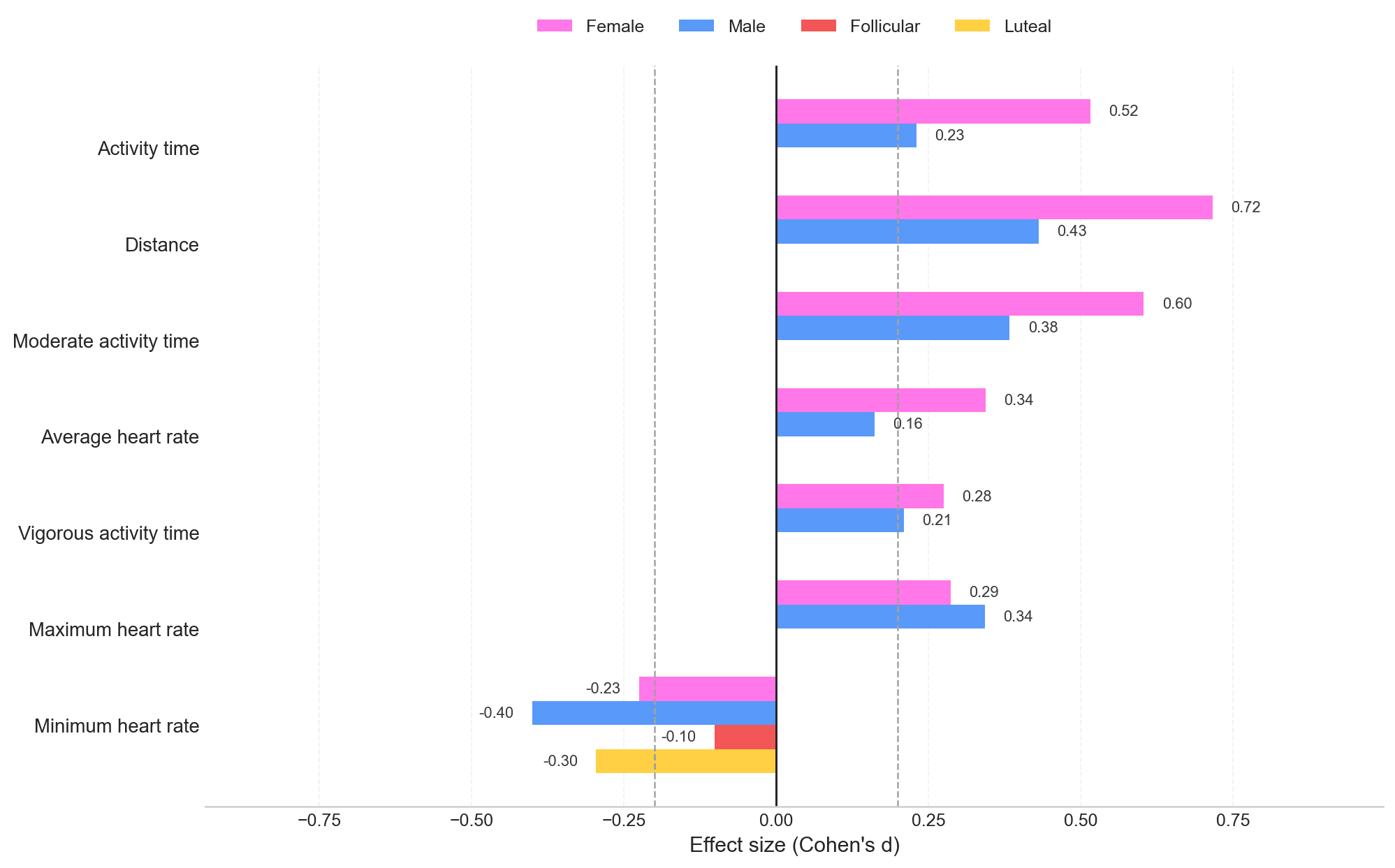
As we looked at in previous blogs, the menstrual cycle can influence recovery and nighttime heart rate. For this reason, we evaluated sauna effects across the follicular and luteal phases and observed statistically higher activity and lower heart rate when women use the sauna on their luteal phase. In fact, heart rate at night was only meaningfully lower (Cohen d > 0.2) compared to non sauna days during the luteal phase. Or in other words, the benefits of saunas seem to appear only during the luteal phase…
What Does This All Mean?
Sauna use is part of a recovery‑oriented day. Sauna days are more active, which fits how people actually use saunas, often as a post‑workout routine. Yet even after accounting for activity, nighttime minimum heart rate is lower on sauna days, suggesting a physiological recovery signal beyond exercise alone.
Mechanistically, this pattern is consistent with known heat‑stress physiology: heart rate increases during sauna exposure, followed by recovery dynamics that can reflect increased parasympathetic influence during cooling [6][7] Within women, the strongest recovery signal in our dataset appears in the luteal phase, where the effect size crosses a meaningful threshold.
References
- UNESCO. Sauna culture in Finland. https://ich.unesco.org/en/RL/sauna-culture-in-finland-01596
- Ketelhut, S., & Ketelhut, R. G. (2019). The blood pressure and heart rate during sauna bath correspond to cardiac responses during submaximal dynamic exercise. Complementary therapies in medicine, 44, 218–222. https://doi.org/10.1016/j.ctim.2019.05.002
- Laukkanen T, Kunutsor SK, Khan H, et al. Sauna bathing is associated with reduced cardiovascular mortality and improves risk prediction in men and women: a prospective cohort study. BMC Medicine. 2018;16:219. (PMC: PMC6262976)
- Kuan, W. H., Chen, Y. L., & Liu, C. L. (2022). Excretion of Ni, Pb, Cu, As, and Hg in Sweat under Two Sweating Conditions. International journal of environmental research and public health, 19(7), 4323. https://doi.org/10.3390/ijerph19074323
- Marcussen, W. (2019, August 23). The Roman Baths in Bath- A Deep Dive into Britain’s Ancient History. World History Encyclopedia. **https://www.worldhistory.org/article/1427/the-roman-baths-in-bath--a-deep-dive-into-britains/**
- Laukkanen JA, Laukkanen T, Kunutsor SK. Cardiovascular and Other Health Benefits of Sauna Bathing: A Review of the Evidence. Mayo Clinic Proceedings. 2018;93(8):1111–1121. (PubMed: 30077204)
- (Study) Recovery from sauna bathing favorably modulates cardiac autonomic nervous system. 2019. (PubMed: 31331560)