nullprogram.com/blog/2026/04/26/
This past Tuesday I typed C-x C-c in Emacs for the last time after 20
years of daily use. Though nearly half that time was gradually
retiring it, switching to modal editing, then to Vim. Emacs is a platform,
and I’d grown accustomed to its applications, especially those I built
myself. There was no particular hurry, so replacements came slowly. With
my newly-acquired superpowers I could knock out the last two pieces
in a few days’ work, namely M-x calc with stackcalc and
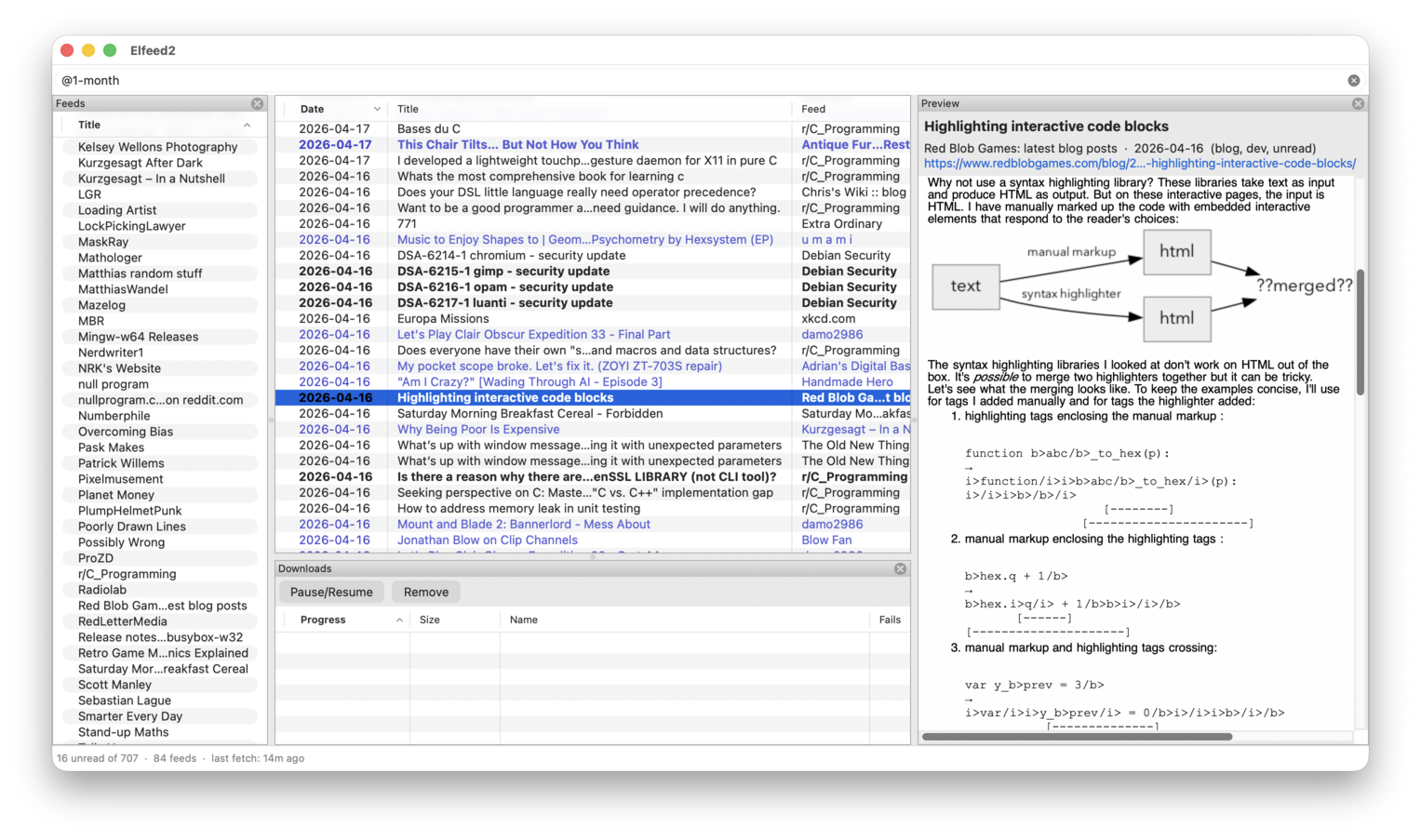
Elfeed with Elfeed2. I’m especially excited about the
latter because it already exceeds the original. Both are multi-platform,
native C++ GUI applications using native UI components.

These actively-in-use packages require new maintainers (apply on the project’s issues/discussion):
No wonder it took so long for me to move on! I’m not handing these off to just anyone, and you’ll need to establish your reputation. Having already made contributions is a good sign, even if never merged. I’m willing to transfer them off my namespace, though you’ll need to manage the Melpa hand-off (on which I’ll sign-off). If there are no takers, these projects will be archived but not deleted.
Trying out wxWidgets
The Emacs Calculator is amazing and the best calculator I’ve ever used, which is why nothing I could find was going to replace it. My clone uses GMP and MPFR for multi-precision, so it’s far faster, as to be expected, but it’s not nearly at feature parity. It’s missing esoteric features including symbolic processing. Though it’s enough to cover all of my own usage. I can add more features later. The Emacs Calculator manual served as a specification when building stackcalc.
Elfeed has been a cornerstone of my daily routines for the past 13 years. Nothing else I’ve found scratches that itch for me, so I’ve always known it would require a rewrite someday. Knowing it would take a few weeks of work, and that I already had the feed reader I wanted, made motivation difficult to find. Though now that I can accomplish ~3 weeks of old-way work in a new-way day, this sort of project becomes that much easier to start and finish. Though it’s not yet at a 1.0 release, after a couple days Elfeed2 was working well enough to replace the original Elfeed.
While Dear ImGui was the right choice for dcmake, it would not be
so for these two applications. Active rendering doesn’t suit a feed reader
left running all day, and I needed a richer toolkit. Professionally I work
in Qt, but I wanted something lighter-weight for my projects, accessible
via CMake FetchContent. That naturally led to wxWidgets. While it
has issues — mitigatable character encoding problems, accidental quadratic
time in many places — it’s worked better than I anticipated, letting me
rapidly produce native-looking applications on Windows, macOS, and Linux.
Unlike Dear ImGui, wxWidgets is a platform, including sane I/O and path handling. I mostly don’t need platform layers when building applications like these. I can simply rely on wxWidgets’ utilities.
Both of these projects build out-of-the-box on w64devkit thanks to the
dependencies being FetchContent-compatible. On all platforms you just
need a C++ toolchain and CMake:
$ cmake -B build
$ cmake --build build
Now that I have experience with wxWidgets, learning its limitations and capabilities, it’s likely to be a foundation of most of my GUI projects to come, except where something like Dear ImGui is a better git.