Escaping the crowded echo chamber
I was recently reading a post by a user on a web development forum. This user, whom we’ll call Mini, was asking the community whether it was worth using JavaScript obfuscation for some of the scripts running on their website. Their main goal was to make it harder for data-scraping bots to reverse engineer and replicate the API requests powering the page.
Then I saw it: like a solo LGTM comment on a +4,156/-1,640 line PR, a comment from another user whom we'll call Echo:
Security through obscurity is bad
What was worse was that this comment had many upvotes, likely from others who had heard the phrase once and simply channelled their inner parrot to repeat it forever.
I decided to reply to Echo's comment and share my thoughts:
Security through obscurity is NOT bad.
Security ONLY through obscurity is bad (Kerckhoffs's Principle).
Security through obscurity, as an additional layer, is good!
At first, I thought this was what Echo actually meant, but to my surprise, Echo believed that all forms of obscurity were redundant and should not be used at all. They also specifically argued that, in the modern day, AI had made getting around any sort of obscurity trivial.
In this post, I will explain why Echo is wrong and why security through obscurity has its place.
Don't show your working out
Security through obscurity is the practice of reducing exposure by keeping an application's inner workings or implementation details less visible to attackers. Unlike in mathematics, you do not want to show your working out.
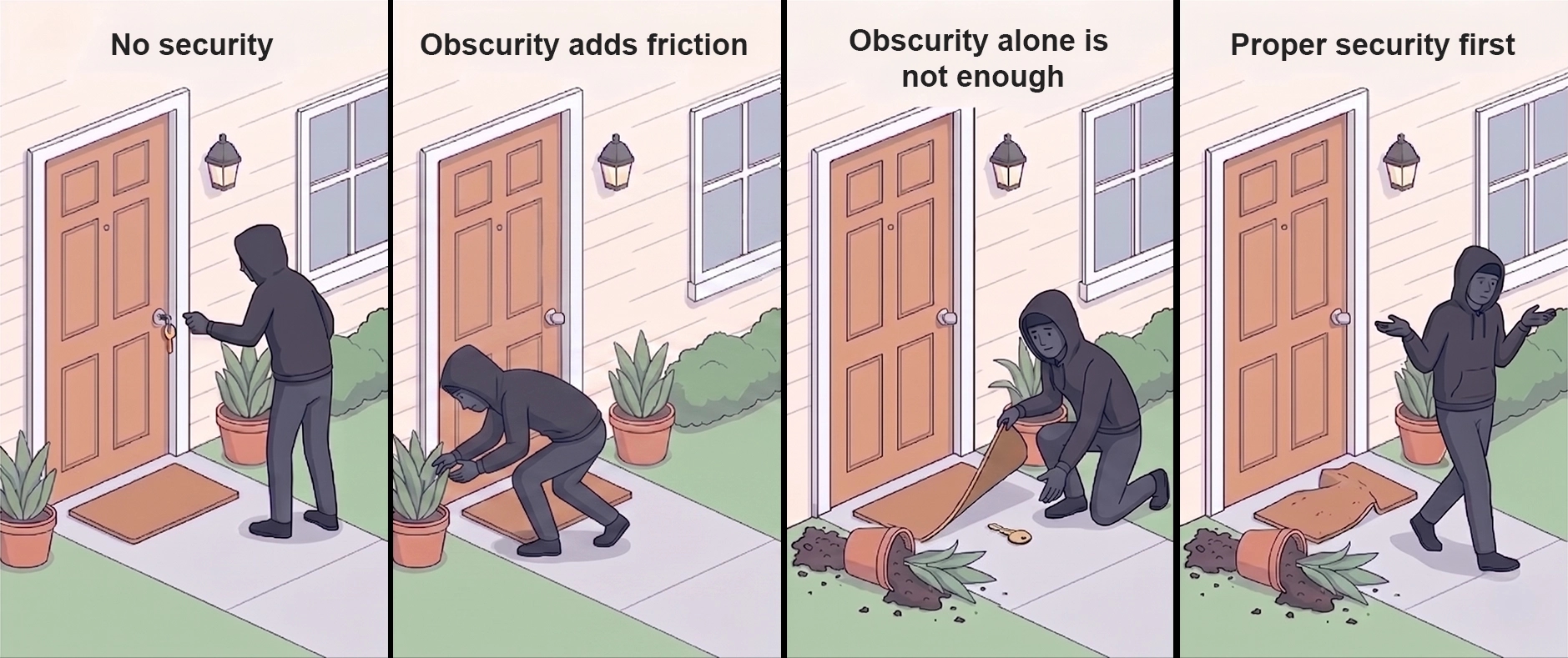
It's the digital equivalent of hiding a spare key under the doormat instead of leaving it in the lock. In this scenario, a malicious actor might not bother looking under the doormat and might just leave. Congratulations, obscurity just saved you a break-in. They might still find the key, but they may check a nearby potted plant or mailbox first. That costs time, and time is money. To a malicious actor, the longer they spend chasing dead ends, the more likely they are to give up and move on.
Now, of course, proper security here would be not hiding a spare key near the door at all, but instead leaving it with a trusted family member or friend. Relying only on obscurity for security is bad. You should always secure your applications to the degree warranted, then sprinkle some obscurity on top to make the endeavour of attacking you more expensive. This is simply one part of a defence-in-depth strategy.

Obscurity in the real world
Of course, some examples might help drive the point home. Here are some specific examples I have personally encountered.
WordPress database table prefix
There is a long-standing security recommendation to change WordPress's default database table prefix to a random one. For example, wp_users becomes wp_8df7b8_users. This is often dismissed as "worthless" because it is security through obscurity.
I used to run this very blog on WordPress. Back in 2015, one of the plugins I used had an SQL injection vulnerability that allowed malicious actors to dump the databases of websites using it. These actors had bots scouring the web for vulnerable WordPress targets.
My website was vulnerable. However, I was not impacted by any attacks, and I updated the plugin to a patched version a few days later. While other sites were "nulled" and destroyed, I was spared. I later found a PoC script on GitHub showcasing the exploitation. Using that PoC on my own site failed with a generic error like Table 'wordpress.wp_users' doesn't exist. Therefore, while I was likely still vulnerable and could have been exploited with different SQL queries, the standard query targeting most users did not impact me.
I was spared thanks to that additional layer of security through obscurity. AI tooling today could keep trying different queries, and it may produce good results for malicious actors, but tokens still cost money. The more time and money the bot spends, the more likely it is to give up and move on. It's a battle of sustained resistance.
CSGO's debug symbol leak
I ran an Australian and New Zealand-based CSGO community server called Invex Gaming for several years. As a server operator, I tried to distinguish the servers I ran by adding unique custom mods. To do this, I used an amazing platform called SourceMod, which allowed you to write custom plugins and extensions. To write useful mods, you would often have to find and call functions directly in the game's binaries. CSGO ships with binaries such as engine.dll, client.dll, and server.dll. These binaries contained much of the game logic we wanted to invoke.
For example, I might want one of my mods to programmatically set a player's health. To do this, my script, running on the CSGO server, had to call the right function in the game. In this case, CBaseEntity::SetHealth is one such function, and calling it programmatically would allow me to set the health of any entity.
This is what the function signature looks like:
class CBaseEntity {
  public:
    virtual void SetHealth(int health) = 0;
};
Now, this is a common and well-known function that SourceMod maps for us correctly. But there are many functions in the game that are less common or not well known. How do we find and use these functions in our scripts? We have to find the function in the binary by reverse engineering it with tools like IDA Pro or Ghidra. Once we have identified it, we can build a stable reference to it using signature scanning or an offset in a virtual function table.
Unfortunately, we cannot access Valve's source code for the game. When looking at reverse-engineered game code, we see a mess of compiled code that takes significant effort to reverse and document properly. Function names, variable names, and data types or structures are not included. This is because it is common practice to strip away debug symbols from game binaries. Debug symbols are metadata generated during compilation that map a program's machine code back to its original human-readable source code. They are extremely useful for reverse engineering and understanding the code.
One day, Valve accidentally pushed an update for the macOS version of CS:GO that included the full, unstripped Mach-O debug symbols in the .dylib binaries. This exposed much more of the game's internals at the time. This led to a rush of server operators using the new information to create new and exciting scripts. Unfortunately, cheat developers also used it to further develop their cheats. A classic double-edged sword.
This is a prime example of Valve valuing the additional layer of security provided by obscurity. Valve has to ship the game in binary form, because the game runs on our machines when we play it. Valve chooses to strip debug symbols from its binaries because doing so is highly effective at reducing the efficiency of cheat developers. Shortly after this release, Valve realised its mistake and re-released the same version with the debug symbols stripped.
Obfuscated code
I do my fair share of malware analysis and CTFs every now and again for fun. It is extremely common to run into obfuscated code, which is source code that has been intentionally complicated to make it harder for humans and tools to understand while remaining fully functional. The malware industry is a billion-dollar industry, and nobody relies on obscurity more than malicious actors. The more obfuscated the malicious payload, the less likely security researchers and tools are to understand what is going on.
On the flip side, enterprises like Google also use JavaScript obfuscation to hide sensitive logic in the browser. A great example is Google reCAPTCHA, where the obfuscation is often heavy and sophisticated in order to make it harder for bots to understand the checks being performed and automate solving them. Netflix also uses obfuscation in its browser-side DRM components to help protect the logic that lets your browser play the video without exposing everything needed to easily extract and save a playable copy. Riot Games also uses obfuscation around parts of the communication between its kernel-level anti-cheat system, Riot Vanguard, and its servers to make it harder for cheaters to fake a clean signal while cheats are running.
Now, there was a suggestion that advances in AI have made obfuscation obsolete. I disagree. While AI tools are good at deobfuscating code, it is still often a slow and expensive process. I do believe a strong model will eventually reach a solution, but it will take time and money. Again, the longer and more expensive it is, the more likely people are to give up and move on.
I do not have concrete data to share on this topic, but I do have some anecdotal evidence. I attempted a hard PWN-style CTF challenge last year that I was not able to solve on my own. Using an LLM, Claude Opus 4.5, and giving it all the information, binaries, and local tools needed to solve the challenge, it still failed at first.
It was not until 4.5 hours of non-stop token burning and many trial-and-error iterations later that the LLM was able to find a solution. This endeavour used 61 million input tokens and 11 million output tokens, or roughly $300 USD. While I was willing to spend that much to gauge the model's ability to solve the challenge, it is important to keep in mind that we already knew a solution existed because this was a CTF challenge with an intended solution. Would malicious actors be willing to spend that much per attempt across a large enterprise attack surface, where results are far from guaranteed? How long are they willing to iterate on one specific angle? That uncertainty is exactly where obscurity still has value.
Spread the word
It should be clear by now that security through obscurity still has its place as an additional security layer in the modern world, even with AI-assisted tooling.
So I no longer want to hear the phrase "security through obscurity is bad".
From now on, let's spread these two statements instead:
Security ONLY through obscurity is bad
Security through obscurity, as an additional layer, is good!